

Dieting has a problem nobody puts on the calorie label: hunger fights back.
Eat less and the body does not simply cooperate. Hunger can get louder. Feeling full can get weaker. The body may even spend less energy, as if it were trying to protect the weight you are working to lose.
That is why researchers started looking beyond medicines that copy one appetite signal. In a large Phase 3 obesity trial, one experimental molecule acted on three signals at once — and produced a result that changed the conversation.
The average weight change in the highest-dose arm was 28.3% at 80 weeks. The molecule was retatrutide.
The science explains why interest is so high. It also raises a more practical question: when a research product uses the same chemical name, how do you tell whether the label is backed by real batch paperwork?
Inside this articleTrial results · how it works · what to verify
- Why hunger can feel stronger when you diet
- Why researchers moved beyond GLP-1 alone
- What the Phase 3 trial actually showed
- What 28.3% does — and does not — mean
- The trial result is easy to find. The vial is harder.
- How the current GLP3-R 30mg batch is presented
- What researchers are watching next
- Sources
- Frequently asked questions
Why hunger can feel stronger when you diet
Appetite is not just a thought. It is a stream of signals between the gut, the pancreas, fat tissue and the brain.
After a meal, those signals help tell the brain that food has arrived. When weight falls, the body can push back: hunger rises, fullness fades sooner and energy use can slow. That is why “just eat less” sounds simple but can feel brutally difficult.
The first medicines in this field focused mainly on one signal, GLP-1. Researchers then asked a bigger question: what if one molecule could work through several related signals at the same time?
Why researchers moved beyond GLP-1 alone
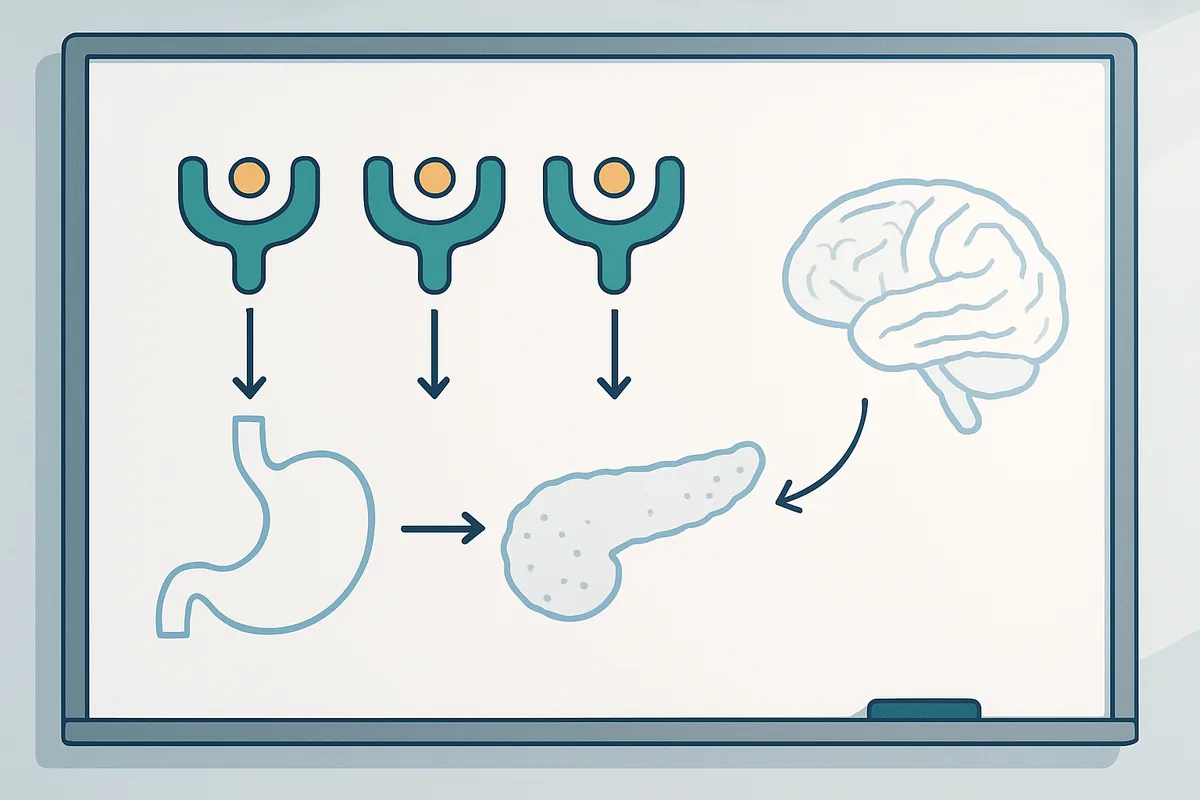
Retatrutide was designed to activate three receptors. You do not need a pharmacology degree to understand the basic idea.
Think of it as three dials on the same control panel: appetite, how the body handles food and how it uses stored energy. Turning all three does not automatically guarantee a better result. The trial had to show whether the idea worked in people.
What the Phase 3 trial actually showed
TRIUMPH-1 was randomised, double-blind and placebo-controlled. That means participants were assigned to retatrutide or an inactive injection, and neither they nor the trial team knew which one they had during the study.
Everyone received the same lifestyle support. The main difference was the study drug.
The 28.3% figure is the estimate focused on what would happen if participants stayed on treatment. A broader analysis that kept people who stopped in the count put the highest-dose average at 25.0%, versus 3.9% for placebo.
That distinction matters. The headline is real, but it is not the only way to count the result.
45.3% reached ≥30% weight loss; most participants did not.
The most common side effects were nausea, diarrhoea, constipation and vomiting. At the highest dose, 11.3% stopped because of side effects, compared with 4.9% on placebo.
What 28.3% does — and does not — mean
The result belongs to Lilly’s investigational retatrutide, supplied and monitored inside a controlled clinical trial.
It does not mean that every person lost 28.3%. It does not mean a 30 mg vial is a 30 mg dose. And it does not mean a research vial sold online is the same physical product used in TRIUMPH-1.
Those lines matter because the linked listing is for GLP3-R (Retatrutide) 30mg, a laboratory research product. The “30mg” describes how much material is listed in the vial. The product page states that it is for research use only and not for human consumption.
The clinical evidence and the research listing can be discussed on the same page. They cannot honestly be presented as the same thing.
The trial result is easy to find. The vial is harder.
Anyone can look up the TRIUMPH-1 numbers. The harder question is what is actually inside a particular research vial.
A polished label cannot answer that. Neither can a purity percentage by itself. A serious research buyer should be able to connect the vial to a batch number and the batch number to independent test documents.
Mass spectrometry helps check molecular identity. HPLC estimates how much of the tested sample matched the main compound. The lot number on the COA should match the batch being sold, and the document should name the testing laboratory.
Those checks still have limits. Purity does not automatically prove sterility, safe use or clinical equivalence.
That is the difference between a marketing claim and something a researcher can inspect.
How the current GLP3-R 30mg batch is presented
The linked product is branded GLP3-R (Retatrutide) 30mg rather than being presented as Lilly’s trial product.
Its listing states at least 99% HPLC purity, mass-spectrometry identity testing and third-party, lot-specific documentation. The COA is where those claims should meet the actual batch number.
It remains a research-use product. Nothing on the listing turns the vial into an approved weight-loss treatment or transfers the TRIUMPH-1 result to that vial.
Current 30mg research batch
GLP3-R (Retatrutide) 30mg
- Listed ≥99% HPLC purity
- Mass-spec identity
- Third-party lot-specific COA
- Research use only
What researchers are watching next
Retatrutide remains investigational. Researchers still need the complete long-term picture: safety over time, what happens after treatment stops and how results differ between groups of patients.
A separate Phase 3 study in 537 adults with type 2 diabetes reported smaller weight changes over 40 weeks, alongside meaningful improvements in blood sugar. That is a useful reminder that the population, study length and trial design all shape the number.
The 28.3% result deserves attention. The honest reason is not that it guarantees anything. It is that a three-signal approach produced an unusually large average change in a large, controlled Phase 3 trial.
Sources
The TRIUMPH-1 weight, waist and safety figures come from Eli Lilly’s 21 May 2026 topline release, Lilly’s triple agonist, retatrutide, delivered weight loss in a Phase 3 obesity trial. The registered study is NCT05929066.
The diabetes figures come from Bajaj and colleagues, TRANSCEND-T2D-1, published in The Lancet and indexed on PubMed. The registered study is NCT06354660.
Frequently asked questions
Is GLP3-R (Retatrutide) an approved weight-loss treatment?
No. Retatrutide remains investigational. The linked GLP3-R 30mg vial is sold as a laboratory research product, not as an approved treatment and not for human consumption.
Did everyone in TRIUMPH-1 lose 28.3%?
No. That was the average in the highest-dose arm using one prespecified analysis. Individual results varied, and 45.3% of that arm lost 30% or more.
Is a 30 mg vial the same as the 12 mg trial arm?
No. Twelve milligrams was a supervised weekly target dose inside the trial. Thirty milligrams is the total quantity listed in a research vial. They are different measurements with different contexts.
What does 99%+ HPLC purity tell me?
It estimates how much of the tested sample matched the main compound under that method. It does not, on its own, prove sterility, safety or a clinical effect.
What should match on a COA?
The product name, lot number, test date, methods and reported results should correspond to the batch being sold. The document should come from a named third-party laboratory.
This article is educational and does not provide medical advice. Retatrutide remains investigational. Research products are not intended for self-treatment.