
Anyone tracking caffeine intake works from a table: a coffee is about this much, an espresso about that, a cup of tea rather less. The tables are not wrong exactly, but they present single numbers for quantities that are genuinely variable, and the variation is not small. Studies that have measured the same drink bought repeatedly from the same outlet have found differences between servings large enough to matter to anyone who is sensitive to caffeine or trying to stay under a limit.
The variability is not sloppiness. It is the arithmetic consequence of a process with many inputs. Caffeine ends up in a cup through extraction from a plant material whose caffeine content varies by species, variety, growing conditions and processing, using a method whose water temperature, contact time, grind size and dose all vary from one preparation to the next. Any one of these shifts the result, and they do not cancel.
Understanding where the variance comes from is more useful than memorising a table, because it tells you which drinks are predictable and which are not, and it explains why the strong coffee you had this morning was not your imagination.
Key takeaways
- Caffeine is measured by liquid chromatography, which separates it from other compounds and quantifies it against standards, so laboratory figures are reliable even when the drinks are not.
- Brewing method sets the broad range; dose and extraction conditions determine where within that range a given cup lands.
- Robusta beans contain substantially more caffeine than arabica, which is why blends behave differently from single origins.
- Packaged energy drinks are the most predictable source, because they are formulated to a specification rather than prepared by hand.
- Decaffeinated is a legal threshold, not zero, and several cups still add up to a measurable dose.
How Caffeine Is Measured Analytically
Caffeine is an unusually convenient molecule to measure, which is why data on it is comparatively abundant and trustworthy.
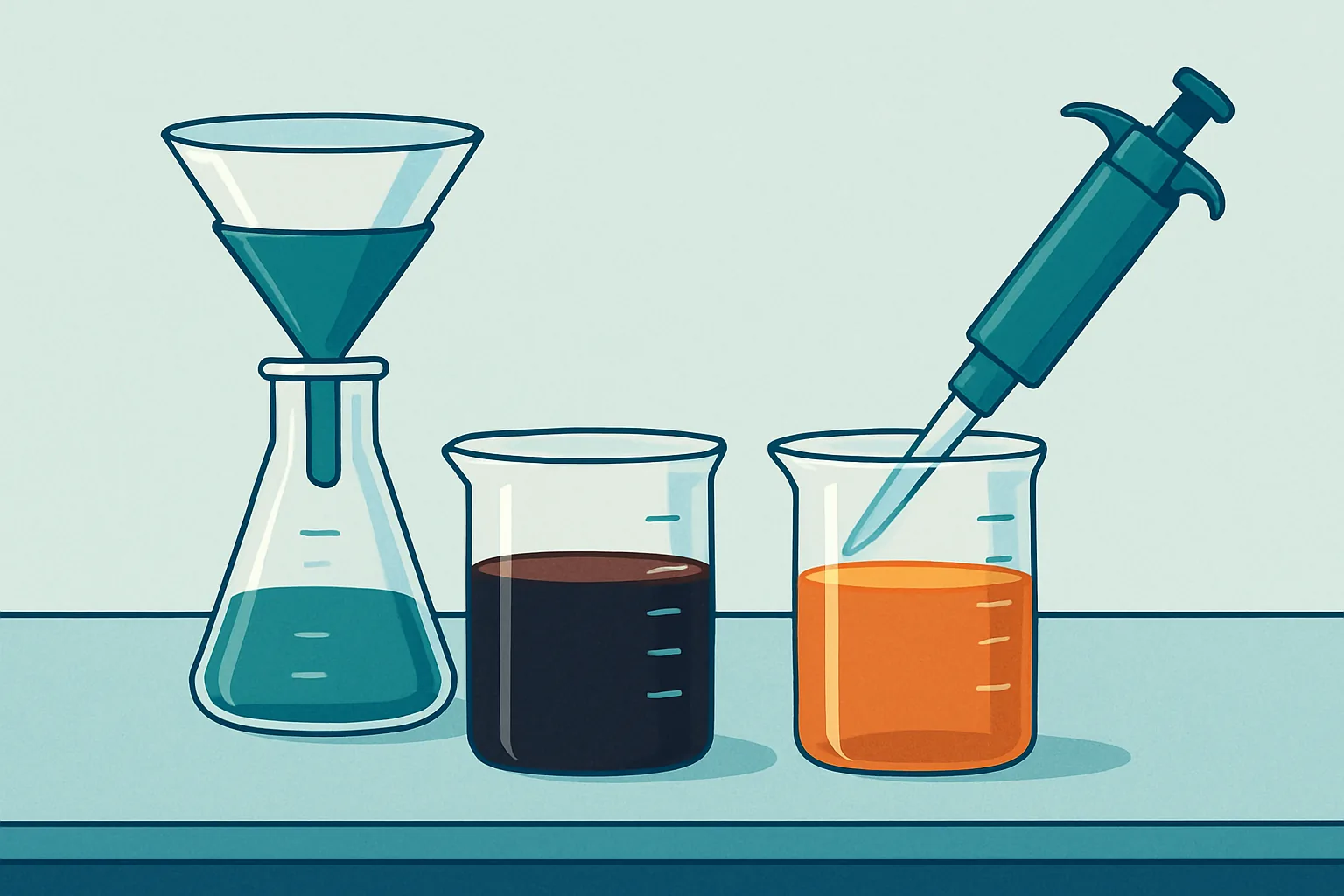
The reference approach is high performance liquid chromatography with ultraviolet detection. A prepared sample is injected into a stream of solvent and pushed through a column packed with fine particles whose surface chemistry retains compounds to differing degrees. Caffeine emerges at a characteristic time, and a detector measures its absorbance in the ultraviolet region, where caffeine absorbs strongly. The area under the resulting peak is proportional to how much was present, and comparison against injections of known standards converts area into concentration.
Sample preparation is simple for beverages: degas if carbonated, dilute into the method’s working range, and filter out particles that would block the column. A milky coffee needs its proteins precipitated first, and a syrup-heavy drink may need cleaning on a small cartridge. Where more certainty is needed, coupling the chromatograph to a mass spectrometer confirms identity by molecular mass and fragmentation rather than retention time alone, and an internal standard corrects for small losses during preparation.
The reliability of the method has a consequence worth stating. When published measurements of the same commercial drink differ substantially, that is almost never analytical error. Caffeine assays are robust and reproducible, so the differences are real differences between the drinks. Simpler methods exist and are weaker: ultraviolet absorbance without separation overestimates, because other compounds in coffee and tea absorb in the same region, and immunoassay strips give an indication rather than a number.
Variation Between Coffee Preparation Methods
The largest single determinant of how much caffeine is in a cup is what kind of cup it is, and the confusion in most people’s mental model is between concentration and total dose.
Espresso is highly concentrated: a small volume of water passes through a compacted bed of finely ground coffee under pressure, dissolving a lot of material into a little liquid. Per millilitre, it contains far more caffeine than filter coffee. But a single espresso is a small serving, and the total caffeine in that serving is typically less than in a mug of filter coffee, which is a weaker solution in a much larger volume. People who say espresso is stronger and people who say filter has more caffeine are both right, about different quantities.
The other methods sit along the same axis. Filter and drip use a moderate dose of medium grind with a few minutes of contact and yield a large volume. A cafetière steeps a coarse grind for several minutes, giving a similar total with a heavier body since no paper filter removes oils and fines. Instant coffee is a dried extract, so the caffeine depends entirely on how much powder was spooned in, the least controlled variable in the subject. Cold brew steeps a very large dose in cold water for many hours and the concentrate is diluted afterwards, so the result depends on the ratio the maker chose.
| Preparation | Concentration per volume | Typical serving size | Main source of variation |
|---|---|---|---|
| Espresso | Highest | Very small | Dose, grind, extraction time |
| Moka pot | High | Small | Dose, heat control |
| Filter or drip | Moderate | Large | Dose to water ratio, grind |
| Cafetière | Moderate | Large | Steep time, dose |
| Cold brew concentrate | High before dilution | Variable | Dilution ratio chosen |
| Instant | Set by the spoon | Large | How much powder was used |
Within each method, three variables dominate. The dose of coffee relative to water sets the ceiling. The grind size determines surface area, and finer grinds extract faster and more completely. Contact time determines how far extraction proceeds. Caffeine is highly water-soluble and comes out early in an extraction, which has an important practical consequence: a shorter or coarser extraction gives up flavour compounds before it gives up caffeine. A weak-tasting, under-extracted cup can still carry most of its caffeine.
This is why a commercial outlet’s drinks vary. A barista’s dose varies by a small amount, the grinder drifts as burrs warm and beans change, the tamp pressure varies, and each shifts the result a little. Together they produce genuine variation between two supposedly identical drinks made minutes apart.
Bean, Roast and Grind Contributions
Before any brewing happens, the raw material has already introduced variation.
The species matters most. Commercial coffee comes overwhelmingly from two species, arabica and robusta, and robusta contains roughly twice the caffeine of arabica by weight. Robusta is cheaper, more disease-resistant, and produces a heavier crema, so it appears in espresso blends and in much instant coffee. A blend containing a substantial robusta fraction delivers noticeably more caffeine than a pure arabica at the same dose, and blend composition is rarely disclosed in a way that lets a consumer calculate it.
Within a species, variety, altitude, soil and season contribute smaller differences. Caffeine functions as a natural insecticide in the plant, and its concentration in the bean is an agricultural variable rather than a constant.
Roast level is where popular belief runs opposite to the chemistry. Darker roasts are widely assumed to be stronger in caffeine because they taste more intense, and the truth is close to the reverse, though the effect is modest. Caffeine is fairly heat-stable and survives roasting largely intact, but the bean loses mass and gains volume as roasting proceeds. So a dark roast bean contains slightly less caffeine than the same bean lightly roasted, and, more importantly, occupies more volume per unit mass. Measuring coffee by scoop rather than by weight therefore delivers less caffeine with a dark roast than with a light one, while measuring by weight nearly eliminates the difference. Anyone wanting consistency should weigh their coffee, and this single change removes one of the larger sources of day-to-day variation at home.
Grind size acts through surface area and flow. A finer grind exposes more surface, extracts faster, and in a pressurised system slows the water, extending contact time. Grinders drift as burrs wear, retained grounds from the previous dose alter the next, and static affects how much lands in the basket. Freshness matters less for caffeine than for flavour, since caffeine does not degrade appreciably as coffee stales: an old bag makes a worse cup of similar strength.
Energy Drinks and Label Tolerances
Packaged energy drinks are the most predictable caffeine source available, and the reason is simple: they are manufactured to a formulation rather than prepared by a person.
Caffeine is added as a purified ingredient in a metered quantity, and manufacturing is designed to hold concentration consistent across a batch, so variation between two cans is small compared with variation between two coffees. Where energy drinks cause problems it is through serving size rather than unpredictability: a large can may hold several times the caffeine of a small one at the same concentration, and the format encourages finishing the container.
Labelling requirements differ by jurisdiction, but the general position in major markets is that caffeine content must be declared on drinks above a threshold concentration, together with a warning that the product is not recommended for children or for pregnant or breastfeeding women. Declared values are subject to the general tolerances applied to nutrition labelling, which permit a stated figure to differ from the measured one within defined limits, so a declared number should be read as a target rather than a guarantee.
Two complications recur in testing. The first is caffeine from botanical sources: guarana, yerba mate and green tea extracts all contain it, and depending on labelling rules their contribution may not appear in a declared figure, so a product listing both added caffeine and a guarana extract can deliver more than it states. The second is the distinction between a beverage and a supplement, which some markets regulate differently, so two similar-looking products on adjacent shelves may fall under separate rules.
Concentrated products deserve separate mention. Caffeine sold as a powder or a concentrated liquid has been associated with serious harm, because the difference between a normal dose and a dangerous one is a small quantity that domestic measuring equipment cannot reliably distinguish. Regulators in several countries have restricted these products for precisely that reason.
Tea, Extraction Time and Temperature
Tea is more variable than coffee in relative terms, and the reasons are mostly under the drinker’s control.
All true tea, black, green, oolong and white, comes from the same species, and the caffeine content of the dried leaf is broadly similar across types. The widespread belief that green tea is inherently low in caffeine and black tea high is not supported by leaf composition; the differences that people notice come from how the tea is prepared. Green tea is customarily brewed with cooler water for a shorter time, which extracts less. Black tea is brewed near boiling for longer, which extracts more.
Steeping time is the dominant variable. Caffeine extracts progressively, rising steeply in the first minutes and continuing to climb, so the difference between a two-minute and a five-minute brew is substantial and most people do not time their tea. Water temperature acts through the same mechanism, since solubility and extraction rate both rise with it. Leaf form matters too: the fine broken leaf in many tea bags presents far more surface area than whole leaf and extracts faster, and squeezing or jiggling the bag increases extraction further. Two people brewing from the same box, one dunking briefly and one leaving the bag in throughout, are drinking quite different beverages.
Matcha sits apart because the leaf is powdered and consumed rather than infused, so essentially all its caffeine is ingested rather than the fraction that extracts, which is why it delivers more than a comparable weight of infused leaf. Herbal infusions, despite the name, contain none unless they include an ingredient that does: yerba mate and guayusa do, while rooibos, chamomile and peppermint do not.
Decaffeinated Does Not Mean Caffeine Free
Decaffeination is a removal process with a defined endpoint, and the endpoint is a threshold rather than zero.
The regulatory definitions differ between jurisdictions but share the same structure: a product may be described as decaffeinated when caffeine has been reduced below a specified small proportion of what it started with, or below a specified small concentration. In practice this means a residue remains, and the residue is measurable.
The removal processes all make caffeine mobile and then capture it. Solvent methods extract caffeine from moistened green beans, directly or via water that is afterwards stripped. The water process extracts everything soluble, passes the liquid through activated carbon that preferentially adsorbs caffeine, and returns the flavour-bearing water to the beans. Supercritical carbon dioxide, held between liquid and gas, dissolves caffeine selectively and releases it on depressurisation. All are effective and none is complete.
Two consequences follow for anyone avoiding caffeine. First, the residue is small per cup but accumulates, so several decaffeinated coffees through a day amount to a modest but real dose that a sensitive person may notice in the evening. Second, testing has repeatedly shown that decaffeinated drinks bought out of the home are sometimes not decaffeinated at all, through equipment shared with regular coffee or simple mistakes at busy times.
Decaffeinated tea follows the same principles, with the added point that the folk method of discarding a brief first infusion to remove caffeine does not work well, because although caffeine extracts early it does not extract completely, and a short rinse removes only part of it along with a good deal of flavour.
Estimating Your Actual Daily Intake
Given all of the above, the honest answer to how much caffeine someone consumes is a range rather than a number, and the useful skill is knowing how wide the range is for each of their habits.
The general guidance from health authorities, including the FDA, is that up to about four hundred milligrams a day is not associated with harmful effects for most healthy adults, with a lower figure of around two hundred milligrams advised during pregnancy, and lower thresholds again for adolescents. These are population-level figures, and individual sensitivity varies considerably, partly through genetic differences in the liver enzyme that clears caffeine and partly through habituation.
Building a personal estimate means ranking sources by predictability. Packaged drinks with declared caffeine sit close to their stated value. Home espresso and filter coffee are predictable if the dose is weighed and erratic if it is scooped. Tea depends almost entirely on steeping discipline. Coffee bought out is least predictable of all, since dose, blend, grinder and operator are outside your knowledge. Two adjustments narrow the range more than any amount of table-consulting: weigh coffee rather than scooping it, which removes the roast and grind-density effects at a stroke, and time your tea, or at least remove the bag consistently.
Timing deserves attention alongside quantity. Caffeine is cleared with a half-life that for most adults sits in the range of several hours, meaning a substantial fraction of an afternoon dose is still circulating at bedtime. That half-life is not fixed: it is prolonged in pregnancy and by certain medications, and shortened in smokers. Someone who sleeps poorly and blames an evening cup may be equally affected by a large mid-afternoon one.
Finally, symptoms are informative in a way that arithmetic is not. Jitteriness, palpitations, disturbed sleep and anxiety after a specific drink are worth noting alongside what that drink was, because the pattern reveals which of your sources are the strong ones far more reliably than a published table can. If a particular coffee shop’s flat white reliably makes you uncomfortable and another’s does not, that is real information about two different blends and two different doses, and it is not available anywhere else.
Frequently asked questions
Why does the same coffee from the same shop affect me differently on different days?
Because it is genuinely a different drink. The dose of ground coffee varies slightly between preparations, the grinder drifts as it warms and as beans change, extraction time varies with tamp and puck condition, and the blend itself changes when the shop takes delivery of a new batch or switches supplier. Your own state contributes as well: caffeine absorption is faster on an empty stomach, and clearance varies with medications, pregnancy and smoking status. Both halves of the explanation are real, and the drink side is larger than most people assume.
Does a dark roast have more caffeine than a light roast?
Very slightly less, by weight, and the practical answer depends on how you measure. Roasting drives off moisture and expands the bean, so a darker roast bean weighs less and occupies more volume. If you measure by scoop, a dark roast delivers fewer beans and therefore less caffeine. If you weigh your coffee, the difference nearly disappears. The perception that dark roasts are stronger comes from the roast flavours, which are more intense and more bitter, and bitterness is not caffeine.
Is espresso stronger than filter coffee?
Per millilitre, considerably. Per serving, usually not. A single espresso is a very small volume of concentrated liquid, while a mug of filter coffee is a much larger volume of a weaker solution, and the larger volume generally wins on total caffeine. This is why the question needs restating before it can be answered: if you mean concentration, espresso; if you mean how much caffeine you actually consumed, a standard mug of filter typically exceeds a single espresso and is comparable to a double.
How much caffeine is really in decaffeinated coffee?
Enough to measure, not usually enough to matter to most people, and occasionally far more than it should be. Regulatory definitions set a low threshold rather than zero, so a residue is expected and is small per cup. The larger practical risk is preparation error outside the home, since testing has repeatedly found decaffeinated drinks from retail outlets containing substantial caffeine, most plausibly through equipment shared with regular coffee or a simple mix-up. Anyone avoiding caffeine for medical reasons should treat out-of-home decaf as less reliable than a packaged product.
Do caffeine tables and apps give accurate figures?
They give reasonable central estimates for standardised products and rough approximations for everything else. For a packaged energy drink or soft drink with a declared value, an app is close to correct. For a coffee shop drink, it is reporting an average of something that varies substantially between servings, and for home-brewed coffee or tea it cannot know your dose, grind or steeping time. The figures are useful for comparing categories and for staying broadly within a limit, and they are not precise enough to support fine-grained tracking.
The most useful conclusion is that predictability varies more than quantity does. A packaged drink tells you what you are getting; a hand-prepared one tells you approximately. If caffeine matters to you, whether because of sensitivity, pregnancy, sleep or a medical reason, the practical move is not to memorise numbers but to shift towards the sources you can control, weigh what you can weigh, time what you can time, and treat everything bought out of the home as a range rather than a value.
This is education, not medical advice. Laboratory results only carry meaning alongside your symptoms, history and examination. Talk to a qualified clinician about your own results before changing anything about your care or supplements.