


Centrifuge quotations are unusually easy to get wrong, because the specification sheet is dominated by two numbers that scale steeply with price and rarely with usefulness. Maximum speed and maximum capacity are the headline figures, they are simple to compare across brands, and they are the ones a purchasing form asks for. Neither is a good starting point.
The instrument’s actual job is defined by a short list of protocols that the laboratory already runs, most of which specify a relative centrifugal force, a duration, a tube format and sometimes a temperature. Work backwards from that list and the specification usually collapses to something considerably cheaper than the first quotation, with money left over for the rotor set that determines whether the machine is convenient to use day to day.
What follows is a way of building that specification in order, along with a candid look at the features that most often turn out to be dead capital.
Key takeaways
- Start by tabulating every protocol you actually run, with its required force, tube type and volume.
- Rotor selection, not the drive, decides what the instrument can do and often costs a substantial fraction of the machine.
- Buy capacity for your realistic peak batch, not your annual sample total.
- Refrigeration is essential for a narrow set of applications and an expensive convenience for everything else.
- Service response time and spares availability affect uptime more than any specification on the front page.
Starting From Your Actual Protocols
Before any vendor is contacted, build a table. One row per procedure that currently uses a centrifuge or is expected to within the equipment’s life. For each row record the required relative centrifugal force, the spin duration, the tube or plate format, the number of samples in a typical run and in the worst run, whether the sample must stay cold, and whether the separation is a hard pellet or a delicate interface.
This exercise almost always produces two surprises. The first is that the protocols cluster tightly. A general laboratory will find that the great majority of its work sits in a modest force range that a mid-range benchtop instrument reaches comfortably, with perhaps one or two outliers that genuinely demand more. The second is that tube format variety is wider than anyone remembers, and that the awkward formats are the ones that cause daily friction.
Treat the outliers explicitly rather than letting them dictate the whole purchase. If two procedures per month need a much higher force, the honest comparison is between one expensive instrument that covers everything and a cheaper instrument plus either a small dedicated high-speed unit or access to a shared machine elsewhere in the building. The second option frequently wins, and it also removes a single point of failure.
Finally, note which protocols are inherited and unverified. Many spin steps are copied from older documents and specify conditions nobody has tested since. Where a protocol demands a force that sits just above a natural price break, it is worth confirming that the requirement is real before spending against it.
Speed, RCF and Rotor Compatibility
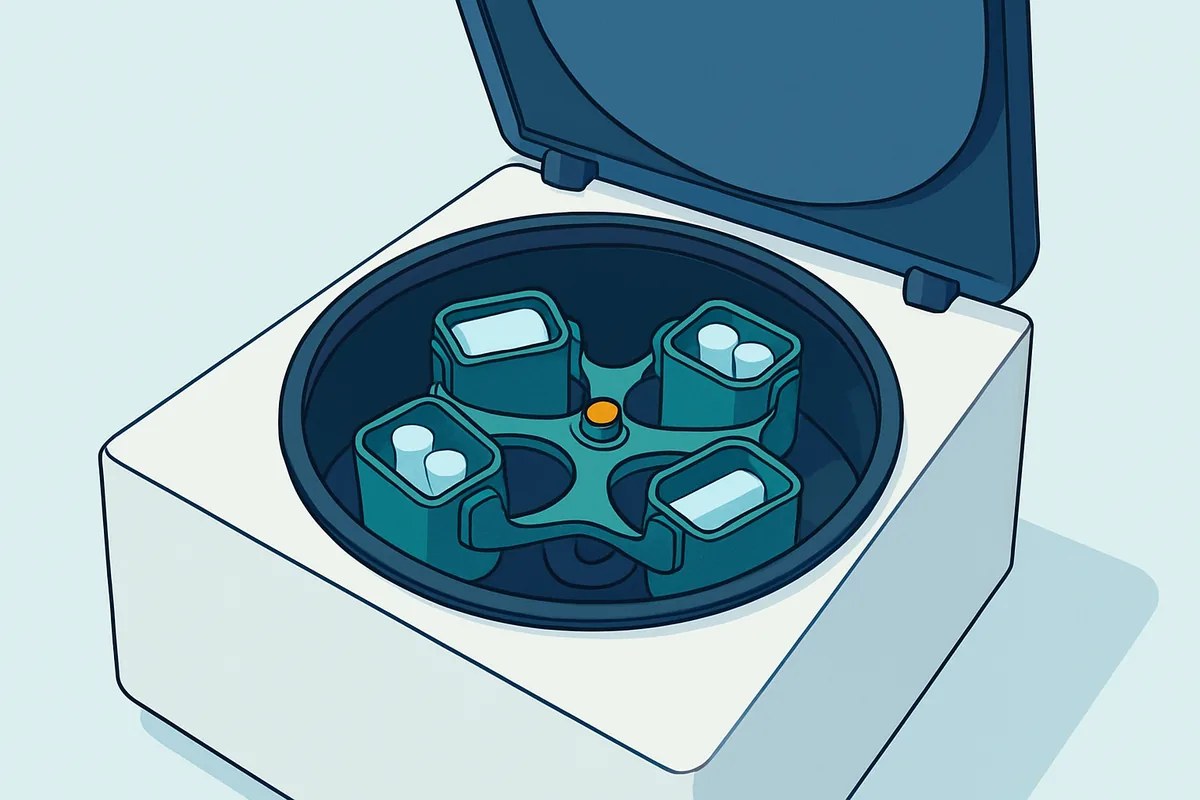
The number that separates samples is relative centrifugal force, which depends on the square of the rotational speed and, crucially, on the radius at which the sample sits. A given rotational speed produces very different forces in a small-radius microtube rotor and a wide swinging bucket rotor. A headline maximum speed therefore means nothing without the rotor it applies to.
Specification sheets handle this by quoting the maximum speed of the fastest rotor and the maximum force of the rotor that produces the highest force, and those are frequently different rotors. Read the rotor tables instead of the front page. Each rotor has its own maximum permitted speed, its own radius, and therefore its own maximum force, and the drive simply has to be able to reach it.
There is a second constraint that catches buyers out. Maximum speed for a given rotor is often derated as tube mass increases, because the drive and the rotor are both limited by the load they carry. A rotor rated for a certain speed with light plastic microtubes may be limited to less with full glass tubes. If your protocols use dense samples or heavy adaptors, check the derating table rather than the headline.
Matching rotors to your table
Return to the protocol table and mark, for each row, which candidate rotor would carry it. The goal is to cover the whole table with the smallest number of rotors, because every additional rotor costs money, occupies storage, and adds a changeover step that consumes bench time. A common good outcome is two rotors: one fixed angle unit for microtubes and one swinging bucket unit for conical tubes. A common bad outcome is five rotors bought because each covered one procedure perfectly.
Capacity Planning Against Throughput
Capacity questions are usually answered with the wrong statistic. The relevant figure is not how many samples the laboratory processes in a week but how many need to be in the chamber at once, which is decided by batch structure rather than volume.
If samples arrive continuously and are processed as they come, a small rotor running frequently is entirely adequate and the instrument is never a bottleneck. If samples arrive as a large batch once a day and every one must be spun before the next step, the peak batch defines the requirement. Between those extremes, the deciding factor is whether a spin sits on the critical path of a time-sensitive workflow.
| Requirement pattern | Capacity that fits | Common overbuy | Consequence of overbuying |
|---|---|---|---|
| Continuous single samples | Small microtube rotor | Large multi-bucket unit | Idle capacity, longer acceleration cycles |
| Daily batch, not time-critical | Mid capacity, two runs acceptable | Capacity sized for the whole batch | Higher purchase and rotor cost |
| Daily batch on a critical path | Capacity for the full batch | Higher speed instead of capacity | Bottleneck persists, money misspent |
| Occasional large volume work | Adaptors in an existing rotor | Dedicated large-volume machine | Expensive instrument used rarely |
| Plate-based assays | Plate carriers in a swinging rotor | Separate plate centrifuge | Duplicate footprint and service cost |
Note the third row, because it is the most expensive error in practice. When a batch does not fit and the spin is on the critical path, the fix is more capacity. Buying a faster machine does not help, since spin time is set by the protocol, and acceleration and braking add only a small fraction. Vendors will happily sell speed to a capacity problem.
Adaptors deserve more attention than they usually get. A well-chosen rotor with a set of adaptors can accept several tube sizes at a small fraction of the cost of additional rotors, at the price of slightly reduced maximum force in some configurations. For most general laboratories that trade is comfortably worthwhile.
Refrigeration and When You Need It
A refrigerated centrifuge costs substantially more to buy, more to service, more to run, and it is physically larger and noisier. It is unambiguously necessary for a specific set of work: separations of labile analytes, live cell preparations, long high-speed spins where frictional heating is significant, and anything where a validated method states a temperature.
The frictional point is worth explaining, because it is the reason refrigeration is not merely a sample-storage convenience. A spinning rotor stirs the air in the chamber, and at high speed that windage deposits real heat. An unrefrigerated chamber can climb well above room temperature during a long, fast spin, and the sample climbs with it. For short, moderate spins the effect is minor. For extended high-speed work it is not.
Where the requirement is only that samples do not warm during a brief spin, cheaper answers exist. Pre-chilling the rotor in a cold room, or running in a cold room outright, handles many applications. Some manufacturers offer a chamber cooling option that is less capable than full refrigeration but sufficient to hold near ambient during moderate runs.
The honest test is whether any current validated method specifies a chamber temperature, and whether any planned work will. If the answer to both is no, refrigeration is a comfort purchase. If the answer to either is yes, it is not optional and should be specified with attention to how quickly the chamber reaches setpoint, since a unit that takes a long time to pre-cool will be left running continuously and will dominate the instrument’s energy use.
Noise, Footprint and Bench Loading
These are the specifications nobody checks and everybody regrets. A centrifuge is one of the loudest routine instruments in a laboratory, and a large refrigerated unit adds compressor noise between runs as well as rotor noise during them. In a shared open laboratory this materially affects working conditions, and the difference between models is large enough to be worth asking about during demonstration.
Footprint is more than the external dimensions. The instrument needs clearance around the ventilation intakes, and it needs vertical clearance for the lid to open fully, which is often more than expected on larger units. Measure the actual bench position including the lid arc before committing.
Bench loading is the one that occasionally causes real problems. Large floor-standing units are heavy, and even benchtop models are dense relative to their size. More importantly, an unbalanced rotor generates vibration that a bench must absorb, and a lightweight or cantilevered bench will transmit it to neighbouring instruments. Balances and microscopes on the same bench as a centrifuge are a persistent source of unexplained variability. Where the layout allows, put the centrifuge on its own solid surface or on the floor.
Vibration also travels through buildings. In laboratories on suspended floors, a large centrifuge can disturb sensitive equipment a room away. This is worth checking before installation rather than discovering afterwards.
Service Contracts and Spare Availability
Uptime is determined less by build quality than by how quickly a broken instrument can be fixed. Two questions matter more than the warranty length. First, what is the guaranteed response time and does it mean a telephone call or an engineer on site? Second, are spare parts, particularly drive components, lid latches and door seals, held in the region or shipped internationally on demand?
Lid latch mechanisms are the most common failure point on heavily used benchtop machines, because they are the part that is operated most and are subject to the interlock system that prevents opening during a run. A machine that will not latch is a machine that will not run, and a latch assembly on a slow boat is a long outage for a trivial component.
Contract structures vary in ways worth comparing directly. A full cover contract including parts and labour has a predictable cost and suits an instrument on a critical path. A labour-only contract is cheaper but exposes the laboratory to the cost of a drive replacement, which can approach a significant fraction of the purchase price. Pay-as-you-go is rational for a second, non-critical machine and risky for a sole instrument.
Ask specifically about rotor inspection, because many contracts exclude it. Rotors have a finite fatigue life and require periodic inspection and, in some designs, retirement after a defined number of runs or years. A laboratory that does not track rotor life is carrying an unrecorded safety risk, and rotor logging should be part of whatever service arrangement is signed.
Finally, ask how long the model will be supported. Manufacturers commit to a parts availability period after a model is discontinued, and buying near the end of a product cycle can shorten the useful life of an otherwise sound instrument.
Specifications That Rarely Earn Their Cost
Several features appear on nearly every quotation and justify their price in a minority of laboratories.
Maximum speed beyond what any current rotor and protocol requires is the largest single overspend. Force requirements in routine work are stable, and the top of a drive’s range is used far less often than buyers imagine when signing.
Very large numbers of programmable run profiles rarely earn their keep either, because most laboratories use a handful of settings repeatedly and store them on paper anyway. Programmable acceleration and deceleration profiles are a genuine exception where gradient work or loose pellets are involved, since an aggressive brake can resuspend what a spin just separated.
Touchscreen interfaces and connectivity packages vary from useful to irrelevant depending on whether the laboratory actually captures run records electronically. If run logs are being transcribed by hand into a paper book, connectivity is worth paying for. If nobody will configure the export, it is a screen.
Extremely high capacity in a single rotor is often a false economy, because the largest rotors are heavy enough to be awkward to lift and change, which discourages using the other rotors at all.
The reasonable place to spend, by contrast, is on rotors that match the tube formats in genuine daily use, on a solid service arrangement, and on the balance of noise and footprint that determines whether people are happy to work next to the thing for the next decade. Those decisions are invisible on a specification sheet and obvious every single day.
Frequently asked questions
Can I use a protocol written in revolutions per minute on a different centrifuge?
Not safely, because the same rotational speed produces a different force in a rotor with a different radius. Convert the protocol to relative centrifugal force using the original rotor’s radius, then set the speed that produces that force in the rotor you actually have. Most manufacturers publish conversion tables or provide the calculation in the instrument’s interface. Any protocol that is going to be used across more than one machine should be rewritten in force terms permanently.
Is a second-hand centrifuge a reasonable purchase?
It can be, provided the rotor history is documented. The drive and chamber of a well-maintained instrument have a long life, and refurbished units from an established supplier often come with a warranty. The risk sits entirely with the rotors: a rotor of unknown age, unknown run count and unknown chemical exposure history is not something to accept casually, since rotor failure at speed is the one genuinely dangerous mode of these machines. Budget for new rotors and the arithmetic changes considerably.
How much does a slower acceleration setting cost me in throughput?
Usually very little, and less than people assume. For a spin measured in minutes, adding a gentler ramp adds seconds. The exception is a workflow with many very short spins, such as brief collection steps, where ramp time becomes a real proportion of the cycle. In that specific case a fast-accelerating small unit is worth having, which is one of the better arguments for a dedicated microcentrifuge alongside a larger machine.
Do I need a separate microcentrifuge if my main unit takes microtube rotors?
Often yes, and for reasons of convenience rather than capability. A small dedicated unit sits at the bench where the work happens, spins up in seconds, and does not require someone to remove a large rotor from the main instrument mid-batch. Since these units are inexpensive relative to a full-size centrifuge, having one per working area usually improves workflow more than any upgrade to the main machine would.
What should be checked routinely between service visits?
Inspect the rotor for corrosion, pitting or cracks, particularly around the tube cavities and the central mounting, and check that the O-rings and lid seals are intact. Confirm the chamber is clean and dry, since spilled samples corrode rotor alloys over time. Verify that the imbalance detection actually stops a deliberately misloaded run during commissioning, and record run counts against each rotor so its service life can be tracked. These take minutes and prevent the failures that matter.
The specification that survives contact with reality is the one built from a protocol table rather than a brochure. Cover the work you actually do, buy the rotors that fit the tubes on your bench, secure a service arrangement you can rely on, and let the unused top end of the speed range be somebody else’s purchase.