


A supplement label is a claim, not a measurement. It states what the manufacturer intends the product to contain, and in a well-run operation that intention is verified by testing before the batch ships. In a poorly run one it is not verified at all, and nothing about the printed panel distinguishes the two cases. This is the gap that independent testing programmes exist to probe.
The findings from that work are more interesting than the headlines suggest. The popular framing is that supplements are unregulated and frequently fake, which is too crude to be useful. What the analytical data actually shows is a distribution: a large group of products that match their labels closely, a smaller group that miss by a margin that would matter to someone relying on the dose, and a small tail where the contents bear little relationship to the panel. The interesting question is which categories fall where, and why.
The reasons are mostly mundane. Botanical material varies with growing conditions. Some active compounds degrade with heat, light and moisture on a timescale shorter than the shelf life printed on the bottle. Blending powders uniformly is genuinely difficult. And a small number of manufacturers economise deliberately, either by underfilling or by substituting a cheaper material that looks similar in a crude test.
This piece walks through the recurring failure modes, how each is detected, and what a testing report can and cannot tell you.
Key takeaways
- Label accuracy testing measures what is in the container, not whether the product does anything.
- Botanical products vary far more than single-compound vitamins and minerals, for reasons rooted in the raw material.
- Underdosing is most common where an ingredient is expensive, and proprietary blends make it harder to detect.
- Some ingredients degrade predictably between manufacture and purchase, so a shortfall is not always deliberate.
- Third-party certification verifies contents and manufacturing controls; it does not verify that the product works.
What Label Accuracy Testing Measures
The core question is deceptively simple: does the quantity of each declared ingredient in a capsule match the amount stated on the panel? Answering it requires deciding what counts as the ingredient, extracting it quantitatively from a complex matrix, and measuring it against a reference standard of known purity.
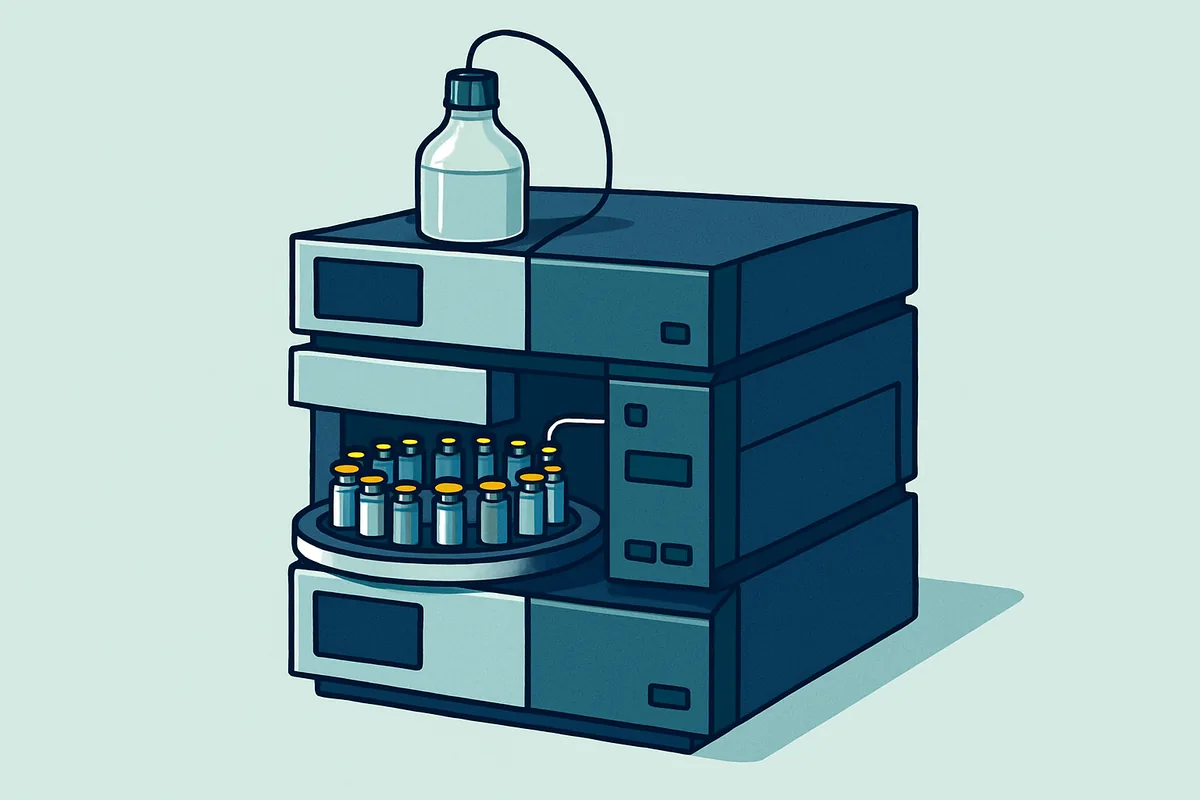
For a vitamin or mineral this is comparatively tractable. The target is a single defined molecule or element. Mineral content is usually determined by digesting the sample and measuring the element directly by a spectroscopic technique, which is precise and hard to fool. Vitamins are generally separated by liquid chromatography and quantified against a calibrated standard, with detection tuned to the compound of interest.
Botanicals are much harder, and the difficulty is conceptual before it is technical. A herbal extract is not one compound but hundreds, and “500 mg of a plant extract” says nothing about the concentration of whatever is responsible for the effect. Programmes therefore test for marker compounds: specific molecules known to be present in the authentic plant at reasonably predictable levels. A marker confirms identity and gives a proxy for concentration, but a product can contain the marker and still lack the wider profile of the genuine material, which is the loophole that adulteration exploits.
Two further measurements usually accompany potency. Contaminant screening looks for heavy metals, pesticide residues, solvent residues and microbial content. Disintegration or dissolution testing asks whether the tablet actually breaks apart under conditions resembling the digestive tract, since a tablet compressed too hard can contain exactly the labelled dose and release almost none of it.
Potency Variance Between Batches
Variability between production runs is the most common finding and the least discussed, because it does not fit a story about deception. The same product, tested from two different lots, frequently returns two different numbers.
The largest driver is raw material. Plants accumulate secondary metabolites in response to their environment, so the content of a given compound varies with soil, climate, harvest timing, plant part and drying method. A manufacturer buying botanical raw material is buying a range, and unless they test each incoming lot and adjust the formulation, that range passes into the finished product. Standardised extracts exist precisely to solve this, by concentrating and blending until a specified marker level is reached, but standardisation adds cost and is not universal.
Blending contributes a second layer. Getting a small quantity of an active powder distributed uniformly through a much larger mass of filler is a real manufacturing challenge, particularly when the two powders differ in particle size or density. Poor blending produces capsules within one batch that differ from each other, which is why competent testing samples multiple units and reports a mean with a spread rather than a single figure.
| Product type | Typical variability | Main driver | Ease of verification |
|---|---|---|---|
| Single mineral, e.g. zinc | Low | Weighing and blending accuracy | Straightforward elemental analysis |
| Fat-soluble vitamin | Low to moderate | Overage practice, degradation | Well-established chromatography |
| Fish or algal oil | Moderate | Source variation, oxidation | Fatty acid profile plus oxidation markers |
| Standardised botanical extract | Moderate | Raw material and extract ratio | Marker compound quantification |
| Whole herb powder | High | Growing conditions, plant part used | Marker plus identity confirmation |
| Probiotic | High | Viability loss over time | Live organism counting, slow and variable |
Manufacturers respond to expected losses with overage, adding more than the label states so that the product still meets the claim at the end of shelf life. This is legitimate and common. It also means a product testing above its label is not necessarily a quality failure, though a large excess raises its own questions where an ingredient has an upper safe intake.
Underdosing and Proprietary Blends
Where testing finds a consistent shortfall rather than scatter around the target, cost is usually the explanation. The pattern is strongest for ingredients that are expensive per unit weight, and weakest for ingredients that cost almost nothing, which is why cheap minerals rarely disappoint on potency while premium botanical extracts and specialised compounds more often do.
The proprietary blend is the structural feature that makes underdosing hard to see. Rather than declaring each ingredient with its own quantity, the panel lists a group of ingredients under a blend name with a single total weight. The order of the list conveys descending quantity and nothing more. A blend can therefore be almost entirely one cheap bulking ingredient, with the impressive-sounding components present in amounts far below anything studied.
Analytically this is still detectable, because chromatography can quantify individual components regardless of how the label groups them. Practically it is rarely detected, because a consumer cannot tell from the panel what should be there, and there is no declared value for a test result to contradict. A blend that is not underdosed loses nothing by declaring its amounts, which is why full disclosure is a reasonable thing to prefer.
A related pattern is the ingredient present at a token level, sometimes called fairy dusting: enough of a fashionable compound to justify naming it on the front of the bottle, far too little to plausibly do anything. Since the amount is declared, this is not a label accuracy failure at all. It is a claim about relevance that the label never actually makes.
Undeclared Ingredients and Substitution
The findings that generate the most concern involve material in the container that the label does not mention. These fall into distinct groups with different implications.
Botanical substitution replaces the declared plant with a cheaper relative or an unrelated filler. It is easiest with powdered material, where visual identification is impossible, and it has been repeatedly demonstrated in testing of products bearing plant names. Detection relies on identity testing rather than potency testing: microscopic examination of plant structures, chemical fingerprinting of the whole extract profile rather than a single marker, and in some cases genetic methods that look for the plant’s DNA. Genetic methods have limits, since heavy processing degrades DNA, which is why laboratories combine approaches rather than relying on one.
The more serious category is pharmaceutical adulteration. This concentrates in a predictable set of product types: those promising weight loss, sexual performance, muscle gain, sleep, or pain relief, where a real drug produces an effect the consumer will notice and attribute to the product. Regulators have repeatedly found prescription drugs and unapproved analogues in such products, sometimes at doses exceeding the medicine’s own labelling, and sometimes as chemical variants designed to evade routine screening. These are dangerous specifically because the consumer does not know they are taking a drug, cannot account for interactions with their medication, and would not think to mention it to a clinician.
Contamination is a third category and often unintentional. Heavy metals arrive with botanical raw material grown in contaminated soil, which is why plants that accumulate metals from the ground receive extra scrutiny. Allergen cross-contact happens on shared equipment. Undeclared caffeine sometimes arrives via a plant extract that naturally contains it.
Degradation Between Manufacture and Shelf
A shortfall at the point of testing does not prove the product was made incorrectly. Some ingredients lose potency over time, and the rate depends on chemistry, packaging and storage.
Probiotics are the clearest case. The label claims a number of live organisms, and those organisms die at a rate governed by temperature, moisture and oxygen exposure. A product manufactured to specification and shipped through a hot warehouse can arrive with a fraction of its declared count. This is why the more informative labels state the count at the end of shelf life rather than at manufacture, and why storage instructions on these products are not decorative.
Oils containing long-chain polyunsaturated fatty acids oxidise, driven by oxygen, light, heat and trace metals. Oxidation does not reduce the measured fatty acid content much, so a potency test can pass while the product has degraded; separate oxidation markers are needed to detect it. The practical signals are smell and taste, which is why a strongly rancid capsule is meaningful information regardless of what the panel says.
Several vitamins are inherently unstable. Some are sensitive to light, some to moisture, some to heat, and some to being in the same tablet as a mineral that catalyses their breakdown. Manufacturers manage this with coatings, desiccants, opaque containers and overage, and the measures work to varying degrees. Storing a bottle in a steamy bathroom or a sunlit kitchen defeats several of them at once.
Manufacturing Practice Requirements
Behind the analytical picture sits a regulatory framework that is more substantial than the “unregulated” shorthand implies, and weaker than the framework covering medicines.
In the United States, supplement manufacturers are required to follow good manufacturing practice rules specific to dietary supplements, enforced by the FDA. Those rules require identity testing of incoming ingredients, written specifications and procedures, batch records, controls on the production environment, and investigation of deviations. In the European Union and the United Kingdom, supplements are regulated as food, with controls on permitted ingredients and forms, maximum levels for certain nutrients, contaminant limits and restrictions on health claims.
The critical difference from medicines is the point at which the regulator engages. Medicines are assessed for quality, safety and efficacy before they can be sold. Supplements in these frameworks generally are not; the manufacturer is responsible for compliance, and the regulator acts after the fact, through inspection and enforcement. Inspections do find failures, and the recurring citations are unglamorous: no specifications written down, no verification that incoming material is what the supplier said, no records showing the batch was made as intended.
That last point explains why testing programmes matter. Compliance is largely about whether a documented system exists and is followed. Independent testing asks a different question, about what is in this particular bottle, and the two answers do not always agree.
Reading Independent Test Programme Reports
Third-party certification marks on a package indicate that an outside organisation has tested the product, verified that contents match the label, screened for contaminants and often audited the manufacturing site. Some programmes additionally screen for substances banned in competitive sport, which matters for athletes because responsibility for a positive test rests with them regardless of what a label said.
What certification does not do is worth stating clearly. It says nothing about whether the ingredient has any benefit, whether the dose is one that has been studied, or whether the product suits any individual. A certified product can be an accurate, contaminant-free delivery of something with no useful effect. Certification is a claim about contents, not about consequences.
When reading a report, a few distinctions repay attention. Check whether the programme tested the specific product and lot in front of you or a sample from a different run, since batch variability is exactly the issue in question. Check what was measured: potency alone, or potency plus contaminants plus disintegration. Check the pass criteria, because programmes differ in how much deviation from label they accept. And check who paid, since manufacturer-funded certification is not disqualifying but the incentives differ from those of a programme that buys products anonymously from retail.
Frequently asked questions
Does a certification seal mean the supplement works?
No, and this is the most frequent misreading of these marks. Certification verifies that the container holds what the label says, within a stated tolerance, and that it is free of the contaminants screened for. Efficacy is a separate question answered by clinical evidence about the ingredient and dose, not by analysis of the product. A meticulously manufactured, accurately labelled capsule of something with no demonstrated benefit will pass certification comfortably. Read the seal as a statement about manufacturing quality and honesty of labelling, then evaluate the ingredient itself on its own evidence.
Are expensive supplements more accurately labelled than cheap ones?
Price correlates weakly and unreliably with accuracy. Testing has found accurate products at low prices and disappointing ones at premium prices, because price reflects branding, packaging and margin as much as it reflects raw material and quality control. The more informative signals are structural: whether every ingredient is declared with its own amount rather than hidden in a blend, whether a third-party mark is present and verifiable, whether the label states potency at the end of shelf life for products that degrade, and whether the company will supply a certificate of analysis for the batch.
Why would a product contain more than the label states?
Deliberate overage is the usual reason. Where an ingredient is expected to lose potency across its shelf life, manufacturers add a margin at production so the product still meets its claim at the end. Analytical tolerance contributes too, since both the manufacturer’s testing and the independent laboratory’s carry uncertainty of a few per cent. A modest excess is therefore normal and often intentional. A large excess is a different matter, particularly for nutrients with an upper intake level, where consistently exceeding the label undermines a consumer’s ability to manage their total intake.
Can a home test tell whether a supplement matches its label?
Not meaningfully. Quantifying a specific compound in a mixed powder requires extraction, chromatographic separation and comparison against a certified reference standard on calibrated instruments, none of which has a consumer equivalent. Simple observations do carry some information: a capsule that will not break apart in water is unlikely to disintegrate well in the gut, and an oil that smells strongly rancid has oxidised. Beyond that, the practical options are choosing products carrying independent certification or requesting the batch certificate of analysis from the manufacturer.
Which product categories most often fail testing?
Two clusters recur. Botanical products, especially whole herb powders and unstandardised extracts, fail more often on potency and identity, because the raw material is inherently variable and hard to verify once ground. Products marketed for weight loss, sexual performance, muscle building and sleep fail more often on undeclared pharmaceutical ingredients, because there is a real drug that would produce the promised effect and a strong commercial incentive to include it. Simple single-nutrient vitamin and mineral products, by contrast, tend to test close to their labels.
The useful shift is to stop reading the label as a description and start reading it as a claim with a verification status attached. A single-nutrient mineral from an established manufacturer is a claim that is easy to make accurately and easy to check. A proprietary blend of exotic botanical extracts promising a dramatic effect is a claim that is difficult to verify, expensive to make honestly, and attached to exactly the market segment where adulteration is repeatedly found. The chemistry does not care about the marketing, and neither should the reader.
This is education, not medical advice. Laboratory results only carry meaning alongside your symptoms, history and examination. Talk to a qualified clinician about your own results before changing anything about your care or supplements.