

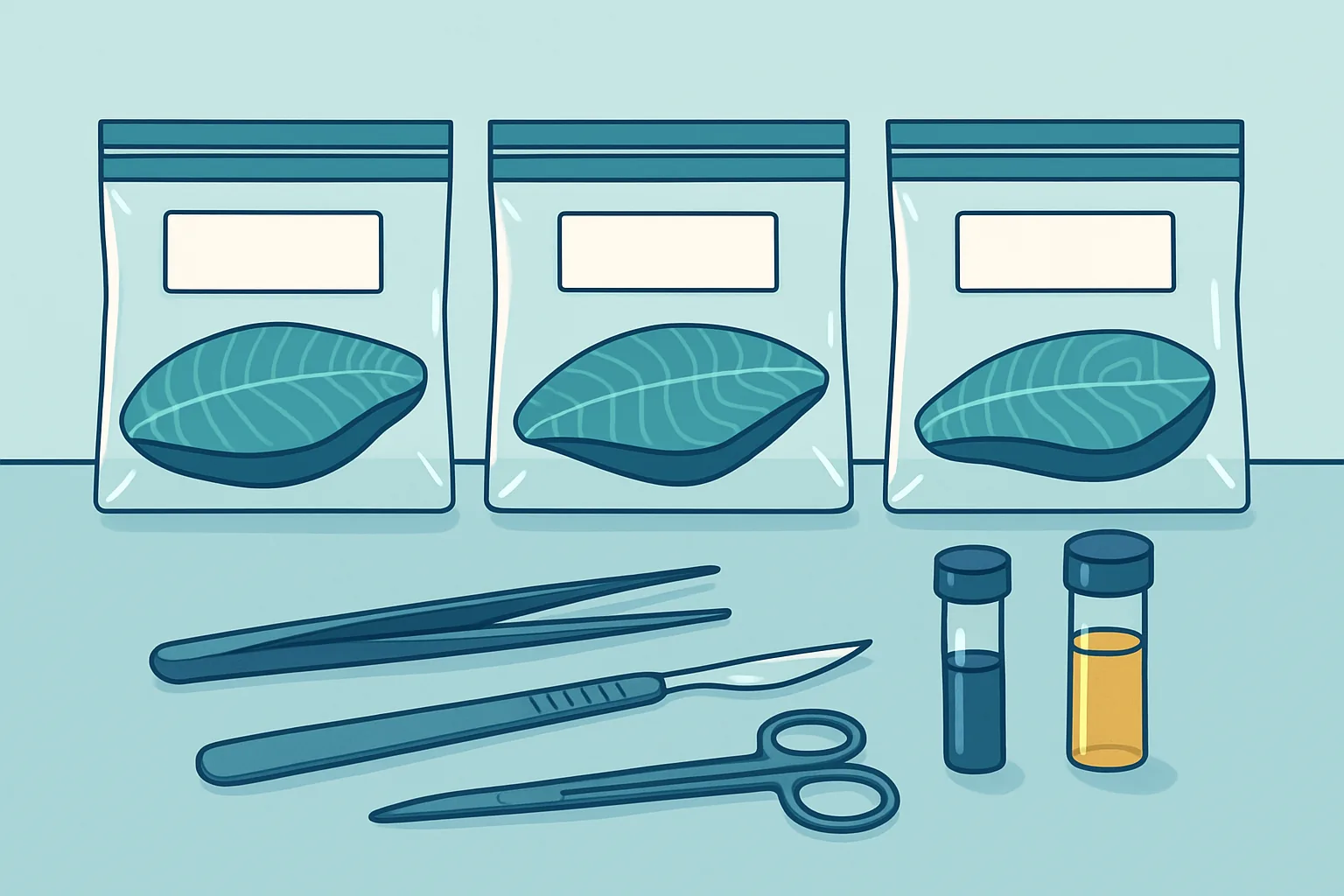
A whole fish on ice is one of the harder things to fake. It has a head, fins, scales, a body shape and a colour pattern, and anyone who handles fish regularly can name it in a second. Remove all of that, and what remains is a rectangle of pale muscle. At that point the only thing distinguishing an expensive species from a cheap one is the word printed on the packaging.
This is the structural problem behind seafood substitution. It is not primarily a story about criminal conspiracies, although those exist. It is a story about a product category in which the identifying features are removed early in the supply chain, the chain itself is long and crosses many jurisdictions, and price differences between species can be several-fold. Fraud follows opportunity, and few food categories offer more of it.
What changed the conversation was a laboratory method borrowed from biodiversity research. DNA barcoding made it possible to take a scrap of a cooked fillet from a restaurant plate and return a species name. Once that became routine and cheap, campaign groups, journalists and regulators began sampling, and the results were consistently worse than the industry expected.
Key takeaways
- Substitution rates measured by DNA testing are far from negligible, and they rise sharply as a product moves from whole fish to processed fillet.
- Barcoding compares a short standard stretch of mitochondrial DNA against reference sequences from identified specimens.
- The method fails quietly when the reference database is incomplete or contains misidentified entries.
- Restaurants and retail sit at the end of a chain, and the substitution often happened much earlier.
- Traceability systems help most when the identity claim is recorded at the vessel and carried forward, rather than reconstructed later.
How Common Substitution Actually Is
Surveys using DNA methods have been run in many countries by regulators, consumer organisations and academic groups, and while individual figures vary widely, the pattern across them is consistent enough to be treated as established.
Substitution is common but not uniform. Some species are mislabelled at low rates that could plausibly reflect honest confusion. Others, particularly high-value fish with cheap look-alikes, are mislabelled at rates that make buying them close to a lottery. Snapper, grouper and several premium white fish sit at the difficult end, along with certain shark and tuna products. Farmed species with a distinct standard appearance tend to sit at the easy end, as do fish sold whole.
The direction of substitution is informative. If mislabelling were mostly innocent error, the substitutions would run in both directions and cheap fish would sometimes be sold as cheaper fish. In practice the swap overwhelmingly replaces a more expensive species with a less expensive one, or a restricted species with an unrestricted-sounding name. That asymmetry is the strongest evidence that most mislabelling is economically motivated rather than accidental.
Rates also rise as products move down the chain. Wholesale samples generally test better than retail, and retail generally tests better than restaurant. Each handling step is another point at which a label can be changed, and the last step is where the fewest checks apply.
Two important cautions apply to any headline figure. Sampling in these studies is usually targeted rather than random, since researchers deliberately test the species most likely to be swapped, so the numbers describe the risky end of the market rather than the average purchase. And naming conventions vary between countries, so a fish legally sold under a market name in one place may count as mislabelled in another without anyone having deceived anybody.
DNA Barcoding and the COI Gene Region

DNA barcoding rests on a simple observation: for most animal groups, a particular short stretch of DNA varies enough between species to tell them apart, and little enough within a species to be reliable.
The stretch used for fish is a region of the cytochrome c oxidase subunit I gene, usually written COI, which sits in mitochondrial DNA. Mitochondria are present in every cell in large numbers, so mitochondrial DNA survives degradation better than nuclear DNA and can be recovered from small or damaged samples. The gene itself accumulates mutations at a rate that is fast enough to separate closely related species while remaining constrained by the protein’s function.
The workflow is short. A small piece of tissue is taken, DNA is extracted, and the barcode region is amplified using primers that bind to conserved sequences flanking the variable middle. The amplified product is sequenced, and the resulting sequence is compared against reference libraries. A close match to reference sequences from a single species, with a clear gap to the next nearest species, gives a confident identification.
The interpretive step matters more than the laboratory step. Barcoding does not read a species name off the DNA. It finds the closest match in a database and applies a threshold to decide whether the match is close enough. Where that threshold sits, and how the results are reported when several species cluster tightly, determines whether an ambiguous case is reported as an identification or as a genus-level result.
For badly degraded material, such as heavily cooked or canned product, the standard barcode is often too long to amplify intact. Shorter mini-barcodes targeting fragments of the same region were developed for exactly this situation. They trade resolution for recoverability, which means they may distinguish families reliably while leaving close species pairs unresolved.
Reference Databases and Their Gaps
Everything about barcoding depends on the reference library, and libraries have three recurring weaknesses.
The first is coverage. Reference sequences must come from specimens identified by a taxonomist and, ideally, retained so the identification can be rechecked. Building that coverage takes decades of fieldwork, and it is uneven. Commercially important species from well-studied regions are represented thoroughly. Species from under-sampled waters, and groups with unresolved taxonomy, are not. A sample from an unrepresented species returns the nearest available relative rather than nothing, and that near-miss can be mistaken for a match.
The second is misidentification within the database itself. If a specimen was named incorrectly before its sequence was deposited, that error propagates to every sample subsequently matched against it. Curated libraries with specimen vouchers and expert review are considerably more reliable than open repositories accepting submissions without verification, and the difference matters most for exactly the difficult groups where errors are likeliest.
The third is biology. Barcoding assumes a clean gap between within-species and between-species variation, and in some fish groups that gap closes. Recently diverged species may share mitochondrial sequences. Hybridisation transfers mitochondrial DNA between species, so a hybrid individual carries its mother’s barcode regardless of its actual ancestry. Widely distributed species sometimes contain deep regional lineages that look like separate species by sequence alone.
| Product form | Visual identification | DNA recoverability | Practical barcoding difficulty |
|---|---|---|---|
| Whole fresh fish | Reliable for a trained handler | Excellent | Low, and rarely needed |
| Skin-on fillet | Sometimes possible | Excellent | Low |
| Skinless fillet | Essentially impossible | Excellent | Low |
| Frozen and thawed portion | Impossible | Good | Low to moderate |
| Breaded or battered portion | Impossible | Good after removing coating | Moderate |
| Cooked or smoked product | Impossible | Reduced, fragmented | Moderate to high |
| Canned or retorted product | Impossible | Heavily degraded | High, mini-barcodes needed |
| Mixed or minced products | Impossible | Multiple species present | High, requires sequencing depth |
Why Processing Destroys Visual Clues
The features used to identify a fish are almost all external or structural. Fin ray counts, scale patterns, lateral line shape, head morphology, colour and body proportions carry the information, and filleting removes every one of them.
What is left is muscle, and fish muscle is remarkably similar across species at the level a shopper can assess. Colour varies, but it varies within a species with diet, season and handling, and it can be influenced deliberately. Texture varies, but cooking flattens the differences. Flake size and fat content give an experienced cook weak hints that are unreliable at the counter.
Processing also removes the labelling anchors. A whole fish carries its identity in its body. A skinned fillet carries it only in the accompanying paperwork, and paperwork can be edited. Once several fillets from different sources are combined in a single tray, even honest record-keeping loses track of which piece came from where.
Cooking, smoking and canning compound the problem by damaging the DNA itself. Heat and acid break the molecule into shorter fragments, so long amplification targets fail. This is why canned products are the hardest category to test and, unsurprisingly, one where mislabelling persists. Mixed products such as fish balls, surimi-based items and minced preparations pose a further difficulty, because they contain multiple species at once and standard sequencing of a single amplified product returns a mixture that cannot be read cleanly. Testing these requires sequencing approaches that resolve many templates in parallel.
Sampling Points Along the Supply Chain
Testing a restaurant plate tells you the fish on that plate was not what the menu said. It does not tell you who changed the label, and that distinction shapes what enforcement can achieve.
A typical chain runs from vessel to processor, sometimes through a second processing country, then to importer, wholesaler, distributor and finally retailer or caterer. Each transfer involves paperwork asserting a species name. Substitution can be introduced at any of them, and the point of substitution is invisible in the final product.
Sampling therefore works differently depending on the goal. Consumer-facing surveys sample at the end of the chain, which measures what people actually receive but attributes nothing. Regulatory sampling works backwards from a positive finding through documentation, which is slower but capable of locating the point of failure. Industry self-testing focuses on incoming consignments, which is where a buyer can actually reject the goods.
Sampling design carries pitfalls. A single fillet from a batch of thousands says little about the batch, because processing lines mix material. Taking multiple sub-samples across a lot gives a much better picture and is standard practice for serious verification. Chain of custody matters too, because a result intended to support enforcement must survive the argument that the sample was mixed up after collection.
Where the chain crosses several countries, differences in legal market names create genuine disputes that are not fraud. A species may be sold legitimately under one name in its country of origin and be treated as a substitute under the destination country’s naming rules. Resolving those cases requires legal analysis rather than more testing.
Economic Drivers Behind Substitution
Substitution persists because the arithmetic favours it. Where two species look identical after filleting and one costs several times the other, the margin available from a label change is large relative to the probability and cost of detection.
Several forces sharpen that incentive. Demand for certain species has grown faster than supply, so prices rise while a cheaper look-alike remains abundant. Quota limits and catch restrictions make some species scarce in ways that create pressure to keep supplying customers who expect them. Long supply chains dilute accountability, since each intermediary can plausibly claim to have passed on what it received. And enforcement capacity is limited almost everywhere relative to the volume traded, so the expected cost of being caught is low.
There is also a category of substitution that is not driven by price at all. Species subject to catch restrictions, protected status or import controls acquire value from being relabelled as something unrestricted, which is why testing surveys periodically find protected species sold under ordinary market names. That form of mislabelling has conservation consequences that a price comparison misses entirely.
Consumer behaviour plays a part. Buyers who select on species name alone, without asking about origin or catch method, give the chain little reason to maintain the more expensive verification. Buyers who ask consistently, and who buy whole fish or skin-on portions where practical, are harder to substitute against, which is a small but real market signal.
What Traceability Systems Can Fix
Traceability means being able to follow a specific unit of product backwards to its origin, and forwards to where it went. It is the structural answer to substitution because it changes what a label asserts: not a claim made at the counter but a record created at the vessel and carried through every transfer.
Effective systems share features. Identity is captured at the earliest possible point, when the fish is still whole and identifiable. Each transformation, from whole fish to fillet to portion to package, is recorded as a link so that a batch can be resolved backwards. The records travel electronically with the product rather than being reconstructed from invoices afterwards. And the data are auditable by someone other than the party who created them.
Digital ledger approaches have received attention for the last property, since a record that cannot be quietly rewritten is more useful than one that can. The important caveat is that no ledger verifies the truth of what was entered. A false species name recorded at the first step becomes an immutable false record. Tamper-evidence addresses tampering after entry, not misrepresentation at entry, which is why DNA testing and traceability are complements rather than alternatives.
Regulation has moved gradually towards requiring more of this. Requirements to record species, catch area and production method, and to keep documentation for imported consignments, exist in several major markets and have expanded over time. Coverage remains partial, with processed and mixed products the most common exclusions, which is precisely where substitution concentrates.
What testing adds is verification pressure. A traceability system that is never checked converges towards being a documentation exercise. Periodic DNA verification, applied at import and at retail, gives the paperwork consequences and is the mechanism by which measured substitution rates in monitored categories have fallen where sustained programmes exist.
Frequently asked questions
Can a shopper tell a substituted fillet by looking at it?
Generally no, and this is the core of the problem. Once skin, head and fins are removed, the remaining muscle looks broadly similar across many species, and the variation within a single species due to diet, season, freshness and handling is often larger than the variation between two species that substitute for each other. Colour can be influenced by feed and by packaging atmosphere. Buying whole fish, or fillets with the skin left on, restores some identifying features and is the most practical consumer defence.
Does DNA barcoding ever give a wrong answer?
It can, and the failure is usually in the reference data rather than the chemistry. If the true species is absent from the reference library, the analysis returns the closest relative present, which can look like a confident match. If a reference sequence was deposited under a wrong name, every sample matched to it inherits that error. Closely related species that recently diverged, or that hybridise, may share mitochondrial sequences and cannot be separated by this marker alone. Well-run laboratories report those cases as unresolved rather than forcing a name.
Is farmed seafood less affected than wild-caught?
Usually yes, for structural reasons rather than virtue. Farmed production involves a known species raised in a known place with documented inputs, so the identity claim starts out well supported and the supply chain is typically shorter. Wild capture involves mixed catches, transhipment at sea in some fisheries, and processing that may occur in a third country. The exception is that farmed products are not immune to origin mislabelling, where the species is correct but the stated country of production is not.
What happens to a business found selling mislabelled fish?
That depends heavily on jurisdiction and on where the substitution occurred. A retailer or restaurant that can show it bought in good faith with supporting documentation is generally treated differently from one that changed the label itself. Consequences range from requirements to correct labelling and withdraw stock, through fines, to prosecution where deception is established or where protected species are involved. The practical difficulty for enforcement is tracing the substitution back through a chain in which each party points to the previous one.
Are mislabelled fish a safety problem or only a price problem?
Mostly price, but not exclusively. Some substitutions carry genuine health relevance: species that accumulate more mercury may be sold as species that accumulate less, which matters for people advised to limit exposure, and certain fish cause a characteristic digestive reaction that consumers cannot anticipate if the species is hidden. Allergy is a further concern in mixed products. There is also a conservation dimension, since substitution can conceal the sale of species subject to restriction and undermines the market signals that support better-managed fisheries.
The practical position for a buyer is neither panic nor complacency. Substitution concentrates in predictable places, namely high-value species with cheap look-alikes, sold heavily processed, at the far end of a long chain. Buying whole or skin-on fish, favouring suppliers who name the species and the catch area rather than a generic market term, and treating an unusually low price for a premium species as information rather than luck will avoid most of it. The rest depends on whether the verification systems behind the label are actually being tested, which is a question of enforcement rather than shopping.
This is education, not medical advice. Laboratory results only carry meaning alongside your symptoms, history and examination. Talk to a qualified clinician about your own results before changing anything about your care or supplements.