
A blood sample taken at nine in the morning can produce a result by lunchtime or three weeks later, and the difference has almost nothing to do with how hard the test is. The instrument that measures a potassium level takes under ten minutes. The instrument that measures a hormone by mass spectrometry takes perhaps twenty. Neither number explains why one result appears the same afternoon and another appears after a fortnight.
The answer is queues. A sample spends the overwhelming majority of its life waiting: for a courier, for reception, for a batch to fill, for an organism to grow, for a pathologist to reach it in a list. Analysis is a small slice at the end of a long sequence of holding patterns, and understanding where those holding patterns are makes the waiting considerably less mystifying.
This piece follows a sample through the whole chain, in order, and names what actually takes the time.
Key takeaways
- Instrument analysis time is rarely the bottleneck; transport and queueing usually are.
- Some tests are batched because running one sample costs almost as much as running fifty.
- Culture-based microbiology is slow because it waits for organisms to grow, not for staff.
- Send-out testing to a specialist laboratory adds transport and scheduling in both directions.
- Reports needing human interpretation join a professional queue that automation cannot shorten.
The Journey From Collection to Reception
The clock a patient starts is the moment of the blood draw. The clock a laboratory measures usually starts when the sample is booked in, and the gap between those two is often the single largest block of time in the whole process.
A sample taken in a hospital ward that has a laboratory in the basement may reach reception in twenty minutes, sometimes carried by pneumatic tube in under two. A sample taken in a community clinic joins a courier round, and courier rounds run on a schedule. If the collection happens shortly after the van has left, the sample waits for the next one, which may be that afternoon, that evening, or the following morning.
Transport conditions constrain that scheduling. Different analytes tolerate delay differently, and stability is the reason certain tests cannot simply be posted.
| Sample type | Typical handling requirement | Practical consequence |
|---|---|---|
| Routine chemistry in gel tube | Centrifuge within hours, then stable refrigerated | Tolerates a same-day courier round |
| Full blood count in EDTA | Analyse within hours; morphology degrades sooner | Needs a nearby or on-site laboratory |
| Blood gas syringe | Analyse within minutes, kept cool | Must be tested at the point of collection |
| Blood culture bottles | Incubated as soon as possible, kept warm | Delay in transit costs detection time |
| Frozen aliquots for send-out | Kept frozen throughout the journey | Shipped in batches on set days |
Anything that needs freezing must be processed before it can travel, which means centrifugation, separation into aliquots and freezing all happen at the collecting laboratory. Those steps take staff time and add another queue.
Weekends and public holidays compress this further. Many community collection points do not run at weekends, and reduced courier schedules mean a Friday afternoon sample can lose two days before it reaches anyone.
Accessioning, Barcoding and Triage
Reception, usually called accessioning, is where a sample becomes a record. Staff match tubes to request forms or electronic orders, confirm the identity matches, check the tube type is correct for the tests ordered, verify the volume is adequate, and apply a barcode that ties the physical tube to the electronic request.
This step is fast per sample and slow in aggregate, because samples arrive in surges. Courier rounds deliver in batches, morning clinic collections arrive together, and a laboratory that processes several thousand tubes a day receives most of them in a few concentrated peaks. A tube arriving at the front of a peak is booked in quickly; one arriving at the back waits behind hundreds of others.
Accessioning is also where samples are rejected, and rejection is the most expensive delay in the whole system because it restarts the entire process. Common reasons are unlabelled or mislabelled tubes, clotted samples where anticoagulant tubes were filled or mixed poorly, insufficient volume, the wrong tube type, and visible haemolysis from a difficult draw. Some of these can be detected immediately; others only emerge when the analyser flags the sample, by which time hours have passed.
Triage happens alongside. Requests marked urgent are pulled out of the queue and routed to a rapid workflow, which is why an urgent test in a hospital returns in under an hour while the same test on a routine request takes most of a day. Triage is a scheduling decision, not a different test, and prioritising one sample necessarily delays others.
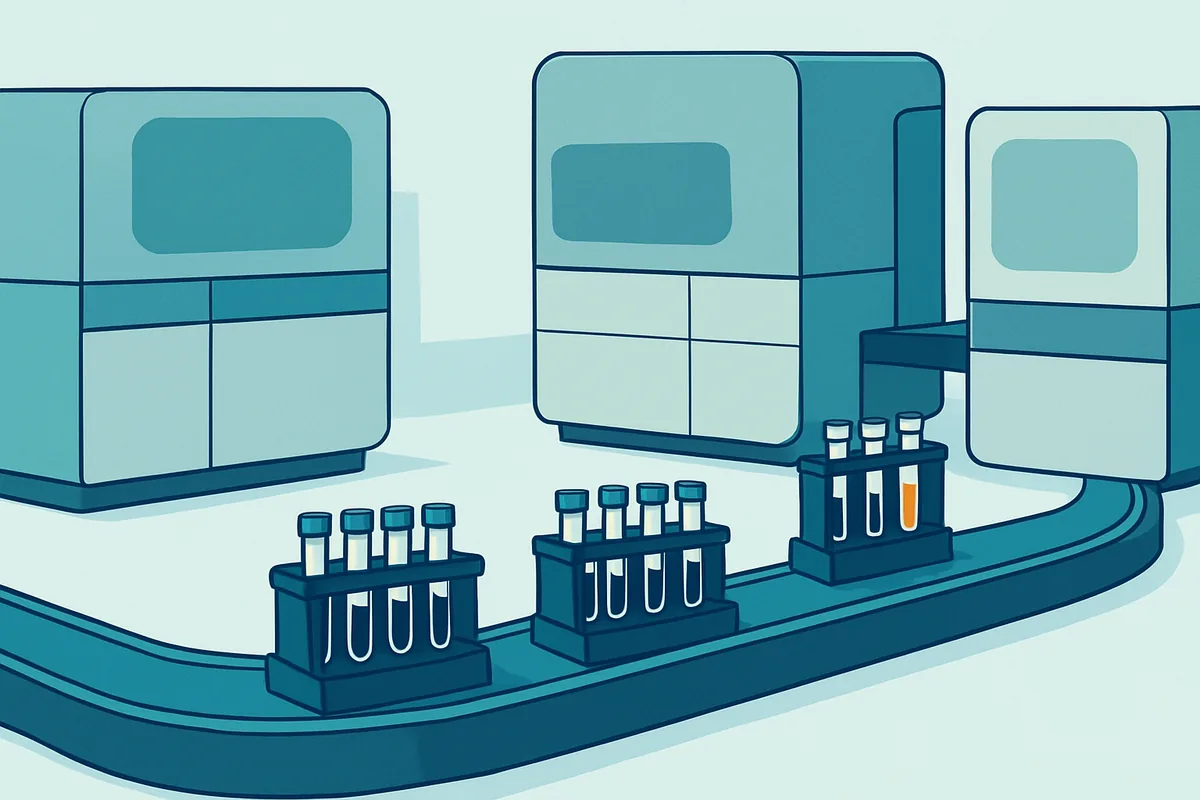
Large laboratories automate much of this with track systems: tubes are loaded once, and a conveyor moves them to centrifuges, decappers, aliquotters and analysers under software control. Automation removes handling delays, and it also creates a single point of failure, since a track fault stops everything on it.
Why Some Assays Are Batched Weekly
Batching is the most common cause of a multi-day wait for a test that takes minutes to run, and the logic behind it is economic rather than technical.
Many assays require a calibration curve and control materials to be run alongside the samples. Setting up that curve consumes reagent, uses a portion of the plate or run, and takes technologist time. If the run is set up for one sample, the entire overhead is spent on one result. If fifty samples are run together, the overhead is shared. For a test where a laboratory receives a handful of requests each week, running on demand would multiply the cost per result several times over.
Reagent kits reinforce this. Many specialist assays are supplied as kits with a fixed number of wells and a short stability once opened. Opening a kit for a single sample wastes most of it, and reagent cost is a real constraint on what a laboratory can afford to offer.
Technique adds a third reason. Some methods, particularly manual immunoassays and certain chromatographic separations, are labour-intensive to set up and are performed by a small number of trained staff. Scheduling those runs on fixed days is how a laboratory guarantees that a competent operator is available, and it is also how competence is maintained, since a technique performed once a month is performed badly.
The visible result is a schedule: certain tests run daily, some twice weekly, some weekly, some fortnightly. A sample arriving the day after a weekly run waits nearly a full cycle before it is analysed, even though the analysis itself takes an afternoon. That is not inefficiency. It is the trade a laboratory makes to keep a rarely requested test available at all.
Culture and Growth-Dependent Delays
Microbiology is slow for a reason no amount of investment removes: it waits for living organisms to multiply, and organisms multiply at their own pace.
A bacterial culture begins by placing the sample on nutrient media and incubating it. Nothing visible happens until a single organism has divided enough times to form a colony, which for common bacteria takes overnight and for slower ones takes considerably longer. Only then can the colony be examined, identified and tested against antibiotics.
The sequence is inherently serial. Identification generally requires a pure colony, so the first growth period must complete before identification starts. Susceptibility testing requires a standardised inoculum prepared from that pure growth, so it starts later still. Each step commonly adds another overnight incubation, which is why a straightforward urine culture takes a couple of days and a positive blood culture with full susceptibilities takes longer.
Blood cultures illustrate the pattern well. Bottles are incubated in instruments that continuously monitor for the metabolic signs of growth, and they flag when growth is detected. A heavily infected sample may flag within hours; a lightly infected one may take a day or more. Bottles that never flag are typically held for several days before being reported as no growth, and that holding period is the reason a negative blood culture result takes days to arrive despite nothing having been found.
Some organisms are dramatically slower. Mycobacteria, the group including the organism causing tuberculosis, divide extremely slowly, and cultures are held for weeks before being called negative. Certain fungi are similar.
Molecular methods sidestep growth entirely by detecting genetic material, and they can return an answer in hours. They have not replaced culture because they detect only what they are designed to detect, and because they do not, on their own, produce the live isolate needed for full antibiotic susceptibility testing. Both approaches are frequently run in parallel: a rapid molecular result to guide immediate treatment, and a culture to confirm and extend it.
Send-Out Testing to Reference Laboratories
No laboratory offers every test. Rare analytes, specialised genetics, unusual toxicology and confirmatory work are concentrated in reference laboratories that serve a wide catchment, and referring a sample adds several distinct delays.
The first is recognition. A send-out request must be identified as such, which sometimes happens at accessioning and sometimes only when a local screening result comes back abnormal and triggers confirmation. In the second case, the send-out clock starts days after collection.
The second is preparation and dispatch. Samples for referral often need centrifugation, aliquotting, freezing and specific packaging, and they leave on scheduled shipments rather than continuously. Frozen shipments in particular go out on set days because of the cost and handling involved.
The third is the receiving laboratory’s own queue, which contains every stage described above: their accessioning, their batching schedule, their analysis. A reference laboratory running a specialist assay fortnightly imposes that cycle on every sample it receives.
The fourth is the return journey. Results must come back, be matched to the original request, be entered or interfaced into the local system, and be reviewed before release. Where systems do not connect electronically, this involves manual transcription with its own checking requirements.
Confirmatory testing in toxicology shows the pattern clearly. An initial screen may be rapid, but a positive screen result is presumptive and is confirmed by a more specific method, often at a different laboratory. The confirmation is what has legal and clinical weight, and it is what accounts for most of the reporting interval.
Pathologist and Clinician Review Queues
Some results are numbers, and numbers can be released automatically once they pass validation rules. Others are interpretations, and interpretations require a person.
Histopathology is the clearest case. Tissue must be fixed, processed overnight, embedded, sectioned, stained and mounted before anyone can look at it, and that processing sequence is largely fixed in duration. The slides then join a pathologist’s list. A straightforward case may be reported the day it reaches the list. A complex resection with dozens of blocks takes far longer to examine, and cases needing additional stains, deeper sections through the block or specialist opinion go back into the laboratory and return to the queue afterwards.
Similar queues exist elsewhere. Blood films flagged for morphological review wait for a scientist. Complex haematology and immunology reports carry an interpretive comment written by a specialist. Bone marrow, cytology and molecular reports frequently require several results to be assembled before a conclusion can be written.
Multidisciplinary meetings add a scheduled step. Where a diagnosis has significant treatment implications, cases are commonly discussed by a group of specialists together, and those meetings run weekly. A case ready on the wrong day waits for the next one.
These queues are the hardest to shorten, because the constraint is trained human attention rather than equipment. Automation has compressed the mechanical parts of the workflow substantially over the past decades while leaving the interpretive parts largely untouched, which is why the proportion of total turnaround spent waiting for a person has increased rather than fallen.
Where Delays Genuinely Get Introduced
Ranking the causes is useful, because the intuitive answer is almost always wrong.
Transport and scheduling usually dominate for outpatient testing. The interval between collection and arrival, driven by courier rounds and site geography, frequently exceeds every laboratory step combined.
Sample problems come next in impact, because they reset the clock entirely. A rejected sample requires a new appointment, a new draw and a new journey, easily adding a week for a community patient. This is the one part of the process where the collection technique and the labelling discipline at the point of draw have an outsized effect.
Batching schedules account for most multi-day waits on tests that are technically quick, and add-on requests are a related trap: asking for an additional test on a sample already at the laboratory works only if the sample is still stable and the required tube type was collected, otherwise the whole cycle restarts.
Growth-dependent testing and human review queues make up the genuinely irreducible portion. Neither can be compressed much without changing the method or the staffing.
Result release adds a final step that patients often do not see. Many laboratories hold certain results for clinical review before release, so a result complete in the laboratory system may not appear in a patient portal until a clinician has seen it. Where the result requires a conversation rather than a number, that delay is deliberate.
The practical upshot for anyone waiting is that the useful question is not how long the test takes but which of these queues the sample is currently sitting in. A test batched weekly, a culture held for a fortnight, and a specimen sent to a reference laboratory produce very different answers, and the requesting clinician’s office can usually say which applies.
Frequently asked questions
Why did one test from my blood draw come back days before another?
Because tests from a single draw are separated at the laboratory and follow completely different paths. Routine chemistry and a blood count run on automated analysers within hours of arrival. A hormone assay may be batched twice weekly. An antibody test may be sent to a reference laboratory. A culture must wait for growth. The tubes are often physically split at accessioning and never travel together again, so the reporting times reflect each individual pathway rather than a single overall process.
Does chasing the laboratory speed things up?
Rarely, and usually only in specific circumstances. If a result is genuinely clinically urgent, the requesting clinician can mark it as such, which moves it into a priority workflow, and that is effective for tests where the constraint is queueing rather than biology. It cannot make bacteria grow faster, cannot bring forward a batched run without wasting reagent, and cannot conjure a slot in a pathologist’s list. An enquiry is most useful when it confirms the sample arrived and was not rejected, because a rejected sample nobody chased is a genuinely avoidable delay.
Why do results sometimes appear in a portal before an appointment?
Because portal release and clinical review are separate processes, and release rules vary between systems. Some laboratories publish results as soon as they are authorised, others delay release for defined categories so a clinician sees them first. Where a result is complex, provisional, or likely to be misread without context, a holding period exists deliberately. If a result appears without explanation, the safest reading is that it is one component of a picture the clinician will assemble, not a conclusion in itself.
What makes a sample get rejected?
The commonest causes are labelling problems, clotting, insufficient volume, the wrong tube type and haemolysis. Labelling failures are the least negotiable, since a tube that cannot be reliably matched to a patient is not testable at any level of care. Clotting occurs when a tube containing anticoagulant is filled too slowly or mixed inadequately. Haemolysis, where red cells rupture and release their contents, distorts several common measurements and often comes from a difficult draw or from drawing through a narrow needle. Most rejections trace back to the collection itself rather than to anything that happened afterwards.
Are faster results always better?
Not uniformly. Speed matters enormously where treatment depends on the answer within hours, which is why emergency departments have rapid workflows and often point-of-care devices. For most planned testing, an extra day changes nothing clinically, and the pressure to release faster carries real costs: less time for review, more provisional reports later amended, and more results reaching patients without context. A well-designed laboratory is fast where speed changes decisions and unhurried where it does not.
If you take one thing from this, make it the shape of the timeline rather than any individual number. A sample spends most of its life stationary, in a courier van, in a rack awaiting accessioning, in a queue for a batched run, in an incubator, or in a list awaiting a specialist. The analytical step everyone pictures occupies a small fraction of the total. Knowing which queue a particular sample is in tells you far more about when the result will arrive than knowing what the test measures, and it is a question the requesting clinician can usually answer in a sentence.
This is education, not medical advice. Laboratory results only carry meaning alongside your symptoms, history and examination. Talk to a qualified clinician about your own results before changing anything about your care or supplements.