
Laboratory injury reporting systems are built around events. Someone spills acid, cuts a hand on broken glass, or drops a nitrogen dewar, and a form gets filled in. The injuries that actually remove people from bench work are almost never events. They are the slow ones: a thumb that stops working properly after eight years of pipetting, a neck that will not turn after a decade at a fixed-height microscope, a shoulder that aches every evening from reaching into a biosafety cabinet.
None of those generate an incident report, because there is no incident. There is only a gradual narrowing of what a person can comfortably do, usually accompanied by the assumption that this is simply what the job costs. It is not. The mechanisms are well understood, they follow from identifiable movements, and the adjustments that reduce them are mostly cheap and always specific.
What follows takes each of the main injury-producing tasks at the bench, explains what the tissue is doing when it gets damaged, and describes the changes that alter the load rather than merely making the workstation look tidier.
Key takeaways
- Laboratory strain injuries come from load repeated at low intensity, not from single heavy efforts, so they build quietly and are rarely reported.
- Manual pipetting loads the thumb in a way it is poorly designed for, and volume, plunger force and hours per week matter more than technique alone.
- Bench height, chair height and elbow angle form one system; changing any of them without the others usually shifts strain rather than removing it.
- Microscope and biosafety cabinet work impose static postures, which fatigue muscle faster than movement does.
- Task rotation and short frequent breaks reduce cumulative load more reliably than any single piece of equipment.
Repetitive Motions That Cause Injury
The tissues involved in strain injury are tendons, the sheaths that tendons run through, the muscles that pull on them, and the nerves that pass alongside. Each fails in a slightly different way, and understanding which one is complaining changes what you do about it.
Tendon and sheath problems arise from repeated loaded movement. A tendon glides through a sheath lubricated by a thin film of fluid, and every repetition produces a small amount of friction and micro-damage that the body repairs continuously. Injury occurs when damage outruns repair for long enough that the tissue changes character. Repair tissue is more disorganised, less able to glide smoothly, and often thicker, which increases friction further. This is why these injuries accelerate once they begin.
Muscle problems come mostly from static loading rather than movement. A muscle held at a constant moderate contraction, as the shoulder and neck muscles are during microscope work, cannot use its normal cycle of contraction and relaxation to pump blood through itself. Held still, it accumulates metabolic waste and becomes ischaemic at a low level. The result is the specific dull ache of sustained posture, which differs from the sharp local pain of a tendon problem.
Nerve compression is the third mechanism. Nerves passing through confined spaces, most famously the median nerve through the carpal tunnel, tolerate a certain amount of pressure. Swelling of adjacent tendons, sustained wrist flexion or extension, or direct pressure from a hard bench edge raise it. Nerves respond with tingling, numbness and eventually weakness, and the symptoms characteristically appear at night rather than during the task.
None of these mechanisms requires heavy force. They require repetition, duration, or fixed position. A laboratory task can be almost effortless and still be genuinely harmful when performed for four hours without interruption.
Pipetting Posture and Thumb Loading
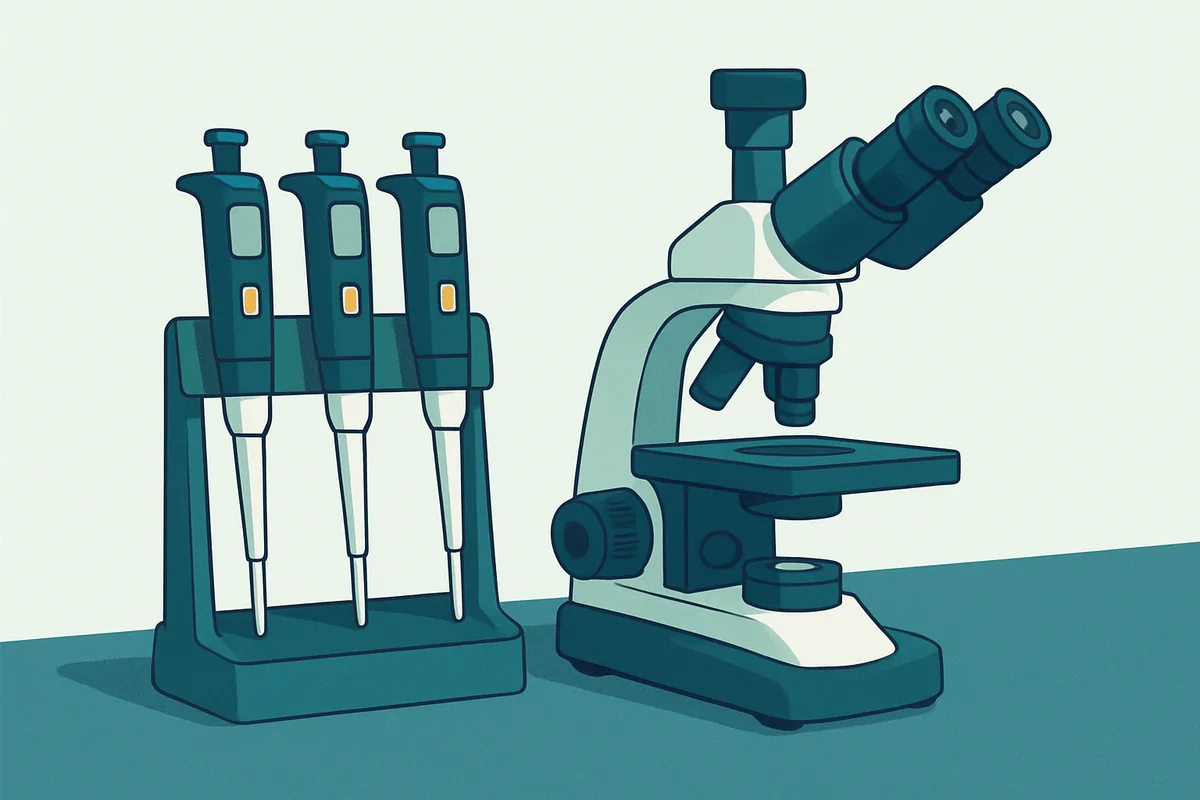
Manual air-displacement pipetting is the most studied laboratory ergonomic problem, and for good reason. It combines every risk factor in one movement.
Consider what the hand does. The pipette is gripped in a closed fist, already a sustained low-level contraction of the finger flexors. The thumb then presses a plunger down against a spring, releases it, presses again to the second stop to blow out the residual volume, and often presses a separate tip-ejector that requires considerably more force than the plunger itself. Meanwhile the wrist is frequently deviated sideways to angle the tip into a tube, and the forearm is held unsupported in the air.
The thumb is the problem. Its long flexor tendon runs through a narrow sheath at the thumb base, and the thumb’s normal role is opposition and grip, not repeated axial pressing against resistance. Tenosynovitis at the base of the thumb and the wrist is the classic laboratory presentation, common enough that most laboratories with long-serving staff have someone who has had it.
Several variables change the load substantially, and they are worth separating because people tend to focus on the least useful one.
| Factor | Why it matters | Practical change |
|---|---|---|
| Hours of continuous pipetting | Duration drives cumulative damage more than any single technique detail | Cap continuous sessions at around half an hour before switching tasks |
| Plunger and ejector force | Ejector force is often the highest single force in the cycle | Choose low-force models; test ejection before purchase, not just aspiration |
| Tip fit and seal force | Hammering tips onto a barrel loads the shoulder and wrist | Use tips matched to the pipette; never press down to seat them |
| Wrist angle | Deviated wrists raise carpal tunnel pressure and tendon friction | Raise or tilt the vessel rather than angling the hand |
| Elbow elevation | An unsupported raised arm loads the shoulder statically | Lower the work surface or use shorter tube racks |
| Number of channels | One eight-channel action replaces eight single actions | Multichannel or electronic pipettes for repetitive plate work |
Technique advice matters, but it is often given in isolation and then blamed when it fails. Keeping the wrist straight, holding the pipette loosely rather than in a clenched grip, and keeping the elbow close to the body all reduce load. They do not compensate for six hours of continuous plate filling. The dose is the dominant variable.
One overlooked detail is vessel height. Reaching up and over the rim of a tall reagent reservoir forces shoulder abduction, and a shoulder held abducted even slightly for long periods fatigues quickly. Working with tubes and reservoirs at or slightly below elbow height removes that, usually at the cost of a different rack.
Bench and Chair Height Relationships
Most laboratory benches were installed at a fixed height chosen for standing work by a person of average height, and they have not moved since. Everything else in the room then has to accommodate that decision.
The starting point is not the bench. It is the elbow. For precision hand work the forearms should be roughly horizontal or angled very slightly downward, with the shoulders relaxed and the upper arms hanging close to the body. Work surfaces higher than that force the shoulders up into a permanent shrug. Lower than that, the neck and upper back flex forward.
The order that works
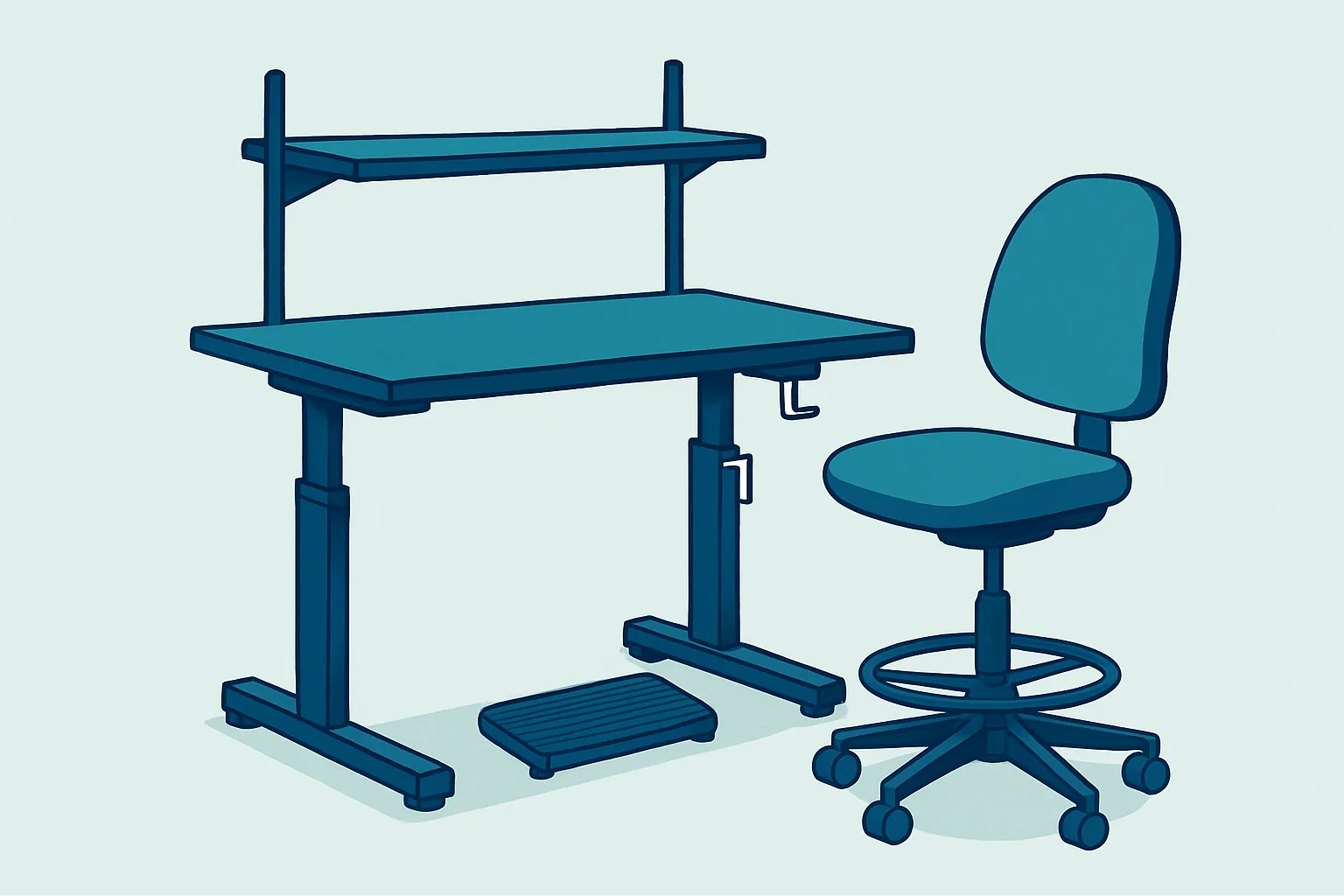
Set the chair first, so the feet are supported and the thighs roughly horizontal with no pressure behind the knees. Then check whether the work surface sits at the elbow. If the bench is too high, which is by far the most common case for seated work at a standing-height bench, the chair must rise, which lifts the feet off the floor. That is what footrests are for, and a footrest is not an optional comfort item here. It is the load-bearing part of the solution, because dangling feet transfer body weight onto the underside of the thighs and compress the vessels there.
The frequent failure is raising the chair without adding a footrest. The person then hooks their feet on the chair base, which twists the pelvis and loads the lower back. The complaint that follows is back pain, and the chair gets blamed.
Knee clearance is the other constraint. Many benches have cupboards or service ducts beneath them that make it impossible to sit close, and reaching forward over an obstruction produces sustained trunk flexion. Clearing one bay of under-bench storage is often the highest-value ergonomic change available in an older laboratory.
Microscope Work and Neck Strain
Microscopy is the purest example of static loading in the laboratory. The operator holds the head and neck in one position, often with the trunk leaning forward, and moves only the hands. Sessions can run for hours.
The geometry of a conventional microscope is the root of it. Eyepieces on many instruments sit at a height and angle that require the user to lean forward and tilt the head down to meet them. The head weighs a substantial amount, and holding it forward of the spine’s vertical line multiplies the load on the neck extensor muscles considerably. Those muscles are then held in exactly the sustained low-level contraction that produces ischaemic ache and, over years, chronic changes.
The remedies are structural rather than behavioural. An eyepiece riser or extension tube raises the viewing height so the user can sit upright with the head balanced over the spine. Instruments with adjustable-angle binocular heads achieve the same thing without an accessory. Where a microscope has a camera, routing the image to a monitor removes the eyepiece constraint completely, and the monitor can then sit at a proper viewing height with the top of the screen at or slightly below eye level. For long screening sessions this is transformative.
The hands need attention too. Reaching forward to the stage or focus controls pulls the trunk forward and defeats the seating adjustment. Supporting the forearms on the bench, ideally with a padded edge so the ulnar nerve is not compressed against a hard surface, keeps the shoulders relaxed.
Eye strain is related. Interpupillary distance and dioptre settings are adjustable on every binocular microscope and are routinely left wherever the previous user had them. Setting them correctly reduces the squinting and head repositioning that feed both eye fatigue and neck tension.
Biosafety Cabinet Reach and Shoulders
A biosafety cabinet is designed around airflow, not around arms. Sash height, work surface depth and grille position all follow from containment requirements, and the consequence is a workspace that requires the operator to reach forward and often upward with the shoulders unsupported.
The specific problem is that the front grille cannot be blocked, so the natural resting position for the forearms is unavailable. Users hold their arms in the air over the grille, elbows away from the body, for the duration of the work. Shoulder abduction held statically is one of the most fatiguing postures the upper body can adopt, and it is why cabinet work produces shoulder and upper-back complaints out of proportion to how long it takes.
Working as close to the front of the usable area as containment allows shortens the reach dramatically, provided the grille stays clear. Arm rests designed for cabinets sit across the front without obstructing airflow and let the forearms take weight.
Height is the other lever. Cabinets on fixed stands frequently place the work surface too high for seated work and too low for comfortable standing. An adjustable stand solves this; failing that, a properly adjusted chair with a footrest gets most of the way there.
Sash position matters for the neck as much as for containment. A sash left low forces the user to duck to see the work surface, adding neck flexion to the shoulder load. Working at the designed sash height, with adequate task lighting inside so the user does not lean in to see, addresses both.
Task Rotation and Micro-Breaks
If only one change is possible, this is the one to make. Every mechanism described above depends on duration. Interrupting duration interrupts all of them.
The physiology is straightforward. Tendon repair proceeds continuously, and short rests let the balance between damage and repair shift back. Static muscle loading is relieved as soon as the posture changes, because blood flow resumes within seconds of the muscle relaxing. Nerve compression falls the moment the wrist returns to neutral. None of this requires a long break. It requires a change.
Short frequent interruptions outperform long infrequent ones. A pause of a minute or two every twenty to thirty minutes, during which the hands come off the pipette and the arms and neck move through their range, addresses the load far better than a single long break in the middle of a four-hour session. Task rotation applies the same principle at a larger scale: alternating pipetting with cell counting, documentation or plate reading changes which tissues are loaded, and rotating repetitive work around a team prevents any one person accumulating the entire dose.
The obstacle is rarely practical. It is cultural. Continuous work looks like productivity, and stopping looks like slacking, particularly for junior staff who are being observed. Laboratories that successfully reduce strain injury tend to be the ones where senior people visibly take breaks and where nobody has to justify stepping away from a plate for ninety seconds.
Symptom reporting has the same cultural problem. Early strain symptoms are mild, intermittent and easy to dismiss, and they respond very well to early adjustment. Once they become constant, recovery takes far longer and sometimes does not fully happen.
Equipment Changes Worth the Money
Not all ergonomic purchases are equally useful, and laboratories often spend on the visible items rather than the effective ones.
Electronic pipettes come first for anyone doing repetitive high-volume work. They remove the plunger force entirely, replacing it with a button press, usually make ejection motorised as well, and enable repeat-dispense modes that cut the number of cycles substantially. They need charging discipline and are heavier than manual pipettes, which matters for some users. But for a person filling plates all week, no other single item comes close. Multichannel pipettes achieve much of the same reduction at lower cost by cutting the number of movements.
Adjustable chairs with a footrest ring, lumbar support and a seat height range covering standing-height benches are the second priority; standard office chairs do not reach laboratory bench height and are a false economy. Footrests, anti-fatigue mats and forearm supports are inexpensive and disproportionately effective, mainly because they make the chair adjustment usable.
Microscope eyepiece risers, adjustable-angle heads or camera-to-monitor setups are essential for sustained microscopy and near-pointless for occasional use. Height-adjustable benches sit at the expensive end: right for a shared station used by people of very different heights, hard to justify where one person can have their existing bench raised once.
The last item costs nothing at all. Ask people what hurts, believe the answer, and change something specific in response. The most common ergonomic failure is not an absent footrest. It is a laboratory where three people have wrist pain and nobody has been asked.
Frequently asked questions
Are electronic pipettes always better ergonomically than manual ones?
For repetitive work, generally yes, because they eliminate the thumb force that drives most pipetting injuries. They are not universally better. They are heavier, which increases static load on the wrist during long holds, and their bulk can make fine positioning harder in tight spaces. Someone doing a small number of varied pipetting steps across a day may find a light, low-force manual pipette more comfortable overall.
How soon should someone act on a mild ache after bench work?
Immediately, in the sense of changing something rather than seeking treatment. An ache that appears during a task and resolves overnight is the earliest and most reversible stage, and it responds well to reducing duration, altering posture or changing equipment. Symptoms that persist into the following morning, wake someone at night, or involve numbness or weakness have moved beyond simple fatigue and warrant clinical assessment.
Does a standing desk solve laboratory ergonomic problems?
It changes them rather than solving them. Prolonged standing brings lower-limb fatigue, venous pooling and lumbar loading, and standing still is not obviously better than sitting still. What helps is alternation. In a laboratory the practical version is usually a standing-height bench with a properly adjustable chair and footrest available, so the same station supports both postures.
Why does laboratory strain injury go unreported so often?
Because reporting systems are designed for events with a clear moment and cause, and gradual-onset injuries have neither. There is no incident to describe, no date, and often no confident attribution to work at all. Add the reasonable worry that reporting a hand problem might affect assignment to technically demanding work, and the result is systematic under-recognition, so laboratories underestimate their own injury burden and under-invest accordingly.
Can technique training alone prevent pipetting injuries?
It helps and it is not sufficient. Grip, wrist angle and elbow position all change the load, and teaching them to new staff is worthwhile. But the dominant variable is exposure: how many repetitions, at what force, for how many hours per week. Perfect technique applied for six continuous hours will still produce injury in a meaningful proportion of people, whereas imperfect technique applied for an hour with breaks generally will not.
Laboratory ergonomics is not about comfort. It is about whether people can still do skilled hand work in fifteen years. The tasks that cause the damage are identifiable, the mechanisms are understood, and the fixes are mostly modest. What is usually missing is the assumption that any of it is preventable. Ask what hurts, look at duration before technique, and change one specific thing at a time so you can tell what worked.