

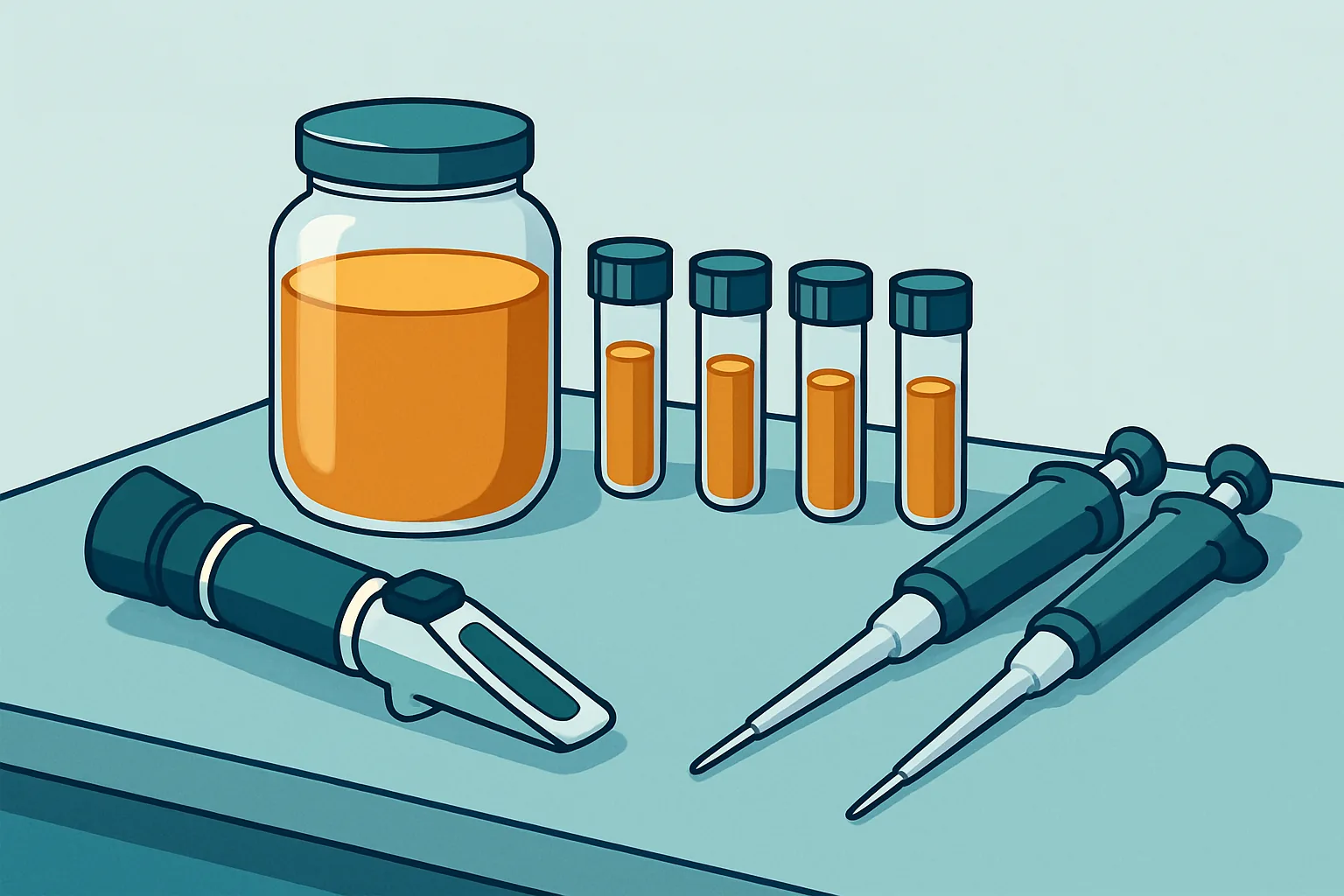
Honey is an unusually easy product to dilute. It is a concentrated sugar solution, and the cheapest commodities on the planet are also concentrated sugar solutions. Blend the two, adjust the water content, and the result looks, pours and largely tastes like honey. The price difference between genuine honey and the syrups used to extend it is large, and the volumes traded internationally are enormous.
That combination has produced a decades-long technical contest. Each time analysts develop a method that reliably separates honey from syrup, producers of adulterated product adjust their syrup formulation to defeat it. The methods have accordingly become more sophisticated, moving from simple composition checks to isotope measurements to whole-spectrum pattern matching, and the current state of play involves comparing an unknown sample against large databases of authentic material rather than measuring any single property.
Understanding that contest is more useful than memorising which test is best, because the honest answer is that no single test settles the question and the ones that come closest depend on reference data whose completeness is contested.
Key takeaways
- Adulteration ranges from crude syrup blending to feeding syrup to bees and harvesting the result.
- Carbon isotope ratio testing exploits a difference between the photosynthetic chemistry of cane or maize and that of most nectar plants.
- Syrup producers responded by engineering products from plants with the same isotope signature as nectar.
- NMR profiling compares a whole spectrum against authentic reference samples rather than measuring one marker.
- Every advanced method depends on reference databases, and who controls those databases is a live commercial and political question.
Ways Honey Gets Diluted or Faked
Adulteration covers a spectrum from obvious dilution to practices that are difficult to define as fraud at all.
The crudest form is direct blending: honey mixed with a sugar syrup after harvest. Historically this used cane sugar syrup or maize-derived syrups, which are cheap, abundant and close enough in sugar composition to be unremarkable in a basic analysis. This is what the first generation of tests was designed to catch, and it is now the easiest form to detect.
More sophisticated blending uses syrups engineered specifically to resemble honey. These are made by treating starch from various plant sources with enzymes to produce a sugar profile approximating that of honey, including the fructose-to-glucose ratio and some of the more complex sugars that simple syrups lack. They are sold openly in some markets, and they exist for one purpose.
A distinct route is indirect adulteration, in which syrup is fed to colonies during a nectar flow and the bees process it. The bees add their own enzymes, so the resulting product carries genuine bee-derived markers while much of the sugar never came from a flower. This is the hardest form to detect, because the material really has passed through a bee.
Beyond sugar, other manipulations exist. Immature honey harvested before the bees have reduced its water content, then dried artificially, differs from properly ripened honey. Resin treatment removes colour, off-flavours or residues, stripping other components at the same time. And origin fraud, where honey is routed through intermediate countries to disguise its source, is a separate offence that authenticity testing is increasingly asked to address.
Carbon Isotope Ratio Testing Explained
The first genuinely powerful authenticity test came from an accident of plant biochemistry.
Plants fix carbon dioxide by one of several photosynthetic pathways. The most common, used by most flowering plants and therefore by most nectar sources, discriminates more strongly against the heavier stable isotope of carbon, so their tissues and sugars are relatively depleted in it. A second pathway, used by sugar cane and maize among others, discriminates less, leaving their sugars measurably enriched in the heavier isotope. The difference is small in absolute terms but highly consistent and readily measured by isotope ratio mass spectrometry.
Because cane and maize sit in the second group and most nectar plants sit in the first, adding cane or maize syrup to honey shifts the overall carbon isotope ratio in a predictable direction. The greater the addition, the greater the shift.
The refinement that made the method robust was the use of an internal reference. Honey contains a small protein fraction that can be separated from the sugars, and that protein derives from the bees and the nectar rather than from any added syrup. Measuring the isotope ratio of the protein and of the sugars separately, and comparing them, provides a self-contained check: in authentic honey the two agree closely, while added syrup moves the sugar value away from the protein value without affecting the protein. This comparison removes the need to know what the plants in a particular region should look like, which is what turned isotope analysis from an interesting observation into a regulatory tool.
The method has clear limits. It detects addition above a threshold rather than trace amounts, it says nothing about syrups made from plants using the first pathway, and it can be confused by unusual botanical sources.
How Adulterators Adapted to That Test
The response was straightforward once the principle was understood: make syrup from plants with the same isotope signature as nectar.
Rice, wheat, sugar beet, cassava and various other starch sources all use the more common photosynthetic pathway. Syrups produced from them carry a carbon isotope ratio indistinguishable from that of most honey, so isotope analysis returns a clean result on a sample that may be substantially syrup. This is not a theoretical possibility. Syrups explicitly marketed for blending with honey are produced at industrial scale from exactly these sources.
Adaptation went further than isotope matching. Enzymatic processing can be tuned to approximate honey’s sugar profile, including the ratio of fructose to glucose and the presence of some oligosaccharides. Additives can be used to adjust the activity of enzymes that laboratories measure as freshness indicators. Where a particular marker compound became a screening target, syrups appeared with that compound at plausible levels or with the compound removed.
Something similar happened with the internal protein comparison. Because that method depends on there being protein of authentic origin to compare against, heavily filtered honey with very little protein left is harder to assess by this route in the first place.
The general lesson matters for anyone reading authenticity claims. Any test that reduces to a single measured marker can be defeated by controlling that marker, and the economics strongly favour doing so. Testing that resists adaptation has to look at many properties at once, so that matching all of them becomes harder than simply selling real honey.
NMR Profiling and Pattern Matching
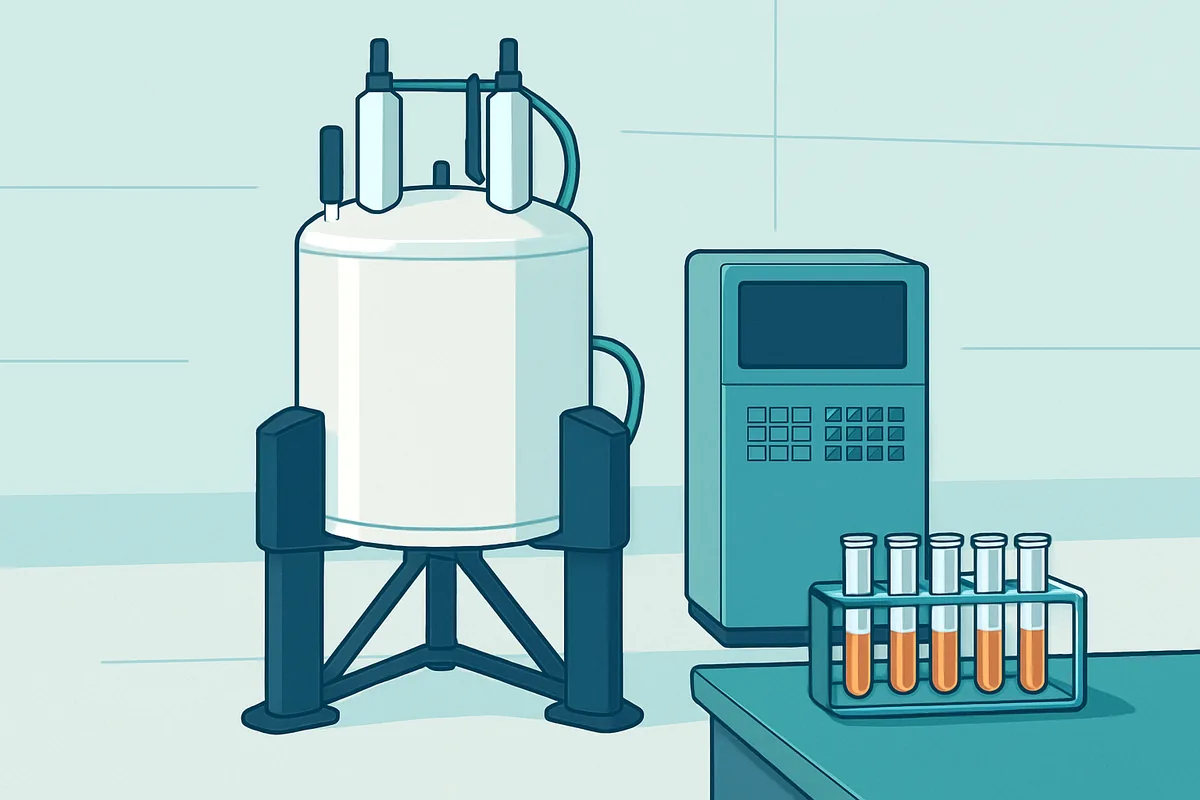
Nuclear magnetic resonance spectroscopy took a different approach: rather than measuring a chosen marker, record a spectrum that reflects hundreds of compounds at once and ask whether the whole pattern resembles authentic honey.
The technique works by placing the sample in a strong magnetic field and observing how the nuclei of particular atoms respond to radiofrequency energy. Each nucleus resonates at a frequency determined by its immediate chemical environment, so a spectrum contains a peak or group of peaks for every distinguishable chemical position in every sufficiently abundant compound. For honey, this produces a dense fingerprint reflecting sugars, organic acids, amino acids and numerous minor components together.
Interpretation is statistical rather than direct. The spectrum of the unknown is compared against a database of spectra from honeys of verified origin, and the analysis asks whether it falls within the range of natural variation for authentic material of that declared type. Deviations can flag added syrup, unusual processing, or a botanical or geographic origin inconsistent with the label.
The strength is breadth. Defeating a profiling method requires matching many features simultaneously, which is far more demanding than matching one, and syrup that has been tuned to pass an isotope test still leaves an unusual overall pattern. NMR is also non-destructive, needs relatively simple sample preparation, and is quantitative for major components.
The weaknesses follow from the same logic. The instrument is expensive and requires specialist support. More fundamentally, the answer is a judgement about whether a sample resembles reference material, so it is only as good as the reference set. A genuine honey of an unusual botanical origin, from a region poorly represented in the database, can be flagged as suspicious simply because nothing like it has been recorded.
| Method | What it detects | Main strength | Main limitation |
|---|---|---|---|
| Basic composition and moisture | Crude dilution, immature product | Cheap, widely available | Defeated by any competent formulation |
| Carbon isotope ratio | Cane and maize syrup addition | Objective, well established, regulator-accepted | Blind to rice, beet and wheat syrups |
| Isotope comparison with protein fraction | Same, with internal reference | No regional baseline needed | Requires sufficient protein present |
| NMR profiling | Broad compositional anomalies, origin mismatch | Hard to defeat on all features at once | Depends entirely on reference database coverage |
| Liquid chromatography for marker sugars | Specific syrup-derived oligosaccharides | Targeted and sensitive | Markers can be removed or avoided |
| Pollen analysis | Botanical and geographic origin | Direct physical evidence of source | Destroyed by filtration, expert-dependent |
Pollen Analysis and Geographic Origin
Pollen analysis, or melissopalynology, is the oldest authenticity method still in serious use, and it answers a different question from the sugar-based tests.
Bees collect nectar from flowers and inevitably carry pollen grains into the hive. Those grains persist in the honey, and pollen from different plant species is morphologically distinct, identifiable under a microscope by an experienced analyst. The assemblage of pollen types in a sample therefore records which plants contributed and, because plant distributions are geographic, roughly where the honey was produced.
This is the basis of monofloral labelling. A honey sold as originating predominantly from a single plant should contain a correspondingly dominant proportion of that plant’s pollen, with thresholds varying by species because different plants shed pollen at very different rates.
Pollen analysis also detects dilution indirectly, since added syrup contains no pollen and dilutes what is present. Its limitations, though, are severe in modern trade. Filtration removes pollen, and ultrafiltration removes it almost completely, which means a heavily filtered honey cannot be assessed this way at all. Filtration is sometimes done for legitimate reasons of clarity and shelf life, which makes an absence of pollen ambiguous rather than damning, and this ambiguity has been the subject of considerable regulatory argument. Pollen can also be added deliberately.
The analysis is labour-intensive and depends on the skill of individual analysts, and the number of people trained to do it well is small and not growing. Where it remains most valuable is in combination: pollen evidence contradicting a declared origin is a strong signal, and pollen consistent with the declaration adds real weight that a chemical test cannot.
Reference Databases and Their Politics
Profiling methods answer the question by comparison, which makes the reference collection the most important asset in the whole system and the most contested.
Building one requires authentic samples of known botanical and geographic origin, collected under controlled conditions, in numbers sufficient to characterise natural variation. Honey varies enormously with plant source, region, season, weather and beekeeping practice, so a database that adequately covers one production region may be thin for another. Assembling that coverage is expensive and slow, and the resulting database is valuable.
Several consequences follow. Much of the best reference data sits with commercial laboratories and industry bodies rather than in the public domain, which makes independent verification of a result difficult. When a test declares a sample non-conforming, the producer may have no way to examine the comparison set that produced the verdict. Disputes over that opacity are frequent and legitimate.
Coverage gaps also fall unevenly. Producers in well-studied regions benefit from dense reference data, while producers in regions with little representation face a higher chance of being flagged for looking unfamiliar. Since those regions are often the ones with less capacity to contest a finding, the effect can penalise small and distant producers rather than fraudulent ones.
There is a further scientific problem. Databases are built from samples believed to be authentic, and if adulterated material enters the reference set it widens the accepted range and makes future detection harder. Verification of reference samples therefore has to be exceptionally rigorous, typically requiring collection directly from the hive with documented provenance.
None of this makes profiling unreliable. It means results should be read as probabilistic statements relative to a particular reference set, and that regulatory action generally rests on a combination of methods together with documentary and supply chain evidence rather than on a single spectrum.
What a Supermarket Label Can Tell You
For a shopper, the honest position is that a label carries limited information and a few useful signals.
Origin statements are the most informative element where they are specific. A label naming a single country of production, and better still a region or producer, indicates a supply chain someone is willing to be identified with. Blends declared only as originating from multiple countries, whether inside or outside a trading bloc, describe a bulk commodity chain in which the material has passed through several hands, and that is precisely the structure in which substitution is easiest.
Price is a real signal because production economics are not mysterious. Honey production requires colonies, labour and a nectar flow, and there is a floor below which genuine honey cannot be produced and shipped profitably. Product priced at or below that floor is telling you something.
Physical characteristics are weaker evidence than commonly believed. Crystallisation indicates a high glucose proportion relative to fructose and is entirely normal in many genuine honeys, so a jar that has set is not a warning sign; if anything, heavily processed product is more likely to remain liquid. Clarity indicates filtration rather than quality. Taste and viscosity vary so widely between floral sources that neither reliably distinguishes authentic from adulterated.
None of the home tests circulated online work. Dissolving honey in water, applying a flame, or observing how a drop behaves on paper tests physical properties that vary across genuine honeys and that engineered syrups reproduce easily. Authenticity determination requires instruments.
What actually helps is shortening the chain. Buying from a named producer or a local beekeeper does not guarantee anything, but it replaces an anonymous commodity flow with a person whose reputation is attached to the jar, and that is a considerably stronger form of assurance than any claim printed on a label.
Frequently asked questions
Does crystallised honey mean it is pure?
No, although the belief is widespread. Crystallisation reflects the balance between glucose and fructose and the presence of small particles that act as nucleation sites, and it varies enormously between floral sources. Some genuine honeys set within weeks, others stay liquid for years. Heavily filtered and heat-treated product is actually less likely to crystallise, because the filtration removes the particles that seed crystal formation. Crystallisation tells you something about the sugar profile and processing history, and essentially nothing about whether syrup was added.
Can any home test detect adulteration?
No. The tests circulated online, involving water, flame, paper or thumbnails, examine bulk physical properties such as viscosity, solubility and water content, all of which vary widely among authentic honeys and are straightforward for a manufactured syrup to reproduce. Some of these tests will label perfectly genuine honey as fake and pass an engineered blend. Real detection requires measuring isotope ratios, resolving complex chemical fingerprints or identifying specific marker compounds, none of which can be approximated in a kitchen.
Why is rice or beet syrup harder to detect than corn syrup?
Because the original detection method relied on a difference in photosynthetic chemistry. Sugar cane and maize use a pathway that discriminates less against the heavier stable carbon isotope, leaving their sugars measurably enriched compared with the sugars of most nectar plants. Rice, wheat and sugar beet use the same pathway as most nectar sources, so syrups made from them carry a carbon isotope ratio indistinguishable from honey. Detecting those requires methods that look at other features, such as specific marker oligosaccharides or whole-spectrum profiling.
Is honey from a local beekeeper automatically authentic?
Not automatically, but the risk profile is different in a way that matters. Adulteration is overwhelmingly a feature of long, anonymous bulk supply chains where material is blended by intermediaries and the eventual seller cannot identify the producer. Buying directly means the person selling it is identifiable and their reputation is attached to the product, which changes the incentives substantially. The residual concerns with direct purchase are more often about labelling accuracy, such as an optimistic monofloral claim, than about syrup addition.
What does it mean if a label says the honey is a blend from several countries?
It means the product is a bulk commodity assembled from multiple sources, which is legal and common. The relevance to authenticity is structural rather than accusatory: blending across sources is exactly the point at which material of uncertain provenance can enter a chain, and it makes tracing any individual batch back to a hive effectively impossible. A specific single origin, ideally with a named region or producer, indicates a chain somebody is prepared to stand behind, which is a meaningfully different proposition even though it is not a guarantee.
The picture that emerges is of a moving target rather than a solved problem. Isotope analysis remains a solid tool against one family of syrups and blind to another. Profiling methods are considerably harder to defeat but hand the decisive role to reference databases whose coverage and governance deserve more scrutiny than they receive. For anyone buying honey rather than testing it, the useful conclusions are narrower and more durable: shorter supply chains carry less risk than long anonymous ones, prices below the cost of production are informative, and the physical appearance of the jar tells you almost nothing at all.
This is education, not medical advice. Laboratory results only carry meaning alongside your symptoms, history and examination. Talk to a qualified clinician about your own results before changing anything about your care or supplements.