


The standard description of HbA1c is that it reflects average blood glucose over the previous three months. That is close enough to be useful and wrong in ways that matter. The weighting is not even across those months, the test is not measuring glucose at all, and anything that changes the lifespan of red blood cells changes the result independently of glucose.
Understanding what the assay physically measures makes each of these clear, and explains why a value that conflicts with a person’s glucose readings is often the assay being wrong rather than the readings.
Key takeaways
- HbA1c measures the fraction of haemoglobin that has glucose permanently attached.
- Recent weeks contribute far more to the value than older ones.
- Anything shortening red cell lifespan lowers HbA1c independently of glucose.
- Haemoglobin variants interfere with some measurement methods and not others.
- Estimated average glucose carries wide individual variation around the printed figure.
How Glucose Permanently Attaches to Haemoglobin
Glucose in the bloodstream reacts slowly and non-enzymatically with proteins it contacts. Haemoglobin, being abundant and contained within cells that circulate for months, accumulates this modification in proportion to how much glucose surrounds it.
The reaction proceeds in two stages. An initial, reversible binding forms quickly and can reverse if glucose falls. That intermediate then rearranges into a stable form that does not reverse. Once a haemoglobin molecule has been modified in this stable way, it stays modified for the remaining life of the cell.
This irreversibility is what makes the test work. The red cell becomes a passive recorder, accumulating a permanent record of its glucose exposure. HbA1c reports the percentage of total haemoglobin carrying this stable modification.
The same chemistry happens to other proteins in the body, which is relevant in two ways. It is the basis of alternative markers such as fructosamine, which reflects glycation of serum proteins over a much shorter window of two to three weeks and is used when red cell problems make HbA1c unusable. It is also thought to contribute directly to long-term tissue damage, since glycation of structural proteins alters their properties in ways that do not reverse.
Note that the process is not enzymatic. Nothing regulates it, nothing accelerates or inhibits it deliberately, and it proceeds purely according to how much glucose is present and for how long. That mechanical simplicity is why the marker is so robust when its assumptions hold.
Why Recent Weeks Weigh More Than Older Ones
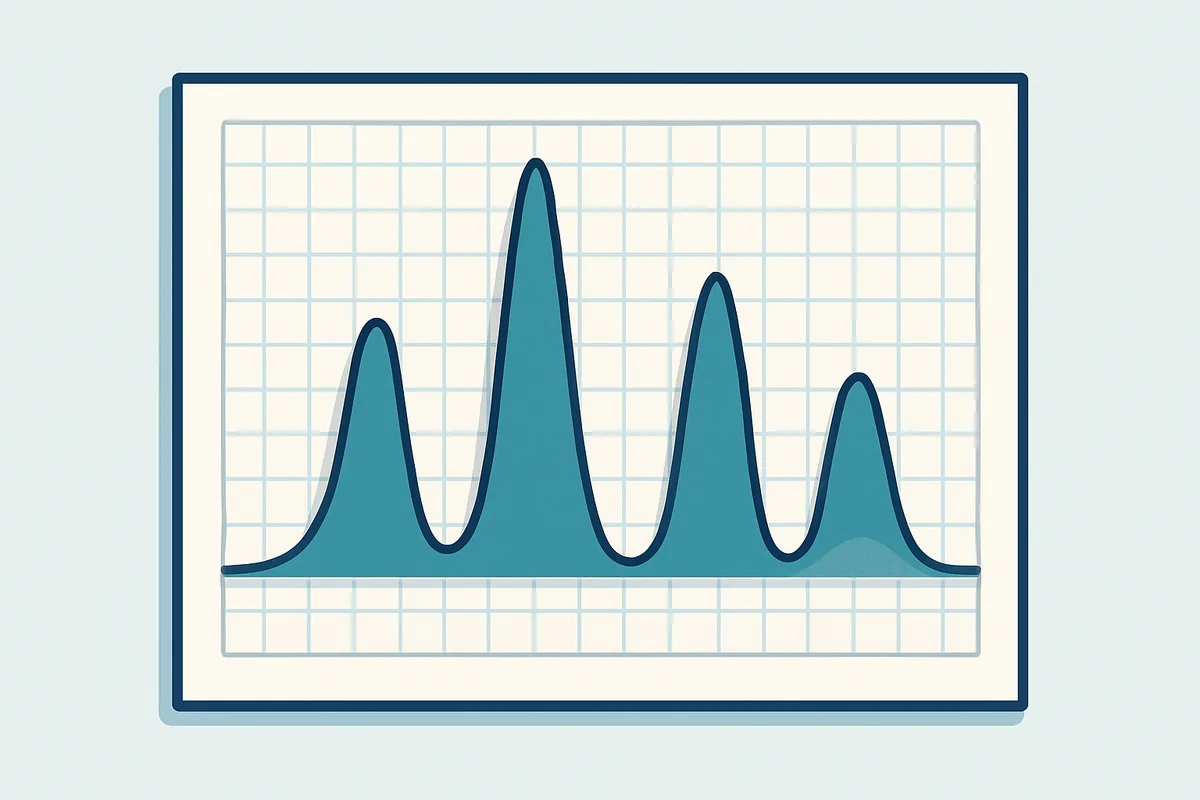
Red cells live roughly 120 days, but they are not all the same age. At any moment the circulating population spans every age from newly released to nearly expired, in approximately even distribution.
A cell released last week has had one week to accumulate modification. A cell released four months ago has had the full period. When you measure the whole population, older cells carry more modification individually, but they are also progressively being removed.
Working through the arithmetic, the previous month contributes roughly half the value, the month before that around a quarter, and everything older the remainder. The practical implication is that HbA1c responds to change faster than the three-month framing suggests. A substantial improvement shows up meaningfully within four to six weeks, though it takes around three months to fully stabilise.
This weighting cuts both ways. A person whose glucose was well controlled for two months and poorly controlled for the four weeks before testing will produce a result closer to the recent period than the longer good stretch. The reverse is also true, which is why a result taken shortly after a determined effort can look better than the preceding months warrant.
The 120-day figure is itself an average with individual variation. Normal red cell lifespan ranges meaningfully between people, and that variation alone produces differences in HbA1c at identical glucose levels. It is one component of what clinicians call the glycation gap.
The Measurement Methods Labs Actually Use
Several distinct methods are in routine use, and they detect the modification by different physical principles.
Ion-exchange high performance liquid chromatography separates haemoglobin species by charge. Glycation slightly alters the molecule’s charge, so modified and unmodified forms elute at different times, and the area under each peak gives the proportion. This method produces a visible chromatogram, which is diagnostically valuable because abnormal peaks reveal haemoglobin variants directly.
Immunoassay methods use antibodies raised against the glycated portion of the molecule. These are simpler to automate and common on general chemistry analysers, but they produce no chromatogram, so interference passes unseen.
Enzymatic and boronate affinity methods rely on other chemical properties of the modification. Boronate affinity binds the sugar directly and is notably tolerant of variants, since it does not depend on the surrounding protein sequence.
| Method | Principle | Shows variants | Typical setting |
|---|---|---|---|
| Ion-exchange HPLC | Charge separation | Yes, as extra peaks | Reference and diabetes centres |
| Immunoassay | Antibody binding | No | General chemistry analysers |
| Enzymatic | Enzyme cleavage and detection | No | High-throughput laboratories |
| Boronate affinity | Binds the sugar directly | Partially | Variant-tolerant testing |
International standardisation programmes have aligned these methods to a common reference, so results are broadly comparable between laboratories. That alignment applies to normal samples; it does not guarantee agreement when interference is present.
Conditions That Make HbA1c Read Falsely Low
Anything that shortens red cell survival reduces the time available for glycation, lowering HbA1c without glucose having changed.
Haemolytic anaemias are the clearest example. Cells are destroyed early, the circulating population skews young, and measured glycation falls. Recent significant blood loss has a similar effect, since the marrow responds by releasing large numbers of new cells. Recent transfusion introduces donor cells carrying the donor’s glycation history rather than the patient’s.
Advanced kidney disease shortens red cell survival and, when treated with agents that stimulate red cell production, floods the circulation with young cells. Both effects push HbA1c down. Pregnancy increases red cell turnover, particularly in later trimesters, which is one reason diabetes in pregnancy is not diagnosed by HbA1c.
The opposite also occurs. Iron deficiency lengthens effective red cell survival and can raise HbA1c modestly without any change in glucose, an effect that reverses when iron is replaced. Splenectomy removes a major site of red cell removal and similarly raises the value.
The pattern to hold onto is simple. Younger circulating cells mean a lower value; older circulating cells mean a higher one. Any condition, treatment or event that changes the age distribution of red cells changes HbA1c through that route alone, entirely independently of glucose.
This is also why HbA1c should be interpreted alongside a full blood count where there is any reason to suspect a red cell problem. An unexpectedly low HbA1c in someone with a low haemoglobin and a raised reticulocyte count is telling a story about red cells, not about glucose control.
When Haemoglobin Variants Break the Assay
Haemoglobin variants are common globally, and several are frequent enough in particular populations to be encountered regularly.
The interference depends on the method. Charge-separation methods can misassign a variant peak, since the variant may elute close to the glycated fraction. Immunoassays can under-detect if the variant alters the region the antibody recognises. Boronate affinity is comparatively robust because it binds the attached sugar rather than the protein around it.
There is an additional subtlety in what the methods are actually quantifying. The internationally standardised definition specifies glucose attached at one particular site on the beta chain of haemoglobin. Methods that detect glycation less specifically can include modification at other sites, which is one source of between-method differences that standardisation programmes work to reconcile.
A more fundamental problem arises when a variant alters red cell lifespan. In that situation no measurement method gives a valid result, because the underlying assumption about cell survival no longer holds. This applies to conditions where cells are destroyed early, and in those cases glucose monitoring must be used instead.
Laboratories using chromatographic methods often detect variants incidentally and flag the report. Laboratories using immunoassays generally cannot, which is one argument for method awareness when a result seems implausible.
Population matters here in a practical sense. Variant prevalence differs substantially by ancestry, and a laboratory serving a population where variants are common will encounter interference regularly rather than exceptionally. Some laboratories select their method partly on this basis.
Estimated Average Glucose and Its Error Bars
Many reports convert HbA1c into an estimated average glucose figure, derived from a regression fitted to data pairing HbA1c against continuous glucose monitoring.
The regression describes the average relationship across a population. Individuals scatter around it, and the scatter is not small. Two people with identical HbA1c can have genuinely different average glucose, because they differ in how readily their haemoglobin glycates and how long their red cells survive. These differences appear consistent within individuals, which has led to the concept of a personal glycation gap.
The practical consequence is that estimated average glucose should be read as an approximation with meaningful width rather than a precise conversion. Where a person’s own glucose data consistently disagrees with the estimate, the disagreement is informative rather than an error to be resolved in favour of the laboratory number.
Reporting units add a further layer of possible confusion. HbA1c is expressed either as a percentage under the older derivation or as millimoles per mole under the international standard, and many reports print both. The two describe the same measurement on different scales, and confusing them produces alarming misreadings in either direction.
Where Continuous Monitoring Fills the Gaps
HbA1c gives one number for months of exposure. That compression is its strength and its limitation.
Two people with the same value can have completely different glucose patterns: one holding steady near the average, the other swinging between high and low values that average to the same figure. Those are different physiological situations, and HbA1c cannot distinguish them.
Continuous monitoring reports how much time is spent within a target range, how much above and below, and how variable the pattern is. Time in range has become a complementary target precisely because it captures what an average discards. Hypoglycaemia is entirely invisible to HbA1c, and can even lower it, so a value that looks excellent may be produced partly by episodes nobody wants.
The two are complements. HbA1c remains the standardised, comparable long-term measure that outcome evidence rests on. Continuous monitoring supplies the pattern behind the number.
Frequently asked questions
How quickly will HbA1c change after I change something?
Meaningful movement appears within four to six weeks, with full stabilisation around three months. Retesting sooner than about three months generally produces a partial picture, which is why testing intervals are set the way they are.
Can HbA1c be used to diagnose diabetes in everyone?
No. It is not used in pregnancy, in people with conditions affecting red cell survival, after recent transfusion or significant blood loss, or where an interfering variant is known. Glucose-based testing is used instead in those situations.
Why does my meter suggest a different average than my HbA1c?
Meter readings are taken at chosen moments, typically clustered around meals and rarely overnight, so their average is not a true average of all glucose exposure. Individual variation in glycation also contributes. Persistent, large disagreement is worth investigating rather than dismissing.
Does a single high HbA1c confirm diabetes?
Generally not on its own. Confirmation on a second sample is standard unless glucose values are unequivocally elevated or symptoms are clear, because a single result can be affected by interference and by laboratory variation.
Do supplements or vitamins affect the result?
Some can affect certain methods. High-dose vitamin C and vitamin E have been reported to interfere with particular assays, though effects are method-dependent and generally modest. Mentioning supplement use when a result seems inconsistent is worthwhile.
The useful mental model is a recorder with a fading memory and a few known faults. It records glucose exposure faithfully as long as red cells live a normal length of time, weights the recent past most heavily, and can be thrown off by anything that changes cell survival or interferes with the measurement chemistry. When the number and the person’s other information disagree, that list is where to look first.
This is education, not medical advice. Laboratory results only carry meaning alongside your symptoms, history and examination. Talk to a qualified clinician about your own results before changing anything about your care or supplements.