
The scissors metaphor has done a great deal of work in explaining CRISPR to the public, and it is not wrong, but it stops at exactly the point where the interesting part begins. Cutting DNA is comparatively easy. Molecular biologists have been cutting DNA at defined sequences since the 1970s using restriction enzymes. What CRISPR changed was that the cut could be aimed anywhere, cheaply, by changing a short piece of RNA rather than engineering a new protein.
And what happens after the cut is not controlled by CRISPR at all. It is controlled by the cell’s own repair machinery, which is why the same editing tool can produce a disabled gene, a corrected gene, or nothing at all depending on which repair pathway the cell chooses.
Key takeaways
- CRISPR evolved as a bacterial immune system that stores fragments of past viral invaders.
- The guide RNA supplies the targeting; the Cas protein supplies the cutting.
- The cell’s repair pathway, not the cut, decides whether an edit disables or corrects a gene.
- Disabling a gene is far easier and more reliable than precisely rewriting one.
- Newer editors modify bases directly without cutting both DNA strands.
The Bacterial Immune System CRISPR Came From
CRISPR was not invented. It was found, sitting in bacterial genomes, doing a job that had nothing to do with human ambitions.
Researchers sequencing bacteria noticed odd stretches of repeated sequence separated by unique spacers, an arrangement that looked deliberate but had no obvious function. The acronym describes the pattern rather than the purpose: clustered regularly interspaced short palindromic repeats.
The spacers turned out to be fragments of viral DNA. Bacteria are attacked constantly by bacteriophages, and a bacterium that survives an infection can capture a short piece of the invader’s genome and file it between the repeats. That archive is heritable, so descendants inherit a record of what attacked their ancestors.
When a matching virus appears again, the bacterium transcribes the relevant spacer into RNA, and that RNA guides a nuclease protein to any DNA carrying the same sequence. The nuclease cuts, the viral genome is destroyed, and the infection fails. It is an adaptive immune system with a molecular memory, running in an organism with no cells to spare for anything elaborate.
The insight that made this into a tool was recognising that the targeting was fully programmable. The protein does not recognise the target itself; it recognises the RNA that is bound to it. Supply a different RNA and the same protein cuts a different sequence.
How a Guide RNA Finds Its Target
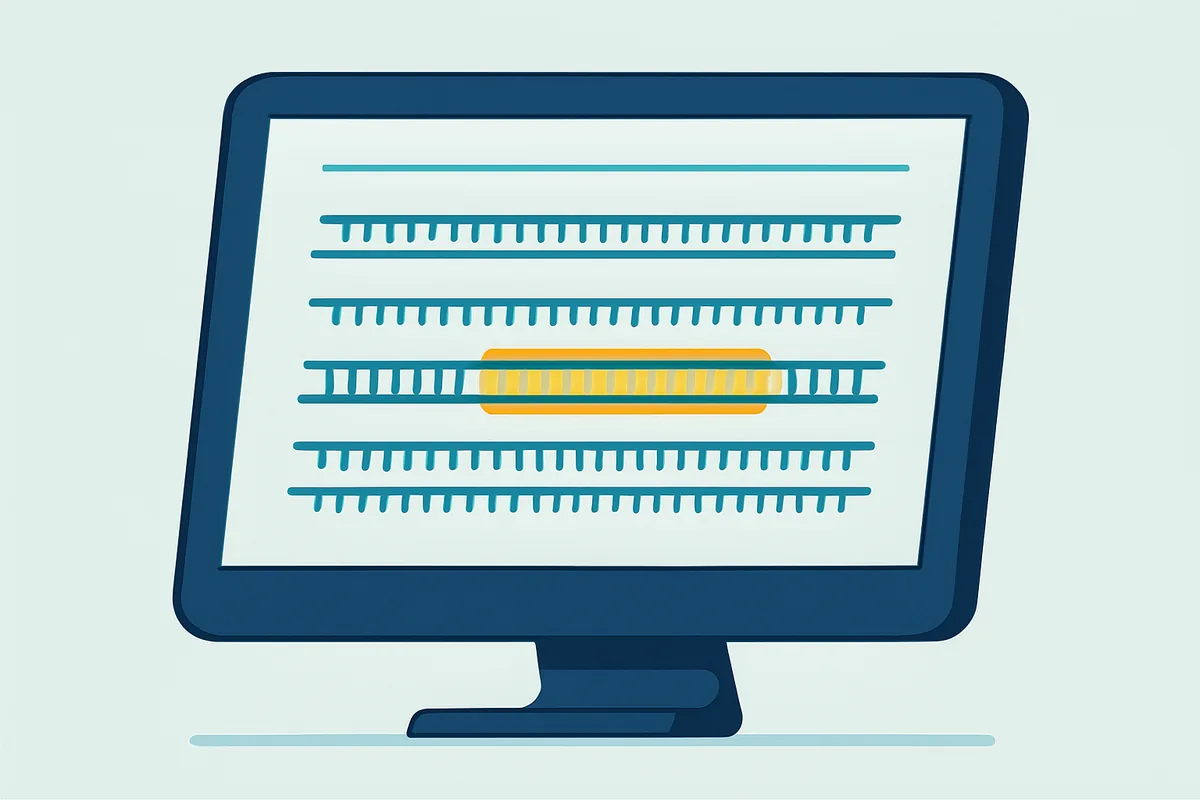
The guide RNA carries roughly twenty bases that determine where the complex will cut. Those bases pair with the complementary sequence on one DNA strand, in the same way the two strands of a DNA molecule pair with each other.
Finding a twenty-base match in a genome of three billion bases is a genuine search problem, and the complex does not solve it by reading sequentially. It binds DNA transiently at many points, testing each briefly, and moves on unless something holds it in place.
What holds it is a short motif immediately adjacent to the target, called a protospacer adjacent motif, or PAM. The Cas protein recognises this motif directly, without RNA involvement. Only after finding a PAM does the protein begin unwinding the adjacent DNA to test whether the guide RNA matches. No PAM means no cutting, regardless of how perfect the sequence match is.
This has an important practical consequence. Targets must sit next to an appropriate PAM sequence, which constrains where edits can be made. For the most widely used Cas9 protein the motif is short and common, appearing on average every few dozen bases, so the constraint is usually manageable. But when a specific position must be edited precisely, PAM availability can become the limiting factor, which is part of why variants of Cas proteins recognising different motifs have been actively developed.
The matching itself is not all-or-nothing. Bases nearest the cut site, sometimes called the seed region, matter far more than distant ones. A mismatch close to the PAM usually prevents cutting; a mismatch at the far end often does not. This asymmetry is the direct cause of off-target activity.
What Cas9 Physically Does to DNA
Once bound with a matching guide, the protein cuts both strands of the DNA at a defined position, usually three bases from the PAM.
The protein contains two separate nuclease domains, each responsible for one strand. That architecture is more useful than it first appears, because either domain can be disabled independently. Inactivating one produces a nickase, which cuts only a single strand. Inactivating both produces a catalytically dead protein that still binds its target with full specificity but does nothing to it.
That dead variant became a platform in its own right. Fusing it to other functional domains lets researchers deliver those functions to any chosen sequence. Attach a transcriptional repressor and you silence a gene without altering it. Attach an activator and you increase its expression. Attach a fluorescent protein and you can watch a specific genomic locus move inside a living nucleus. None of these involve editing at all; they use the targeting system as a delivery address.
For actual editing, though, the double-strand break is the event that matters, because a break in both strands is one of the most dangerous things that can happen to a chromosome. The cell treats it as an emergency.
Why the Repair Pathway Decides the Result
This is the part the scissors metaphor obscures. CRISPR makes a break. The cell repairs it. The outcome depends entirely on which repair mechanism runs.
The default pathway in most cells is non-homologous end joining. It simply pulls the broken ends back together and ligates them. It is fast and works in any phase of the cell cycle, which is why cells rely on it. It is also imprecise: the process frequently gains or loses a few bases at the junction.
Inside a protein-coding sequence, gaining or losing a number of bases not divisible by three shifts the reading frame. Everything downstream is translated as nonsense, and a premature stop codon usually appears shortly after. The gene is functionally destroyed. This is why gene knockouts are the easiest CRISPR experiment: you exploit the repair machinery’s sloppiness rather than fighting it.
The alternative pathway is homology-directed repair, which uses a template. Normally the template is the matching chromosome or a sister chromatid. If a researcher supplies a synthetic template carrying a desired change flanked by sequence matching either side of the break, the cell can copy that change into the genome.
That is precise editing, and it is much harder to achieve. The pathway operates mainly in dividing cells during specific cell cycle phases, competes against the always-available joining pathway, and typically succeeds in a minority of cells. In non-dividing cells such as neurons or mature muscle, it is largely unavailable.
| Approach | Mechanism | Typical use | Main limitation |
|---|---|---|---|
| Non-homologous end joining | Cell rejoins broken ends imprecisely | Disabling a gene | Cannot control the exact change |
| Homology-directed repair | Cell copies a supplied template | Correcting or inserting sequence | Inefficient, needs dividing cells |
| Base editing | Chemically converts one base to another | Single-letter changes | Limited to certain conversions |
| Prime editing | Writes new sequence from an RNA template | Small insertions and corrections | Larger construct, lower efficiency |
Knockouts Versus Precise Edits
The gap between these two ambitions explains most of the distance between headline claims and laboratory reality.
Disabling a gene is routine. Design a guide targeting an early exon, deliver it, and a substantial fraction of treated cells will carry disruptive insertions or deletions. Selecting individual clones and sequencing them identifies those with the desired disruption. This has transformed functional genomics, because asking what a gene does by removing it is now a matter of days rather than years.
Correcting a specific mutation is a different proposition. The template must be delivered alongside the editing components, the cell must be in a receptive state, and the correct pathway must win the competition. Efficiencies vary enormously between cell types and target sites, and in many therapeutic contexts the achievable fraction of corrected cells is the central obstacle.
There is also the question of what happens in the cells that were cut but not corrected. Those cells have been repaired imprecisely, meaning a therapy aiming to fix a gene may disable it in a proportion of cells instead. Whether that matters depends on the biology involved, but it is a consideration that does not arise in a knockout experiment.
Off-Target Effects and How They Are Measured
Because matching tolerates mismatches at positions distant from the cut site, guides can direct cutting at sequences resembling but not identical to the intended target.
Predicting these computationally is possible but incomplete. Algorithms scan the genome for similar sequences adjacent to appropriate PAMs and rank them by predicted likelihood. The rankings correlate imperfectly with what actually happens, because chromatin state, sequence context and delivery method all influence accessibility.
Empirical methods are therefore preferred where the stakes are high. Several approaches capture the locations of double-strand breaks across the genome directly, either by inserting a tag at break sites and sequencing outward, or by treating purified genomic DNA with the editing complex and sequencing the resulting cut positions. Each has characteristic blind spots, and using more than one is standard practice for therapeutic development.
Mitigation strategies are well established. Shortening the guide slightly reduces tolerance for mismatches. High-fidelity Cas variants have been engineered with weakened non-specific DNA contacts, so that near-matches release before cutting. Delivering the complex as protein rather than as DNA limits how long it persists, and a shorter exposure produces fewer off-target events. Using paired nickases, where two adjacent single-strand cuts are required to produce a break, means an off-target event at either site alone is repaired harmlessly.
Base and Prime Editing as Refinements
Both newer approaches share a premise: if the double-strand break is the source of unpredictability, avoid making one.
Base editors fuse a catalytically impaired Cas protein to an enzyme that chemically modifies a DNA base in place. One class converts a cytosine to a thymine; another converts an adenine to a guanine. The complex binds its target, exposes a short single-stranded window, and the attached enzyme acts on any suitable base within that window. Repair processes then propagate the change to the opposite strand.
Because no double-strand break occurs, insertions and deletions are rare and no repair template is needed. The constraint is scope: only certain conversions are available, and if more than one editable base falls in the window, all may be changed. Since a large fraction of known disease-associated variants are single base substitutions, that limited scope still covers substantial ground.
Prime editing goes further. It uses a nickase fused to a reverse transcriptase, guided by an extended RNA that both specifies the target and carries the new sequence to be written. The complex nicks one strand, and the reverse transcriptase copies the new sequence from the RNA directly into the genome at that point.
This handles all base conversions plus small insertions and deletions, without a double-strand break or a separate template. The trade-offs are a larger molecular construct, which complicates delivery into cells and tissues, and efficiencies that vary considerably by target. Both approaches are relatively young compared with the original system, and the boundaries of what they reliably achieve are still being mapped.
Frequently asked questions
Does CRISPR editing change every cell in the body?
No. Editing components must physically reach a cell to act on it, and delivery is the central practical difficulty. Therapeutic approaches either remove cells, edit them outside the body and return them, or deliver components to a specific tissue. Whole-body editing is not how any of this works.
Are edits made with CRISPR heritable?
Only if the edited cells are eggs, sperm or early embryos. Editing ordinary body cells changes those cells and their descendants within the individual, and nothing is passed to offspring. Editing that would be heritable is subject to strict prohibitions in most jurisdictions and is a separate ethical and legal question from ordinary somatic editing.
How precisely can a change be targeted?
The cut position is determined within a base or two. The resulting sequence change is much less predictable when relying on the imprecise repair pathway, which is why outcomes are verified by sequencing rather than assumed. Base and prime editing offer greater control over the exact change.
What happens to cells that are edited incorrectly?
In laboratory work, individual clones are screened by sequencing and unwanted ones discarded. In therapeutic contexts that is not possible, so the fraction of correctly edited cells and the nature of incorrect edits become central safety questions, assessed before any treatment proceeds.
Why is delivery described as the hard part?
Because the editing machinery is large and must cross a cell membrane and reach the nucleus without being destroyed or triggering an immune response. Viral vectors, lipid nanoparticles and physical methods all work in some contexts and fail in others. Targeting has largely been solved; getting the tool to the right place has not.
The useful way to hold all this is that CRISPR supplies aim, not outcome. The guide RNA decides where, the Cas protein decides that a break occurs, and the cell decides what the genome looks like afterwards. Every practical advance since the original demonstration, from nickases to base editors, has been an attempt to take more of that final decision away from the cell and give it to the experimenter.
This is education, not medical advice. Laboratory results only carry meaning alongside your symptoms, history and examination. Talk to a qualified clinician about your own results before changing anything about your care or supplements.