
Two cortisol results, one high and one low, can come from the same healthy person on the same day. That is not a laboratory failure or a sign of instability. It is the hormone doing exactly what it is supposed to do, which is to vary several-fold on a daily cycle. A cortisol value that arrives without the time it was collected and the method used to collect it is not a difficult result to interpret. It is not interpretable at all.
This is unusual among common blood tests. Sodium, creatinine and haemoglobin are reasonably stable across a day, so a single measurement compared against a printed range carries real information. Cortisol is not like that, and applying the same reading habit to it produces confident conclusions that are unrelated to what is happening in the person.
The consequences are practical. A morning sample low in the range is read as adrenal insufficiency when it was drawn late in the morning after the peak had passed. An evening sample within the daytime range is called normal when the point of measuring at that hour is that it should have fallen far below it. And a great deal of testing sold for fatigue and stress reports patterns against templates that clinical endocrinology does not recognise.
What follows is the biology that makes cortisol behave this way, how each sample type measures a different thing, and why the tests that answer serious questions are the ones that push the system rather than observe it.
Key takeaways
- Cortisol follows a strong daily rhythm, peaking around waking and reaching its lowest point around midnight.
- A result is meaningless without the collection time; the same value can be normal or abnormal depending on the hour.
- Serum measures total hormone, saliva approximates the free fraction, and urine integrates output over a day.
- Most circulating cortisol is bound to protein, so anything changing that protein changes the serum value without changing biology.
- Dynamic tests that suppress or stimulate the axis answer questions no single sample can.
The Daily Curve Cortisol Follows
Cortisol is produced by the adrenal cortex under the control of a three-tier system. The hypothalamus releases corticotropin releasing hormone, which prompts the pituitary to release adrenocorticotropic hormone, which drives the adrenal cortex to make cortisol. Cortisol then feeds back on both the pituitary and the hypothalamus to reduce their output, forming a closed loop that holds the system within bounds.
Two features shape the daily pattern. The first is that release is pulsatile rather than continuous. ACTH is secreted in bursts, and cortisol follows each burst by a few minutes, so the blood concentration rises and falls repeatedly through the day. Two samples drawn twenty minutes apart from a perfectly healthy person can differ substantially for this reason alone, which limits how much weight any single value can carry.
The second is the circadian envelope superimposed on those pulses. Pulse frequency and amplitude are governed by the central clock in the hypothalamus, entrained mainly by light. Output begins climbing in the second half of the night, peaks in the first hour or so after waking, declines across the day with a modest bump after meals, and reaches its lowest point around the middle of the night. The difference between peak and trough is large, not marginal.
The sharp rise immediately after waking has its own name, the cortisol awakening response, and it is a distinct phenomenon overlaid on the circadian rise. It is measured relative to waking rather than to the clock, which is why saliva protocols using it specify intervals from waking rather than times of day.
Crucially, the rhythm is anchored to the sleep-wake cycle, not to the clock on the wall. A night shift worker who sleeps during the day has a shifted curve, and interpreting their morning sample against a daytime reference range is simply an error.
Why Morning and Midnight Values Differ Wildly
Because the curve is steep, the timing of a sample determines what it can tell you, and different questions require different points on the curve.
Morning sampling, conventionally shortly after waking, tests the top of the curve. It is the right time to ask whether the system can produce enough cortisol, because a low value at peak output is difficult to explain away. A comfortably normal early morning value makes significant adrenal insufficiency unlikely, and a clearly low one demands investigation. The value shrinks quickly with delay: sampling at eleven in the morning tests a point already well down the descending limb, where a modest value means nothing.
Late-night sampling tests the bottom of the curve, and it exists to answer the opposite question. In healthy people, cortisol at around midnight falls very low. One of the earliest changes in conditions of cortisol excess is loss of that nocturnal trough, so a midnight value that fails to fall is informative even when every daytime value looks unremarkable. This is why late-night salivary cortisol became a first-line screening test for suspected excess: the abnormality is a failure of rhythm, and rhythm can only be seen by sampling where the curve should be lowest.
The practical implication is that “check my cortisol” is not a request a laboratory can fulfil sensibly without knowing the question. Suspected deficiency points to an early morning sample. Suspected excess points to late-night sampling, or to a suppression test, or to a urine collection. A single mid-afternoon sample, which is when many people happen to attend for blood tests, sits in the least informative part of the day.
Serum, Saliva and Urine Compared
The three routine sample types measure genuinely different quantities, and the differences are not subtle.
| Sample type | What it measures | Best used for | Main limitations |
|---|---|---|---|
| Serum or plasma | Total cortisol, bound plus free | Morning assessment, stimulation testing | Affected by binding proteins; venepuncture itself can raise it |
| Saliva | Approximates the free fraction | Late-night sampling, awakening response | Contamination by blood or topical steroid; technique dependent |
| 24-hour urine | Free cortisol excreted over a day | Assessing total daily output in suspected excess | Collection errors; affected by kidney function and fluid intake |
Serum is the reference method and the one used for dynamic testing, because the assays are well characterised and the timing can be controlled precisely. Its weakness is that it reports total hormone, most of which is bound and biologically inactive.
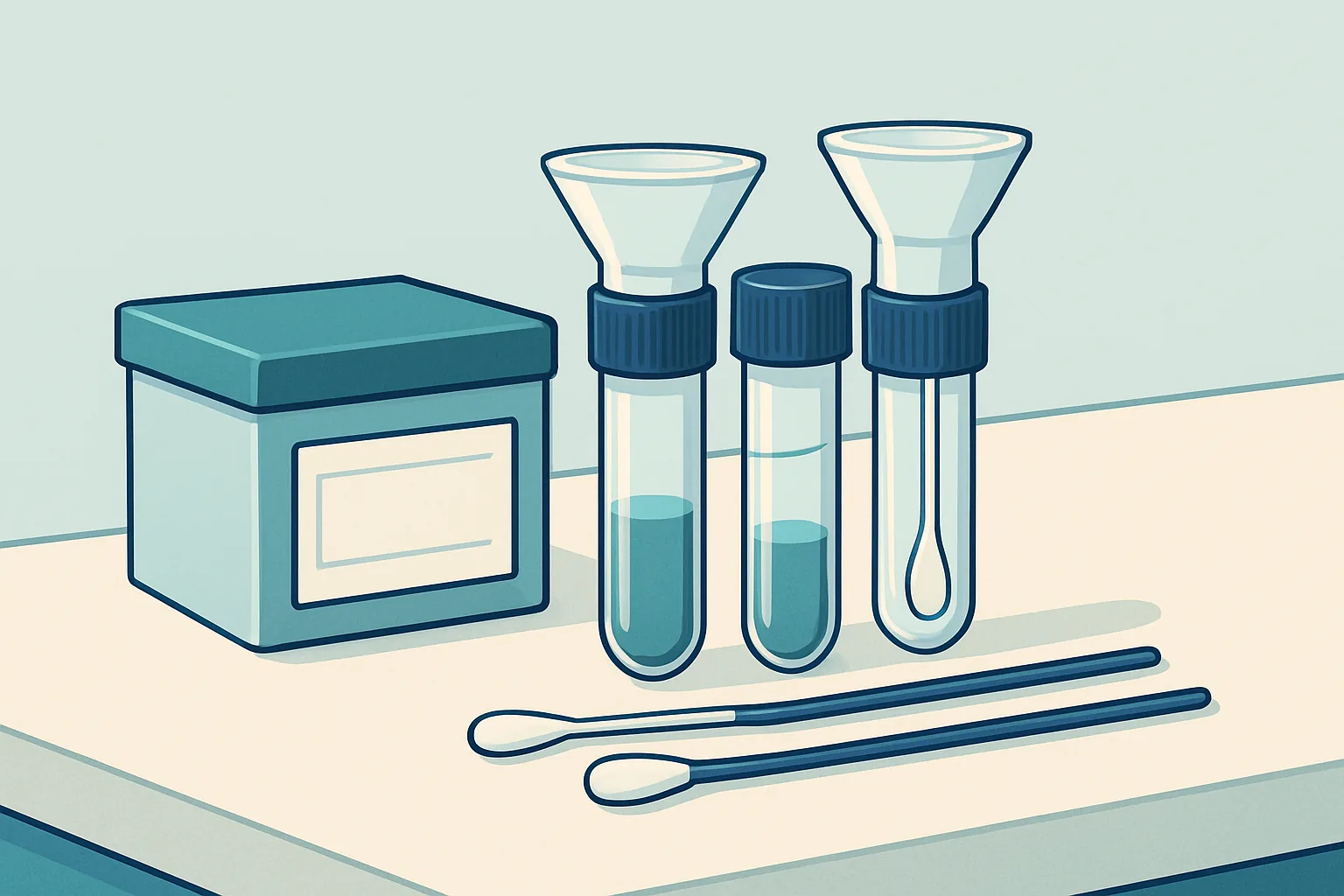
Saliva has a specific advantage that follows from a physical mechanism: only unbound cortisol diffuses across the salivary gland epithelium, so salivary concentration tracks free cortisol rather than total. It is collected without a needle, which matters because venepuncture is itself a stressor capable of raising the value being measured, and it can be collected at home at midnight, which is otherwise impractical. Its weaknesses are technical: blood from gums after brushing contaminates the sample with total cortisol, topical steroid creams on the hands transfer to the swab, and eating, drinking or smoking near collection interferes.
Twenty-four hour urine measures the free cortisol filtered and excreted across a whole day, integrating the pulses and the rhythm into a single figure of total output. That integration is its strength for detecting excess and its weakness for detecting deficiency, since a modest reduction is easily lost within the range. Its accuracy depends entirely on the collection being complete, which is why creatinine is usually measured alongside as a rough check.
Free Versus Protein-Bound Cortisol
The distinction between bound and free hormone explains a large share of confusing results, and it is worth being precise about.
The great majority of circulating cortisol is bound to corticosteroid binding globulin, with a further portion loosely bound to albumin. Only a small fraction circulates free, and only that free fraction can cross cell membranes and act on receptors. Serum cortisol assays measure the total, so the number reflects the size of the reservoir rather than the amount of active hormone.
This matters because the binding protein is not constant. Oestrogen raises it substantially, so combined oral contraceptives and oestrogen therapy increase total serum cortisol markedly while the free fraction remains normal. Pregnancy does the same, more strongly as it advances. In the other direction, conditions with low protein production or heavy protein loss, including severe liver disease, nephrotic syndrome and critical illness, lower binding globulin and depress total cortisol even though free cortisol may be normal or high.
The clinical trap is easy to picture. A woman taking a combined contraceptive can have a total cortisol that looks raised without anything being wrong, and a critically ill patient with low albumin can have a total cortisol that looks inadequate while free hormone is abundant. In both cases the measurement is accurate and the inference is wrong.
Free cortisol assays exist and are not routine in most laboratories. The usual practical routes around the problem are to measure salivary cortisol, which reflects the free fraction directly, to measure urinary free cortisol, or where possible to pause the interfering medication for a period before testing under medical advice.
Dynamic Tests That Beat Single Samples
Because the system is a feedback loop with a rhythm and pulses on top, the most informative tests do not observe it at rest. They push it and watch how it responds.
For suspected deficiency, the short synacthen test administers a synthetic ACTH analogue and measures cortisol before and at set intervals afterwards. A healthy adrenal cortex responds with a substantial rise; a diseased or long-unstimulated one does not. This converts a question about a fluctuating baseline into a question about reserve capacity, which is far more stable. Measuring ACTH at baseline then separates the levels of the problem: high ACTH with low cortisol indicates the adrenal glands are failing to respond, while low or inappropriately normal ACTH points upward to the pituitary or hypothalamus.
For suspected excess, the logic reverses and the tests probe feedback. A low dose of dexamethasone, a potent synthetic steroid, is given overnight, and cortisol is measured the following morning. In an intact system the synthetic steroid suppresses ACTH and the morning cortisol falls low. Failure to suppress indicates autonomous production that is not listening to feedback. Dexamethasone is used because it does not cross-react appreciably in the cortisol assay, so it suppresses the axis without appearing in the result.
Confirmation usually rests on more than one of late-night salivary cortisol, urinary free cortisol and dexamethasone suppression, because each has its own false positives. Localising the source afterwards is a specialist sequence, not something a single blood test resolves.
Medications That Interfere With the Assay
Interference comes in two distinct kinds, and separating them helps in reading a result.
The first kind is biological: the drug changes how much cortisol the body makes or how much is bound. Any glucocorticoid taken for any reason, including oral, injected, inhaled, nasal and topical preparations, suppresses the axis through the same feedback mechanism as dexamethasone. Patients frequently do not think of a skin cream or an inhaler as a steroid, and it is a common reason for an unexpectedly low result. Oestrogen-containing medication raises binding globulin and therefore total serum cortisol. Some drugs used in epilepsy induce liver enzymes that clear dexamethasone faster, which can cause an apparent failure to suppress in someone whose axis is normal.
The second kind is analytical: the drug or its metabolite is measured as though it were cortisol. Several synthetic steroids are structurally similar enough to cross-react in immunoassays to varying degrees depending on the antibody used. Prednisolone in particular can be detected as cortisol by some assays. Mass spectrometry based methods largely avoid this by separating compounds by mass and chromatographic behaviour rather than by antibody binding, and their adoption has reduced this problem where they are available.
Beyond drugs, ordinary states shift results. Acute illness, pain, surgery and psychological stress all raise cortisol appropriately, which is the hormone working rather than a diagnostic finding. Shift work and recent travel across time zones displace the rhythm.
Reading a Result Against Its Collection Time
Practically, a cortisol result should be read as a triple: the value, the clock time, and the sample type. Missing any one of the three, the number cannot be placed.
The first question is what time the sample was taken and, for saliva protocols keyed to waking, what time the person woke. The second is which question the test was meant to answer, because a value adequate for excluding deficiency is not the same as a value adequate for excluding excess. The third is what else was in play: steroid medication in any form, oestrogen, acute illness, shift work or recent travel.
Reference ranges deserve particular care here. A range printed beside a cortisol result is usually a morning range, and comparing an afternoon sample against it makes normal physiology look like a finding. Ranges are also assay-specific, and the shift toward mass spectrometry methods means figures from different laboratories are not always comparable.
Two patterns deserve explicit mention because they lead to real harm. The first is a low morning value in someone taking or recently stopping steroids, which reflects suppression of the axis by the medication and is expected; stopping abruptly on the strength of it is dangerous, and any change belongs with the prescriber. The second is the interpretation of a daily saliva curve as adrenal fatigue, a construct describing a supposedly exhausted adrenal gland producing a flattened rhythm. Endocrine organisations have consistently found no evidence for it as a diagnosis, and the underlying data are largely the ordinary variation of a hormone that varies enormously by design. The concern is not the label itself but that genuine causes of persistent fatigue, including thyroid disease, anaemia, sleep disorders, depression and real adrenal insufficiency, go uninvestigated while the label sits in place.
Frequently asked questions
What time should a cortisol blood test be taken?
For assessing whether the body can produce enough cortisol, early morning, conventionally within an hour or so of waking, because that is when output peaks and a low value is hardest to explain by timing. Attending later in the morning substantially reduces the test’s value, since the curve is already descending steeply. If the question is instead whether there is too much cortisol, morning blood is the wrong test entirely, and late-night salivary sampling, a twenty-four hour urine collection or an overnight suppression test is used. The right timing follows from the question.
Can stress on the day of the test change the result?
Yes, and this is a genuine limitation rather than a technicality. Acute physical or psychological stress raises cortisol, which is precisely its function, and a difficult venepuncture, pain, illness or anxiety about the appointment can all lift a value. This is one of the arguments for salivary sampling in some situations, since it avoids a needle and can be done at home. It is also why an isolated mildly raised result in someone attending in distress is usually repeated under calmer conditions rather than acted upon.
Are home saliva cortisol panels useful?
The measurement can be technically sound, and late-night salivary cortisol is a validated clinical test. The difficulty lies in what is done with the results. Panels marketed directly to consumers often report a four-point daily curve interpreted against a template of adrenal fatigue or stress stages, which is not a framework endocrine organisations recognise, and the natural variability of the hormone means many healthy people produce curves that look abnormal against it. Collection technique also matters more than the instructions usually convey, and errors mostly push results in unpredictable directions.
Why would cortisol be high but no disease be found?
Several states raise cortisol without any disease of the axis, sometimes described as physiological hypercortisolism. Severe obesity, poorly controlled diabetes, chronic alcohol use, depression, and any acute illness or major stress can all produce mildly elevated values and even blunt the daily rhythm. Oestrogen-containing medication raises the total serum measurement by increasing the binding protein while free cortisol stays normal. This is why a single high value is not treated as a diagnosis, and why confirmation uses at least two different testing approaches before anyone looks for a source.
Does a normal morning cortisol exclude adrenal problems?
A clearly normal early morning value makes significant adrenal insufficiency unlikely, but does not exclude milder or partial deficiency, particularly of pituitary origin, where baseline output can be adequate while the reserve to respond to illness is not. That is what stimulation testing is for: it asks whether the system can rise under demand rather than whether it is adequate at rest. It also does not address the opposite question, since cortisol excess is diagnosed by loss of the nocturnal trough and by failure to suppress, neither of which a morning value can show.
The habit worth building is to refuse to read a cortisol value in isolation. Ask when the sample was taken, relative both to the clock and to waking. Ask what was in the tube: serum measuring total hormone, saliva approximating the free fraction, or urine integrating a day’s output. Ask what question the test was ordered to answer, and whether the timing chosen could possibly answer it. A number without those attachments is not weak evidence. It is a measurement taken at an unspecified point on a curve that moves several-fold every day.
This is education, not medical advice. Laboratory results only carry meaning alongside your symptoms, history and examination. Talk to a qualified clinician about your own results before changing anything about your care or supplements.