
A refurbished instrument at a fraction of list price is one of the most tempting line items a laboratory manager ever sees. Sometimes it is the best purchase of the year. Sometimes it is a large object that occupies bench space for eighteen months, consumes a service budget, and is eventually collected as scrap.
The difference between those outcomes is rarely the age of the machine or the condition of its paintwork. It is whether the instrument belongs to a class that ages gracefully, whether the parts and consumables it needs will still be sold in five years, whether its software will still install and license, and whether anyone will agree to service it.
Those four questions can be answered before money changes hands, and answering them is the entire skill. A well-chosen second-hand instrument commonly delivers most of the useful life of a new one for a small share of the cost. A badly chosen one is not a bargain at any price, because the purchase price is the smallest number in the equation.
Key takeaways
- Instruments dominated by mechanics and optics usually age well; those dependent on proprietary consumables, embedded software or specialised detectors often do not.
- Ask for the full service record and the last performance qualification report before agreeing to anything, and treat their absence as a finding.
- Check parts and consumable availability against the manufacturer’s own end-of-support dates, not the seller’s reassurance.
- Software licensing and operating system dependency strand more instruments than mechanical wear does.
- Model five years of service, consumables, qualification and downtime; purchase price is usually a minority of the total.
Which Instruments Age Well and Which Do Not
The useful division is not old versus new. It is how much of the instrument’s value sits in components that wear predictably and can be replaced, versus components that are proprietary, unrepairable or tied to a support contract.
Instruments that age well tend to be mechanically and optically simple, built around parts that are either standard or straightforwardly replaceable. Centrifuges are a good example: the rotor and motor do the work, wear is visible and documented, rotors carry their own inspection regime, and a well-maintained unit can run for many years. Ovens, incubators, water baths and hotplates are similar, with heating elements and controllers being the failure points and both being replaceable. Balances hold value well because the load cell is robust and the calibration path is external and independent of the manufacturer. Microscopes are perhaps the strongest case of all, since good objectives outlive several generations of stand and the optical performance does not degrade with use if the glass has been cared for.
Instruments that age badly cluster around a few characteristics. Detectors with a finite life, such as photomultipliers, some detector arrays and the ion sources and turbo pumps in mass spectrometry, are consumables with long intervals rather than permanent parts, and their replacement cost can approach the purchase price of a used instrument. Anything requiring a proprietary cartridge, chip, column format or reagent kit is hostage to the manufacturer’s decision to keep selling it. Instruments with tightly integrated embedded computers are hostage to software, which is discussed below. Anything under active regulatory scrutiny, where the current version has features the older one lacks, may be perfectly functional and still unacceptable to an auditor.
| Instrument class | Ages well because | Watch for |
|---|---|---|
| Centrifuges | Simple mechanics, documented rotor life | Rotor hours, corrosion, obsolete rotor sizes |
| Microscopes | Optics do not wear out | Missing objectives, camera and software coupling |
| Balances | Robust load cell, external calibration | Drafts, damaged cell from overload, no calibration cert |
| Incubators and ovens | Replaceable elements and controllers | Sensor drift, door seals, mapping documentation |
| HPLC systems | Modular, widely serviced, parts common | Pump seal wear, detector lamp hours, software version |
| Mass spectrometers | High capability per pound spent | Source and pump condition, vendor support status |
| PCR and qPCR instruments | Mechanically simple | Block uniformity, optics, closed consumable formats |
| Automated analysers | Very high capability per pound | Reagent tie-in, track compatibility, end of support |
The pattern is consistent. Ask what fails, what it costs to replace, and who is allowed to replace it. If all three answers are comfortable, age is close to irrelevant.
Service History and What to Demand
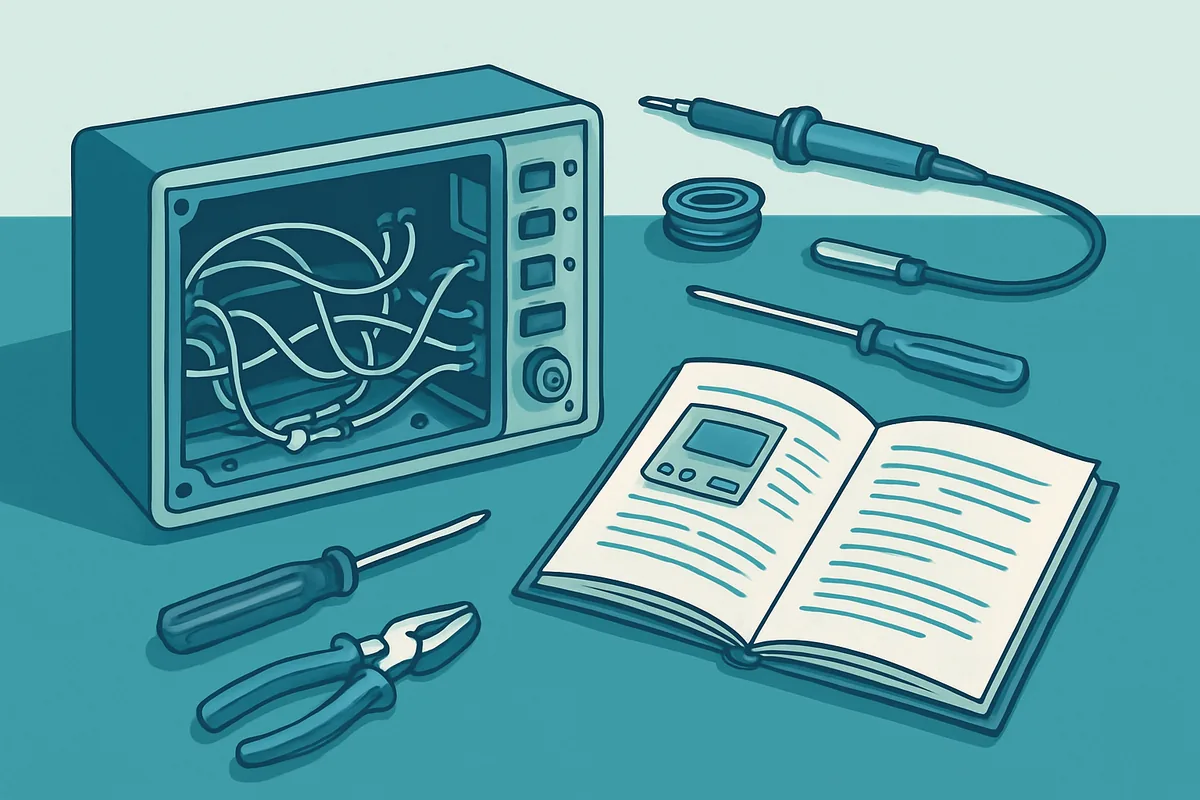
The single most informative document in a used equipment sale is the service record, and the most informative thing about a seller is whether they can produce one.
Ask for the complete history: preventive maintenance visits with dates, parts replaced with part numbers, faults reported, and any repair that required a major component. Ask for the running hours or cycle count where the instrument records them, which most modern systems do. Ask for the last performance qualification or calibration certificate, and read who issued it and when.
Certain patterns in that record matter more than the total age. Regular preventive maintenance by the manufacturer or an accredited third party, at the recommended interval and without long gaps, is worth more than low hours with no documented care. An instrument that has sat unused for two years is often in worse condition than one that ran continuously, because seals dry, pumps seize, batteries fail and moving parts corrode without circulation. Repeated repairs to the same subsystem suggest a chronic fault that has been patched rather than resolved.
Refurbishment itself needs definition, because the word is unregulated. At one end it means a full strip, replacement of all wear parts, reassembly, and testing against the original factory specification with a report to prove it. At the other it means cleaning and a functional check. Ask what was actually replaced, whether the work was done by manufacturer-trained engineers, and whether the instrument was tested against original specifications or merely confirmed to switch on. Get the answer in writing as part of the contract, and ask for the acceptance test data.
Consumable and Parts Availability Risk
This is where second-hand purchases most often fail, and it is entirely foreseeable.
Manufacturers publish end-of-life and end-of-support dates for their platforms. There is typically an announcement that a model is discontinued, a period during which parts and service remain available, and a final date after which neither is guaranteed. Find those dates for the exact model and configuration before purchase. A seller’s assurance that parts are “widely available” is not evidence; the manufacturer’s published support schedule is.
Then separate three categories. Generic parts, such as tubing, fittings, standard fuses, common bearings and off-the-shelf lamps, are low risk. Vendor-specific mechanical parts, such as a particular pump head or a specific detector flow cell, are medium risk and may be available from third-party remanufacturers. Proprietary consumables that only the manufacturer makes, such as a sealed reagent cartridge, a bespoke chip or a coded microplate, are the high risk category, because when the manufacturer stops producing them the instrument becomes unusable regardless of its mechanical condition.
The reagent tie-in question deserves special attention on clinical and analytical platforms. Some systems are sold cheaply precisely because the manufacturer earns its margin on consumables, and those consumables may be priced on the assumption of a service contract you do not have. Check the consumable price per test independently and put it into the five-year model, because a low acquisition price paired with expensive locked-in consumables can be worse value than a new system on a negotiated reagent agreement.
Third-party service is the other half of this. For common platforms such as chromatography systems, an active independent service market exists, parts are remanufactured, and support outlives the manufacturer’s own schedule by years. For niche or heavily proprietary instruments, no such market forms. Before buying, find out whether at least one independent engineer within reasonable travel distance will contract to support the model. If nobody will, you are buying an instrument you cannot maintain.
Software Licensing and Version Lock
More used instruments are stranded by software than by mechanical failure, and the problem is rarely visible during a demonstration.
Start with whether the licence transfers. Some control and data systems are licensed to an organisation or to a specific machine, and transferring ownership requires the manufacturer’s agreement, sometimes with a fee that is a significant fraction of the purchase price. Some cannot be transferred at all, meaning you buy hardware and then buy software again. Establish this in writing, from the manufacturer rather than the seller, before committing.
Then consider the controlling computer. Instrument software often depends on a specific operating system version, a particular interface card, or a driver that was never updated. If the instrument arrives with a computer running an operating system that no longer receives security updates, connecting it to the network may be prohibited by your own IT policy, and running it isolated means manual data transfer, which in a regulated environment creates its own documentation burden. Ask which operating systems the current software version supports and whether an upgrade path exists.
Data integrity requirements have made this sharper. Where records must be attributable, contemporaneous and protected from alteration, older software may lack audit trails, individual user accounts or secure electronic signatures. An instrument that is mechanically perfect and analytically accurate can still be unusable for regulated work if its software cannot meet those expectations, and retrofitting compliance is expensive or impossible.
Installation, Qualification and Calibration
The cost of getting an instrument working is routinely underestimated, and it does not scale down with the purchase price.
Decommissioning and transport are the first line. Sensitive instruments need proper preparation: fluidics drained and flushed, moving parts locked, vacuum systems vented in the correct sequence, and appropriate crating. Mass spectrometers, sensitive balances and anything with precision optics do not tolerate casual handling. Specialist laboratory movers cost more than a general haulier and are cheaper than a damaged instrument.
Site requirements come next and are the most common source of surprise. Check electrical supply, including phase and any requirement for conditioned power; heat output and whether the room’s cooling can absorb it; bench loading for heavy items; vibration isolation; gas supplies and extraction; water quality and drainage; and physical access, including door widths, lift capacity and corridor turns. A goods lift that cannot take the crate has stopped more installations than any technical fault.
Then comes qualification. Whatever your quality framework calls it, the sequence is the same: confirm the instrument was delivered as specified and installed correctly, confirm it operates within specification across its range, and confirm it performs for your actual methods with your actual samples. This work has to be done for a used instrument exactly as for a new one, and often takes longer because the baseline is unknown. Budget engineer time, standards and reference materials, staff time, and the days of lost productivity while it happens.
Calibration must come from an accredited source with traceable standards, and for some instrument classes the manufacturer is the only realistic provider. Get a quotation for that service before purchase, not after, and confirm the provider will accept the instrument onto contract given its age and history. A refusal to take on an old machine is not unusual and is far better discovered before delivery.
Warranty Terms Worth Negotiating
Used equipment warranties vary from meaningless to genuinely useful, and the difference is in clauses that are easy to read and easy to skip.
Duration is the least important term. Most failures that reflect a bad refurbishment appear within the first months of real use, so a warranty covering that period has value even if it is short. What matters far more is scope. A warranty covering parts but not labour, or excluding the specific subsystems most likely to fail, transfers very little risk. Confirm explicitly whether detectors, lamps, pumps, sources and other high-cost wear items are included or listed as consumables.
Response time and remedy define whether a warranty is usable. A commitment to attend within a defined number of working days is worth considerably more than one that promises only best efforts. Ask what happens if the fault cannot be fixed: repair, replacement with equivalent equipment, or refund, and on what timescale.
Two clauses are worth pressing hard for. First, an acceptance period during which you can test the instrument on your own methods and reject it if it fails to meet the agreed specification, with the seller bearing return costs. Second, a written performance specification that the instrument must meet on installation, expressed in the parameters you care about rather than the general claim that it is functional. Together those move the burden of proof to where it belongs.
Also confirm who holds the warranty obligation. A refurbisher’s own warranty depends on the refurbisher still trading in a year. A manufacturer-certified refurbishment programme typically carries a stronger commitment and eligibility for a normal service contract afterwards, which is often the deciding advantage over a cheaper independent unit.
Total Cost Over Five Years
The disciplined way to compare a used instrument against a new one, or against two used candidates, is to model everything for five years and compare the totals rather than the price tags.
Include the purchase price, transport and installation, licence transfer or software purchase, initial qualification, and any site modification. Then add annual costs: service contract or expected repair spend, consumables and reagents at your real throughput, calibration and requalification, and utilities where they are material. Then add the item everyone forgets, which is the cost of downtime, estimated as the days per year you expect the instrument to be unavailable multiplied by what that unavailability costs in outsourced testing, delayed projects or idle staff. Finally, consider residual value, which for a platform approaching end of support is effectively zero.
Two patterns emerge from doing this honestly. Where the instrument is mechanically simple, well supported and lightly used, the used option usually wins decisively and the model confirms an easy decision. Where the instrument depends on proprietary consumables, carries an uncertain support status, or needs an expensive detector or pump replacement that the seller has not mentioned, the totals converge and sometimes cross, and a new system on a negotiated contract turns out to be the cheaper choice.
Frequently asked questions
Is a manufacturer-certified refurbishment worth the premium over an independent seller?
Frequently, yes, though not always. The premium typically buys a documented rebuild against factory specification, a transferable warranty backed by a company that will still exist, guaranteed licence transfer, and eligibility for a standard service contract afterwards. If the platform is one you cannot service independently, that last point alone can justify the difference. For a simple, widely supported instrument with an active third-party service market, an independent refurbisher with a good service record may offer better value.
How old is too old?
Age itself is a weak signal. The meaningful questions are how long the manufacturer will supply parts and service, whether the consumables it needs remain in production, whether its software will run on a supportable operating system, and whether the wear items it will need are affordable. A fifteen-year-old microscope with good optics may have decades of life left, while a five-year-old analyser on a discontinued reagent cartridge may already be a dead end.
What should I insist on seeing before I commit?
The complete service and maintenance record with dates and parts, the running hours or cycle count, the most recent calibration or performance qualification certificate, a written statement of what the refurbishment actually replaced and who performed it, and acceptance test data against the original specification. Ideally, watch the instrument run material representative of your own samples. Missing documentation is itself a result, and it should move the price or end the conversation.
Can I get a used instrument qualified for regulated work?
Usually yes, provided the software meets current data integrity expectations and the qualification is performed properly. The instrument’s history matters less than the evidence you can generate now: installation and operational qualification, performance qualification against your own methods, and a traceable calibration from an accredited provider. The common blocker is not mechanical condition but software that lacks audit trails, individual user accounts or secure records, which generally cannot be retrofitted.
Who will service it once I own it?
Answer this before purchase, not after. Confirm that either the manufacturer will accept the instrument onto a contract given its age and history, or that a named independent engineer within reasonable reach will support the model and can obtain parts. Get an indicative annual quotation from whoever that will be, and feed it into the five-year model. An instrument nobody will contract to maintain is a liability regardless of how well it runs on the day it arrives.
The habit worth building is to treat the price as the least interesting number in the transaction. Establish which failure modes the instrument class has and what they cost. Read the service record and the refurbishment specification. Confirm parts, consumables and independent service availability against the manufacturer’s own published dates. Settle the software licence in writing. Then build the five-year model and negotiate against it. Laboratories that do this buy used equipment routinely and successfully; laboratories that skip it eventually acquire an expensive shelf.