
Buffers are the most heavily used and least examined reagents in laboratory science. Almost every experiment involving a protein, a cell, an enzyme or a nucleic acid happens in one, and almost nobody chooses one deliberately. The buffer in the protocol is the buffer that gets used, and if the protocol was inherited from a thesis written a decade ago, nobody in the chain has asked whether it is the right choice.
Most of the time this is fine, which is precisely the problem. A poorly chosen buffer does not fail loudly. It fails by drifting: the pH moves during the experiment, an enzyme loses a fraction of its activity, a protein aggregates slightly, and the result appears as increased variability rather than as an error. That variability gets attributed to the sample, the operator or the instrument, and the buffer is never suspected.
Choosing well takes about five minutes and requires three things: understanding what a buffer resists, why the pKa matters more than the pH on the label, and how much capacity your reaction needs. Everything else is preparation technique.
Key takeaways
- A buffer resists pH change because it contains a reservoir of both a weak acid and its conjugate base to absorb added acid or alkali.
- The Henderson-Hasselbalch equation is a ratio relationship, which is why dilution changes capacity but barely changes pH.
- Buffering capacity is highest at the pKa and falls away sharply beyond one pH unit either side.
- Tris changes pH markedly with temperature, so a buffer set at the bench does not hold at fridge or incubator temperature.
- Ionic strength and specific ion effects mean a buffer is never chemically inert in the reaction it hosts.
What a Buffer Resists and Why
A buffer is a solution containing appreciable quantities of both a weak acid and its conjugate base. That is the whole definition, and the behaviour follows from it directly.
When a strong acid is added, the incoming protons are taken up by the conjugate base, converting some of it into the weak acid form. When a strong base is added, it removes protons from the weak acid form. In both cases the added species is consumed by an existing reservoir rather than remaining free in solution, and because pH measures free hydrogen ion activity, the pH moves only slightly.
Two conditions are necessary and often forgotten. Both forms must be present in substantial amounts, and neither reservoir may be exhausted. A solution of pure acetic acid is not a buffer, and neither is pure sodium acetate; a mixture of the two is. Once enough alkali has converted essentially all of the acid form, the reservoir is spent and the next addition moves the pH abruptly.
It helps to picture a titration curve. Plotting pH against added base for a weak acid gives a curve with a flat region in the middle and steep sections at either end. The flat region is the buffering zone, flat because added base is being consumed by conversion rather than accumulating. Its midpoint is the pKa, where the two forms are present in equal concentrations.
That midpoint is the whole basis of buffer selection. A buffer used far from its pKa operates on the steep part of its curve, with one large reservoir and one nearly empty one. It resists change in one direction and barely at all in the other, and it will look perfectly fine on the pH meter while doing almost nothing useful.
Two things a buffer does not do are worth stating. It does not hold pH constant, only slows its change. And it does not protect indefinitely: a reaction that continuously generates acid, such as cell culture producing lactate, will exhaust any practical buffer.
The Henderson-Hasselbalch Relationship
The relationship between pH, pKa and the ratio of the two buffer forms is expressed by the Henderson-Hasselbalch equation: pH equals pKa plus the logarithm of the ratio of conjugate base to weak acid.
The equation is simple, and the important consequences are not always drawn from it.
First, pH depends on a ratio, not on absolute concentration. If both components are present at ten times higher concentration in the same proportion, the pH is unchanged. This is why diluting a buffer tenfold produces only a small pH shift while resisting change far less effectively. Concentration determines capacity; ratio determines pH. Conflating the two is the most common misunderstanding in buffer work.
Second, when the two forms are equal in concentration, the logarithm of the ratio is zero and the pH equals the pKa. The pKa is not an abstract constant but the pH the buffer naturally sits at when half-titrated.
Third, moving from a ratio of one to a ratio of ten shifts the pH by exactly one unit but consumes nine tenths of one reservoir. This is the arithmetic behind the rule that a buffer works within roughly one pH unit of its pKa: beyond that, small further additions produce large pH movements because the minor component is nearly gone.
Fourth, the equation is an approximation. It assumes concentrations can stand in for activities, which is progressively less true as ionic strength rises. This explains why a buffer calculated on paper rarely lands exactly on target when measured. The equation is for planning; the meter is for finishing.
Choosing a Buffer by Its pKa
The selection rule is a single sentence: choose a buffer whose pKa is within roughly half a pH unit of your target working pH, and never more than one unit away.
Applying it requires knowing where common buffers sit.
| Buffer | Approximate pKa at 25 °C | Useful range | Temperature sensitivity | Notes |
|---|---|---|---|---|
| Citrate | Multiple, around 3.1, 4.8 and 6.4 | Wide, acidic | Low | Chelates calcium, magnesium and other metals strongly |
| Acetate | About 4.8 | Acidic | Low | Volatile odour; simple and inexpensive |
| MES | About 6.1 | Slightly acidic | Low | Minimal metal binding; good for enzyme work below neutral |
| Phosphate | About 7.2 for the second dissociation | Near neutral | Very low | Precipitates with divalent cations; participates in many enzyme reactions |
| HEPES | About 7.5 | Physiological | Moderate | Widely used in cell culture; can generate peroxides in light |
| Tris | About 8.1 | Slightly alkaline | High | pH shifts substantially with temperature and dilution |
| Bicine, glycine | Around 8.3 and 9.6 | Alkaline | Moderate | Glycine is an amino acid and can participate in reactions |
| Carbonate | Around 6.4 and 10.3 | Alkaline | Moderate | Exchanges with atmospheric carbon dioxide |
The table makes the classic mistake visible. Tris is the default in a great many molecular biology protocols, and its pKa sits above eight. Using Tris at pH 7.0, which happens constantly, places it more than one unit below its pKa, where its capacity against added acid is poor. The solution reads 7.0 on the meter and will not hold there under load.
Phosphate at pH 7.2 is nearly ideal from a capacity standpoint and carries other problems: it precipitates with calcium and magnesium, which rules it out for many cell and enzyme systems, and it is a substrate or product in a large number of enzymatic reactions.
This is why the family of zwitterionic buffers developed for biological work, of which MES, HEPES, MOPS and PIPES are the most familiar, became standard. They were designed for pKa values spread across the physiological range, low metal binding, poor membrane permeability and minimal ultraviolet absorbance. None is perfect, but each was chosen against criteria rather than inherited.
Buffer Capacity and Concentration Effects
Capacity is the quantity of strong acid or base a buffer can absorb per unit of pH change. It is the property that actually matters at the bench and the one least often considered.
Capacity depends on total buffer concentration and on proximity to the pKa. It scales roughly linearly with concentration, so doubling molarity doubles the ability to absorb an insult. It peaks at the pKa and falls away symmetrically, dropping substantially one unit either side and becoming negligible beyond two.
Choosing a concentration means estimating the acid or base load the system will produce. A binding assay with no chemistry occurring needs very little, and a low concentration is desirable because it minimises interference. A reaction that liberates protons, a cell culture generating organic acids, or an electrophoresis system passing current all impose real loads and need substantially more.
The temptation is to raise concentration as insurance, and it carries costs. High buffer concentrations raise ionic strength, which affects protein solubility, enzyme kinetics and binding constants. They can inhibit enzymes directly. They increase conductivity, which matters in mass spectrometry, where high salt causes ion suppression. Use the lowest concentration that holds pH over the duration of the experiment, and test that assumption by measuring the pH at the end rather than assuming it held.
Dilution deserves a note because it behaves counterintuitively. Diluting a buffer changes its pH only slightly, since pH depends on the ratio of forms, but it reduces capacity in direct proportion. A tenfold dilution still reads close to the correct pH and has lost most of its ability to defend it.
Temperature Dependence of Common Buffers
Every buffer’s pKa is temperature-dependent, because the enthalpy of the acid dissociation is not zero. What varies is how much, and the differences between buffers are large enough to break experiments.
Tris is the notorious case. Its pKa falls by roughly 0.03 units per degree Celsius of warming, so a Tris buffer adjusted to pH 8.0 at room temperature reads appreciably higher when chilled and lower at incubator temperature. Across the span from a cold room to 37 °C, the shift can approach a full pH unit. A protein purification buffer titrated on the bench and then used in a cold room is not at the pH written on the bottle.
Phosphate is at the other extreme, with a very small temperature coefficient, which is one reason it persists in protocols despite its chemical drawbacks. HEPES and the other zwitterionic buffers sit in between.
The practical rules follow directly. Adjust the pH at the temperature at which the buffer will be used, letting the solution equilibrate before measuring. Record that temperature alongside the pH, because a protocol saying only “pH 8.0” is ambiguous for a Tris buffer. Where an experiment spans temperatures, either choose a buffer with a small coefficient or document the shift.
A pH meter’s automatic temperature compensation does not solve this. That function corrects the electrode’s own response, a property of the measuring system. It cannot correct for the genuine change in the solution’s pH caused by the shifting pKa, because that change is real rather than an artefact.
Ionic Strength and Downstream Interference
A buffer is never a neutral background. It contributes ions, and those ions participate.
Ionic strength alters the activity coefficients of everything in solution, shifting equilibria, changing measured binding constants and affecting electrostatic interactions within and between proteins. Protein solubility depends on it non-monotonically, rising at low salt and falling at high, which is the basis of salting-out precipitation.
Specific ion effects sit on top of that. Phosphate binds calcium and magnesium and precipitates them, removing cofactors enzymes require. Citrate and EDTA chelate divalent metals deliberately, which is useful for that reason and disastrous when the metal was needed. Tris carries a primary amine that reacts with aldehydes and with certain labelling chemistries, so a Tris buffer will quench an amine-reactive labelling reaction efficiently.
Optical interference matters in any assay read spectrophotometrically. Buffers absorbing in the ultraviolet interfere with protein quantification and with nucleic acid measurement, and some components react with protein assay reagents directly, which is why manufacturers publish compatibility tables.
Then there are biological effects. HEPES can generate hydrogen peroxide when exposed to light, which is quietly toxic to cultured cells. Buffers that permeate membranes can alter intracellular pH rather than merely controlling the medium. Bicarbonate systems depend on equilibrium with atmospheric carbon dioxide, which is why culture media left outside an incubator drift alkaline within minutes.
The lesson is not to avoid these buffers but to check the interaction between buffer and assay before assuming inertness. Where an unexplained effect appears, swapping the buffer for one with a similar pKa and different chemistry is a fast and informative control.
Preparing and Storing Solutions Reliably
Good preparation is mostly about doing things in an order that makes the result reproducible.
Weigh accurately and calculate honestly. Many buffer salts are hydrates, and the water of crystallisation counts towards the mass. Using the anhydrous molecular weight for a hydrated salt produces a weaker solution than intended, and the error is invisible because the pH still adjusts correctly. Check the form on the bottle, not the protocol.
Dissolve in less than the final volume, adjust the pH, then make up to volume. Adjusting afterwards adds acid or base to an already-final volume and dilutes the buffer by an unrecorded amount.
Adjust with the acid or base matching the counter-ion you want. Using hydrochloric acid on Tris produces Tris-chloride and adds chloride; using sulphuric acid adds sulphate. Where the counter-ion matters, and in ion exchange chromatography it matters greatly, this is a real choice rather than a detail.
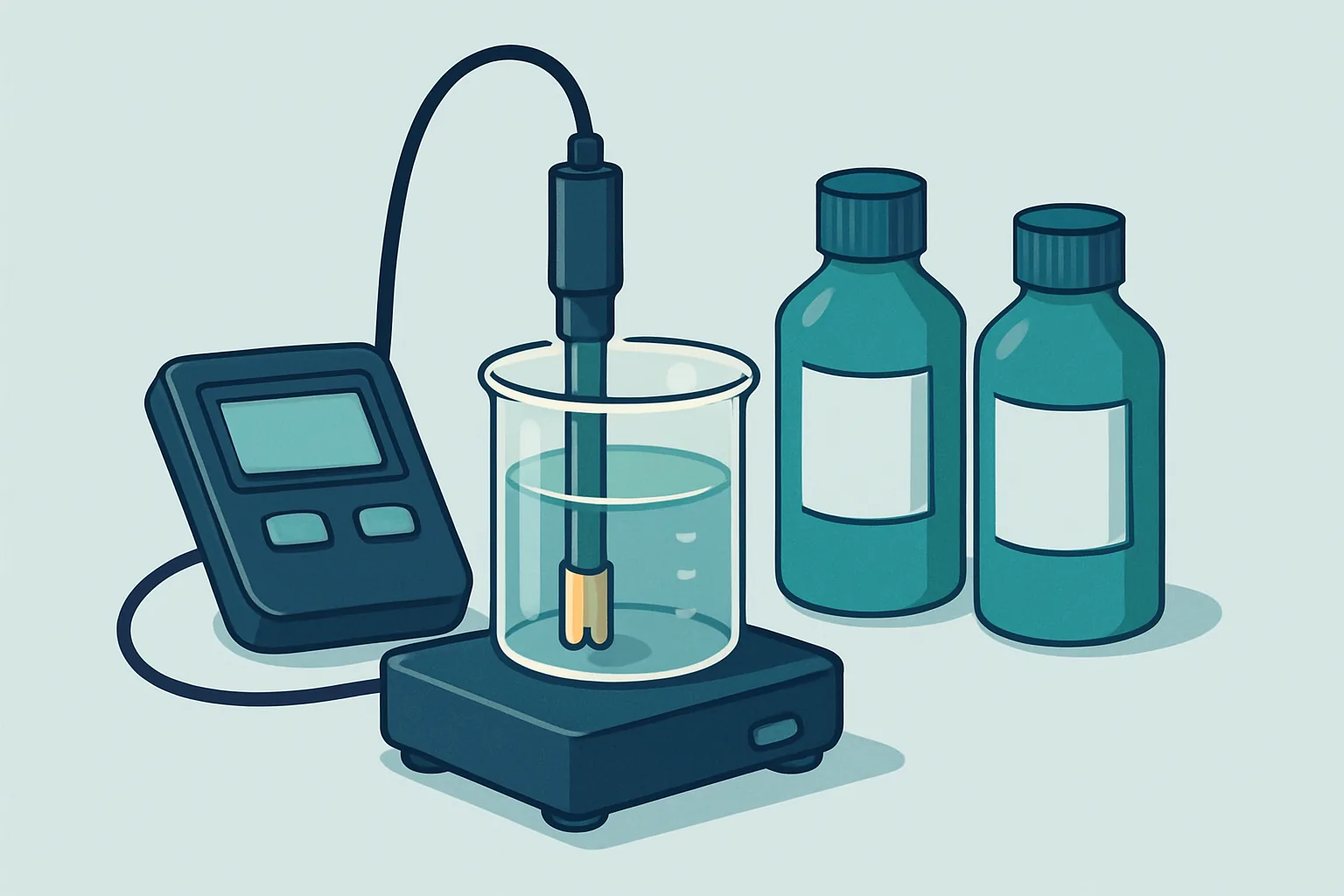
Calibrate the meter before each session with fresh standards spanning the target pH, and rinse but do not wipe the electrode, since wiping generates a static charge that produces a drifting reading. Allow the reading to stabilise properly; electrodes in low ionic strength or cold solutions respond slowly. Store the electrode in the recommended storage solution rather than in water, which strips ions from the junction.
Filter and store sensibly. Filtration through a fine membrane removes particulates and most microorganisms, which matters because buffers containing organic components support microbial growth readily. A cloudy buffer should be discarded rather than filtered and reused. Label every bottle with the composition, concentration, pH, the temperature at which the pH was set, the date and the preparer.
Making concentrated stocks saves time and introduces one trap worth naming. A stock adjusted to a particular pH will not necessarily be at that pH once diluted to working concentration, because dilution changes ionic strength and activity coefficients. Check the pH of the working dilution rather than trusting the stock’s label, at least once when a new recipe is introduced.
None of this is difficult, and that is what makes buffer errors so persistent. They survive because they produce no dramatic failure, only a slow widening of the error bars and an experiment that works better on some days than others. Spending five minutes matching a pKa to a working pH, and another five checking that the pH held at the end of the run, removes a whole category of irreproducibility that otherwise gets attributed to everything except the solution the reaction was sitting in.
Frequently asked questions
Why does my Tris buffer read a different pH in the cold room?
Because the pKa of Tris is strongly temperature-dependent, falling by roughly three hundredths of a pH unit per degree of warming and rising by the same amount on cooling. A buffer set to pH 8.0 at room temperature genuinely sits well above that in a cold room and below it at incubator temperature. This is a real change in the solution, not a measurement artefact, so automatic temperature compensation cannot correct it. Adjust at the temperature of use, and record it.
Can I just use a stronger buffer to be safe?
Higher concentration does increase capacity, and it also raises ionic strength, which affects protein solubility, enzyme kinetics, binding constants and conductivity. In mass spectrometry it causes ion suppression and contaminates the instrument, and some enzymes are directly inhibited by high buffer concentrations. The better approach is to estimate the acid or base load the experiment generates, use the lowest concentration that holds pH across the run, and verify by measuring at the end.
What is wrong with using phosphate buffer for everything?
Phosphate has excellent properties on paper, sitting close to physiological pH with a very small temperature coefficient. Its problems are chemical rather than physical. It precipitates calcium and magnesium, removing cofactors that many enzymes require and creating visible precipitates in media containing divalent cations. It is also a participant in a great many enzymatic reactions as substrate, product or inhibitor, so it is not a passive background in the assays that use it most. Where either issue applies, a zwitterionic buffer with a similar pKa is usually the better choice.
Does diluting a buffer change its pH?
Only slightly for most buffers, because pH depends on the ratio of the acid and base forms and dilution changes both equally. What changes substantially is capacity, which falls in direct proportion to concentration, so a diluted buffer reads correctly and defends that reading far less effectively. Some buffers do show a measurable pH drift on dilution through activity effects, which is why checking the working dilution rather than trusting the concentrated stock is worthwhile.
How long can I keep a prepared buffer?
It depends on composition and storage rather than on a fixed shelf life. Simple inorganic buffers stored filtered and refrigerated last a long time. Buffers containing organic components or protein supplements support microbial growth and degrade much faster, and reducing agents oxidise within days in solution, so they are usually added fresh. Any buffer that has become cloudy, developed a film or shifted in pH should be discarded. Carbonate-based buffers drift as they exchange with atmospheric carbon dioxide, so they should be made close to the time of use.