
Every new laboratory worker is handed the same list. Wipe the cabinet with ethanol. Do not reach over open vessels. Flame the neck of the bottle. Change gloves. The list is correct, and learning it as a list is the reason most people keep contaminating cultures anyway.
Rules memorised without a mechanism fail in exactly the situations that matter, because bench work constantly presents cases the list does not cover. Does it matter which side of the cabinet the waste pot sits on? Is it worse to reach over an open flask or to move quickly past it? A list answers neither. A mental model answers both.
The model is simple to state. Contamination is the arrival of an unwanted organism in a place where it can grow. Organisms travel on particles, particles travel on air currents and on surfaces you touch, and almost everything in aseptic practice is either about controlling where the air goes or about controlling where your hands go. Once you hold that, the rules stop being arbitrary.
Key takeaways
- Almost all contamination comes from the operator and the room, not from reagents or from the air arriving in a cabinet.
- A biosafety cabinet protects work through a moving curtain of air, and that curtain is easy to break with your own arm.
- The critical zone is the small volume around every open opening; keeping it clear matters more than any single ritual.
- Disinfectants need contact time to work, and wiping a surface dry immediately does very little.
- Most persistent contamination problems trace back to a habit rather than to bad luck.
Where Contaminants Actually Come From
The intuitive picture is of microbes drifting through the air and landing in your flask. That happens, but it is a minority route. The dominant source of contamination in a cell culture or microbiology laboratory is the person doing the work.
Human skin sheds continuously. Every person releases a large number of skin scales each minute, and a substantial fraction carry viable organisms. Talking, coughing and even breathing project droplets forwards. Hair sheds, and clothing releases fibres carrying whatever they have accumulated. This is why laboratory coats, gloves and, in more demanding settings, masks and sleeves exist: they are not personal protection so much as a barrier between the product and the person producing it.
The second source is surfaces. Anything that has been in the open laboratory carries a load: the outside of a media bottle, a pipette box lid, a marker pen, a mobile phone, the operator’s gloves after touching a door handle. Hands are the most active vector because they touch everything and then travel into the work area.
The third source is the shared environment. Water baths are a well-known reservoir, since warm standing water grows organisms readily and then coats anything immersed in it. Incubators accumulate spillage. Fungal spores from building work or damp are persistent and germinate weeks later. Mycoplasma deserves separate mention because it is invisible under a microscope, does not turn media cloudy, and usually arrives from another contaminated culture.
Reagents sit far down this list. Sterilised media fail occasionally, but a high contamination rate almost always originates in the room or in your hands.
Airflow Patterns in a Biosafety Cabinet

A cabinet does not create a sterile bubble. It creates a directional airflow that carries particles away from the work before they can settle, and it depends entirely on that flow remaining organised.
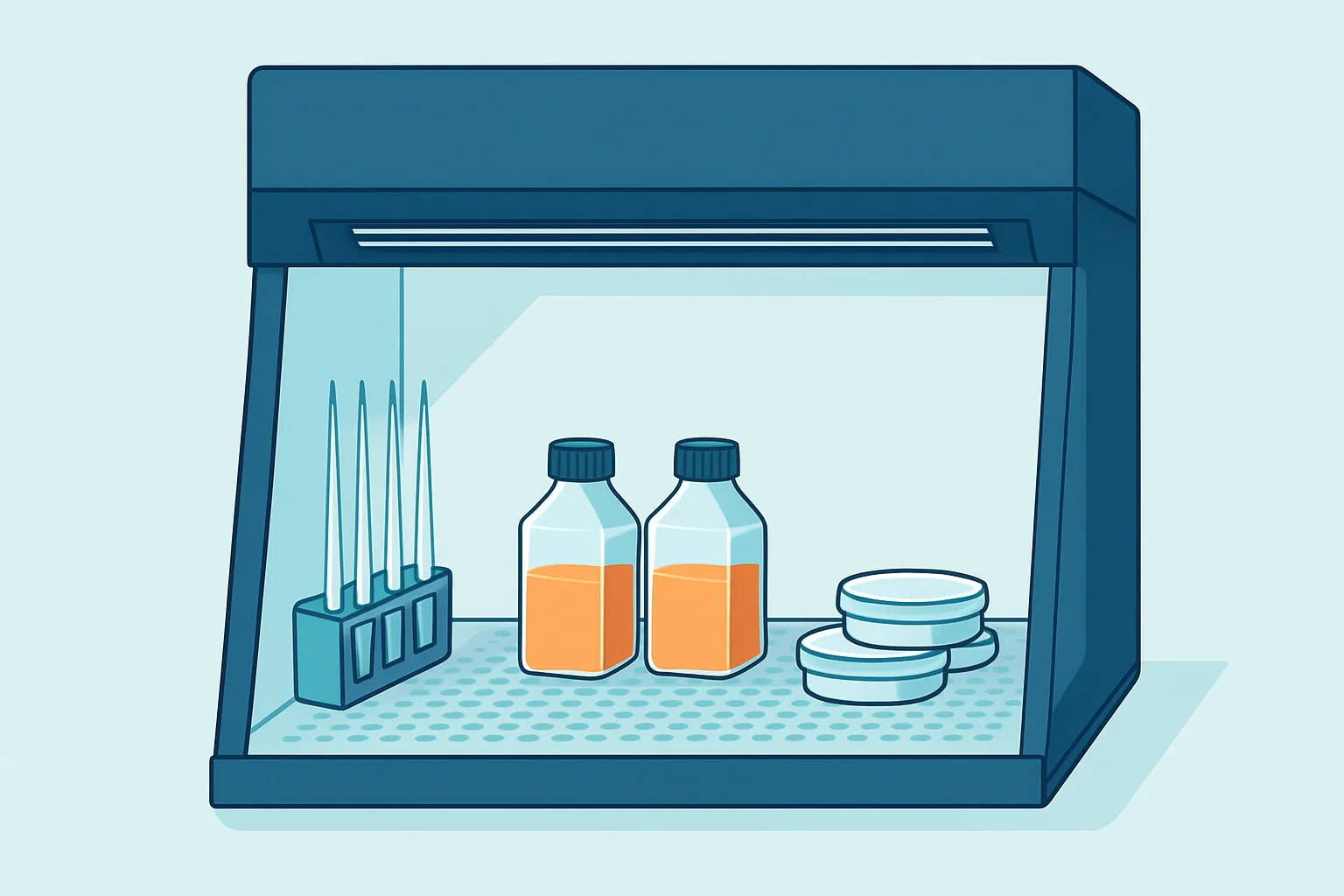
In the common Class II cabinet, room air is drawn in through a grille at the front edge of the work surface. This inward flow forms an air curtain across the opening, and it is what protects the operator from anything aerosolised inside. Meanwhile filtered air descends vertically from the top of the cabinet onto the work surface. This downflow is what protects the work: it is HEPA-filtered, so it is effectively free of particles, and it sweeps continuously downwards, pushing anything shed by the operator’s hands or arms down into the rear and front grilles rather than allowing it to drift laterally onto an open vessel.
Two consequences follow immediately, and they explain a large share of the classic rules.
First, anything placed above an open vessel will shed particles into it, because the air is moving downwards. Reaching over an open flask puts your arm, with its cuff and glove, directly upstream. This is the single most common technique error, and it is why work is arranged so that hands approach from the side.
Second, the air curtain at the front is fragile. Rapid arm movements in and out, a door opening nearby, a person walking past, or an air conditioning vent aimed at the cabinet can all disrupt it enough to pull unfiltered room air across the work surface. Movements should be slow and deliberate, and arms should be moved in and out in a straight line rather than swept.
A horizontal laminar flow bench works differently and is often confused with a biosafety cabinet. It blows filtered air outwards, horizontally, from the back towards the operator. It protects the work well and protects the operator not at all, which makes it appropriate for sterile media and unsuitable for anything hazardous. In a horizontal bench, the rule becomes: never place anything upstream of your open vessel, meaning never between the filter face and the work.
The front grilles must stay clear. Placing a notebook, a discard tray or a pile of wrappers across the front grille blocks the intake, collapses the air curtain, and quietly converts an expensive cabinet into an ordinary bench.
Hand Movement and the Critical Zone
The critical zone is the volume of air immediately around any opening through which sterility could be lost: the mouth of a bottle, the neck of a flask, the tip of a pipette, the open surface of a plate. Aseptic technique, reduced to a single idea, is the discipline of keeping that zone clear of anything unsterile and clear of anything that would disturb the airflow protecting it.
Practically, this means arranging the cabinet before starting rather than reaching for items mid-procedure. Clean items to one side, waste to the other, and the active work in the middle third of the surface where downflow is most stable. Nothing crosses over the work. A right-handed operator typically keeps pipettes and tips to the right, media and vessels centrally, and the discard to the left, so that the hand carrying used material never travels above the clean material.
Hand movements should be economical. Every additional pass over the work area is another opportunity to shed particles, and every hesitation with an open vessel extends the exposure.
Fingers deserve specific attention. The parts of a pipette, a lid or a cap that will contact sterile surfaces must not be touched, and the parts you do touch must not later contact sterile surfaces. This is the whole of the technique in one sentence, and most failures are a violation of it: fingers walking down a pipette shaft, a cap held in a palm, a plate lid set face-down on the bench.
Flaming, Wiping and Surface Disinfection
Flaming and wiping do different jobs and are frequently confused.
Flaming an inoculation loop sterilises it by incineration. Heating to red heat destroys everything on the wire, and the only technique points are to heat the entire portion that will enter the culture and to allow it to cool before touching a specimen, since a hot loop will spatter and kill the organisms you are trying to transfer. Passing a glass bottle neck through a flame is a different action with a weaker rationale: it creates a brief convective updraught at the opening and dries any liquid film on the rim, but it does not sterilise the glass in the time available. It is a supplement, not a substitute, and it is actively inappropriate inside a biosafety cabinet, where an open flame disrupts the laminar downflow and can damage the filter above.
Wiping is chemical. Ethanol at around seventy percent works better than absolute ethanol because water is required to denature proteins effectively; pure ethanol dehydrates the cell surface and fixes rather than kills. It acts quickly against vegetative bacteria and enveloped viruses and poorly against bacterial and fungal spores, which is why an alcohol-only regime tends to select for mould over months.
Contact time is the point most often missed. A disinfectant needs the surface to remain visibly wet for its stated contact time, which is typically measured in minutes rather than seconds. Spraying and immediately wiping dry accomplishes mechanical removal and little chemical killing. The correct sequence for a cabinet is to remove clutter, wipe with a detergent or disinfectant to remove soil, apply the disinfectant and leave it wet, then wipe residue at the end of the session so that alcohol films and salts do not build up.
| Agent | Effective against | Weak against | Practical contact time | Main drawback |
|---|---|---|---|---|
| Ethanol around 70 percent | Vegetative bacteria, enveloped viruses | Spores, some non-enveloped viruses | Short, but must stay wet | Evaporates before it acts if sprayed lightly |
| Hypochlorite (bleach) | Very broad, including spores | — | Minutes | Corrodes stainless steel; needs a rinse step |
| Quaternary ammonium | Many bacteria, some viruses | Spores, some resistant species | Minutes | Inactivated by residues and hard water |
| Hydrogen peroxide formulations | Broad, including spores at higher strength | — | Minutes | Material compatibility varies |
| Dry heat or flame | Everything on the item heated | Anything not reached by the heat | Seconds for a loop | Only suitable for small metal items |
Opening and Closing Vessels Correctly
The moment a vessel is open is the moment sterility is at risk, and technique here is mostly about geometry and duration.
Caps and lids are held, not put down. A screw cap comes off into the hand holding the pipette or into the crook of the fingers, outer surface downwards, and goes straight back on. Setting it on the work surface exposes the inner face to whatever the surface carries and to settling particles. If a cap genuinely must be set down, it goes inner-face upwards, never inner-face down, though this remains a compromise rather than good practice.
Bottles and flasks are held at an angle rather than upright while open. An angled opening presents a smaller target to anything falling from above and reduces the time an opening spends directly under a moving hand. Plates follow the same logic: the lid is lifted at an angle and held above the plate as a shield rather than removed entirely, keeping the agar surface covered from above for all but the necessary moment.
Pipettes are never rested on the work surface between uses. A pipette that has touched the bench is unsterile along its length, and the length is what enters the bottle. Serological pipettes go straight from wrapper to controller to vessel to discard.
Sequence matters too. Open one vessel at a time, complete the transfer, and close it before opening the next. Two vessels open simultaneously double the exposed area and encourage hands to travel between them across open ground.
Media Handling and Sterility Checks
Media are where contamination becomes visible and where it is easiest to catch early.
Prepared media should be inspected before use, every time. Cloudiness in a normally clear broth, colonies on an agar surface, a colour shift in a pH indicator, or a change in the meniscus can all indicate growth. Media containing phenol red are useful here because a fermenting contaminant acidifies the medium and turns it yellow, often before anything is visibly turbid.
Incubating a small proportion of each new batch of media without inoculation is the standard sterility check. A batch is held for a defined period at the temperature at which it will be used, and any growth condemns the batch. This catches filtration failures, autoclave failures and contamination introduced during dispensing, and it costs a handful of plates or tubes.
Storage conditions matter more than they appear. Refrigerated media are usually warmed before use, and the standard warm water bath is precisely the reservoir described earlier. Bottles taken from a bath should have their outsides dried and wiped before entering a cabinet, or the bath should be replaced with a dry bead bath.
Aliquoting is the underrated defence. A large bottle opened repeatedly accumulates risk with every entry, and a single contamination event destroys the whole volume. Dividing supplements and media into single-use or few-use aliquots limits the damage from any one lapse and reduces the number of openings substantially.
Common Habits That Quietly Break Sterility
Most chronic contamination is habitual, and the habits are recognisable.
Talking over open work is near the top. Speech projects droplets forwards for a considerable distance, and a conversation held while a cabinet is open delivers them at exactly the wrong height. Related is the habit of leaning into the cabinet, which places the head, hair and shoulders in the plane of the opening and disrupts the air curtain.
Reaching over is the second. It feels efficient and it is the direct violation of the downflow principle. The correction is layout: if you are reaching over something, the layout is wrong.
Gloves are a frequent blind spot. Gloves protect the work only while they remain clean, and a glove that has touched a door handle, a keyboard, a phone or a face is as contaminated as a bare hand. Wiping gloved hands with alcohol on re-entering the cabinet, and doing so periodically during long procedures, costs seconds. Wearing the same gloves from the corridor into the cabinet costs cultures.
Overfilling the cabinet is subtler. A crowded work surface blocks grilles, creates turbulence around tall objects, and forces exactly the reaching and repositioning that technique is designed to avoid.
Then there is the false economy of speed. Rushing produces the fast arm movements that break laminar flow, the fumbled cap that lands face-down, and the shortcut of leaving a bottle open while fetching something.
The final habit worth naming is the failure to investigate. When a culture contaminates, the reflex is to discard it and repeat. That discards the evidence. Noting which cultures were affected, whether they shared media, an incubator shelf, a session or an operator, and what the contaminant looked like will usually identify the source within a few episodes. Bacterial contamination overnight tends to point at technique or media; fungal contamination appearing later points at the environment or the incubator; a contaminant appearing in every vessel from one session points at a shared reagent. Aseptic technique improves fastest when contamination is treated as data rather than as bad luck.
Frequently asked questions
Should I flame bottle necks inside a biosafety cabinet?
No. An open flame inside a cabinet disturbs the vertical downflow that protects the work, creates a hot updraught towards the filter, and introduces a genuine fire risk around alcohol. The convective and drying benefit of flaming a neck is small compared with the airflow protection you already have. Flaming remains appropriate for inoculation loops at an open bench, where it is doing real sterilisation by incineration rather than acting as a ritual.
Is a laminar flow bench the same as a biosafety cabinet?
They look similar and behave very differently. A horizontal laminar flow bench blows filtered air outwards over the work and towards the operator, protecting the material but offering the person no protection at all. A Class II biosafety cabinet draws air inwards at the front while bathing the work in filtered downflow, protecting both. Anything infectious, toxic or of unknown hazard belongs in a cabinet; a laminar bench is for sterile, non-hazardous work such as pouring media.
Why does mould keep appearing weeks after a spill?
Fungal spores are far more resistant than vegetative bacteria and survive alcohol wiping comfortably. They also survive drying, settle into seams, filters, waste bins and door seals, and germinate whenever moisture and nutrients appear. That delay between contamination and visible growth is what makes mould so hard to trace. Controlling it requires a sporicidal agent used with proper contact time, attention to humidity and standing water, and a look at whether building work or plant material is nearby.
How much does the room outside the cabinet matter?
Considerably. The cabinet draws its front-curtain air from the room, so air quality, foot traffic, door movement and ventilation all influence how stable that curtain is. A cabinet positioned opposite a busy door or under an air conditioning outlet is disturbed repeatedly regardless of technique. Where contamination rates stay high despite good practice, the cabinet’s position is worth examining before the operator is.
Do I need to change gloves during a long procedure?
Changing is not always necessary, but decontaminating is. Gloves accumulate contamination from every surface they touch, including the outside of bottles and the cabinet surface itself, and that load transfers to the next thing handled. Wiping gloved hands with an appropriate disinfectant on entering the cabinet and at intervals during work handles most of this. A full change is warranted after touching anything outside the cabinet, after any spill, and whenever a glove is punctured or visibly soiled.