

A surprising proportion of what is known about human biology was worked out in a fruit fly, a millimetre-long soil worm, a small striped fish, or a mouse. To an outsider this looks like an odd historical accident, or worse, like scientists studying whatever was convenient and hoping it applied.
It is neither. Each of these organisms was adopted for reasons that can be stated precisely, and the reasons are almost always the same three quantities in different proportions: how quickly it reproduces, how easily its genome can be manipulated and observed, and how similar its biology is to ours. Those three pull against each other. Organisms closely related to humans are slow, expensive and hard to manipulate. Organisms that are fast, cheap and tractable are distant relatives.
Choosing a model is choosing a position on that trade, and the choice is made per question rather than once. The same laboratory may use a worm to find a gene and a mouse to test what it does in a mammal. What follows is how the trade actually works, and what it explains about why results sometimes fail to carry across.
Key takeaways
- Model organism choice is a deliberate trade between generation time, genetic tractability and similarity to human biology.
- Core cellular and developmental mechanisms are conserved widely, which is why distant organisms remain informative.
- Genetic tools differ enormously between species and often determine which questions are practical.
- Findings translate best for conserved processes and worst for immunity, metabolism regulation and behaviour.
- Housing cost and regulatory burden scale steeply with how closely related an organism is to us.
What Makes an Organism a Good Model
A useful model organism satisfies several criteria at once, and the reason only a handful are widely used is that satisfying all of them simultaneously is rare.
It must be practical to maintain: thriving in a laboratory, breeding reliably on demand, and occupying little space per individual. An organism requiring a seasonal cue to reproduce, or a diet that cannot be manufactured, is unusable regardless of how interesting its biology is.
It must reproduce quickly and in numbers. Genetics is a statistical enterprise, and detecting a phenotype that appears in a quarter of offspring requires many offspring. Short generation time also allows several generations to be followed within the life of a project.
It must be manipulable. The ability to introduce mutations, delete genes, add reporters, and control expression in particular tissues at particular times is what converts an organism from something to observe into something to experiment on.
It must be observable. Transparency, accessible embryos, small size for whole-animal imaging and well-mapped anatomy are the main reason certain species dominate developmental biology.
And there must be an existing community. A model organism carries shared infrastructure: annotated genome databases, strain repositories that distribute mutants on request, published protocols, and reagent collections. A newcomer studying such a species starts years ahead, which produces a strong self-reinforcing effect. The dominance of a few species is partly biological suitability and partly accumulated investment.
Underlying all of it is conservation. Distant organisms are informative because the fundamental machinery of cells, the way DNA is copied and repaired, how proteins are made and degraded, how cells divide, and the signalling pathways that pattern embryos, is broadly shared across animals. A gene controlling a developmental decision in a fly frequently has a human counterpart doing something recognisably related.
Generation Time Versus Human Similarity
The central trade is best seen laid out directly.
| Organism | Generation time | Relative cost | Genetic tractability | Similarity to humans |
|---|---|---|---|---|
| Bacteria | Under an hour | Negligible | Extremely high | Cellular basics only |
| Budding yeast | Hours | Very low | Extremely high | Core cell biology |
| Nematode worm | A few days | Very low | Very high | Conserved pathways, simple nervous system |
| Fruit fly | About two weeks | Low | Very high | Development, neurobiology, many disease genes |
| Zebrafish | A few months | Moderate | High | Vertebrate organs and development |
| Mouse | About three months | High | High | Mammalian physiology, immunity, behaviour |
| Non-human primate | Years | Very high | Limited | Closest available |
The pattern is unmistakable and it runs in one direction. Moving down the table buys similarity and pays in time, money and experimental flexibility.
The consequence is that questions get routed to the cheapest organism that can answer them honestly. A question about how a conserved signalling pathway is regulated at the molecular level can be attacked in yeast or worms, where thousands of genetic variants can be tested quickly. A question about how that pathway shapes a vertebrate heart needs a vertebrate. A question about how a drug affects mammalian metabolism, immunity and behaviour needs a mammal.
Generation time compounds in a way that is easy to underestimate. Crossing two strains and examining the second generation of offspring takes a month in flies and most of a year in mice. A genetic screen requiring thousands of individuals is routine in worms and effectively impossible in mice at the same scale. This is why so many genes were first identified in invertebrates and only later characterised in mammals: the discovery step needs numbers, and the validation step needs relevance.
Genetic Tools Available Per Organism
What can be done to an organism often matters more than what it is, and the toolkits differ dramatically.
The nematode worm has an advantage nothing else matches: every cell division from fertilised egg to adult has been traced, so the fate of each of its roughly thousand cells is known. That makes it possible to ask what happens to one identified cell when a gene is removed. It is transparent throughout life, so fluorescent reporters can be watched in a living animal. Gene silencing by feeding worms bacteria expressing double-stranded RNA is startlingly simple and enabled genome-wide screens.
The fruit fly’s signature tool is a binary expression system that separates a tissue-specific driver from the gene to be expressed. Crossing a fly carrying a driver active in one tissue to a fly carrying any transgene produces offspring expressing that transgene in exactly that tissue. Thousands of driver and responder lines exist and can be combined freely, which is a combinatorial resource of remarkable power. Flies also permit mosaic analysis, generating patches of mutant tissue within a normal animal, which rescues the study of genes whose loss would otherwise be lethal.
The zebrafish contributes transparency in a vertebrate. Embryos develop externally and are optically clear, so organ formation, including a beating heart and a developing nervous system, can be watched directly in a living animal. Embryos are produced in large clutches, which makes chemical and genetic screens practical at vertebrate scale.
The mouse offers the deepest mammalian toolkit: precise gene replacement, conditional systems that delete a gene only in a chosen tissue or only after a chemical is administered, and an enormous catalogue of existing engineered strains. Conditional deletion is essential because many genes are required for embryonic survival, and studying their adult function demands removing them later.
Genome editing has narrowed these gaps considerably. Targeted mutation is now achievable in species that previously had no genetic tools at all, which has begun to open up organisms chosen for their biology rather than their tractability. Existing infrastructure still confers a large advantage, but the barrier to entry has fallen substantially.
Where Findings Translate and Where They Stall
Translation succeeds and fails in patterns, and the patterns are consistent enough to be predictive.
Conserved cellular and developmental machinery translates well. The cell cycle, DNA repair, protein folding and degradation, apoptosis, and the major developmental signalling pathways are ancient and shared. Genes controlling body plan segmentation in flies turned out to have counterparts patterning the vertebrate body. Cell cycle control genes found in yeast proved central to human cancer biology. When a mechanism is this old, a discovery in a distant organism is very likely to hold.
Organ development translates moderately well among vertebrates. Heart, kidney, eye and neural tube formation follow broadly similar programmes in fish, mice and humans, with species-specific elaborations. A gene required for a structure in zebrafish is a reasonable candidate for the equivalent human condition.
Immunity translates poorly, and this is one of the most consequential failures. Mouse and human immune systems differ in the relative abundance of cell types, in the receptors they express, in how they respond to bacterial products, and in the details of inflammatory signalling. Immunological findings that looked convincing in mice have repeatedly failed to reproduce in human trials, and awareness of this has driven both humanised mouse models and greater use of human cells and tissue.
Metabolism translates partially. Core pathways are conserved, but body size drives metabolic rate, and a mouse runs far faster metabolically than a human. Drug clearance and dosing therefore need scaling, and the enzymes handling drug metabolism differ enough between species that a compound safely cleared in one can accumulate in another.
Behaviour and higher brain function translate least of all. Rodent models of psychiatric conditions rest on behavioural readouts that stand in for human symptoms without being them, and it is genuinely unclear how much a mouse’s response in a maze reveals about human anxiety or depression. This is widely regarded as a major reason for the high failure rate of neuropsychiatric drug development.
The generalisation worth carrying is that translation tracks evolutionary age. The older and more fundamental the process, the further a finding travels. Recently evolved, species-specific and behaviourally complex traits travel badly.
Housing, Cost and Practical Constraints
The practical economics shape research direction more than most published discussion admits.
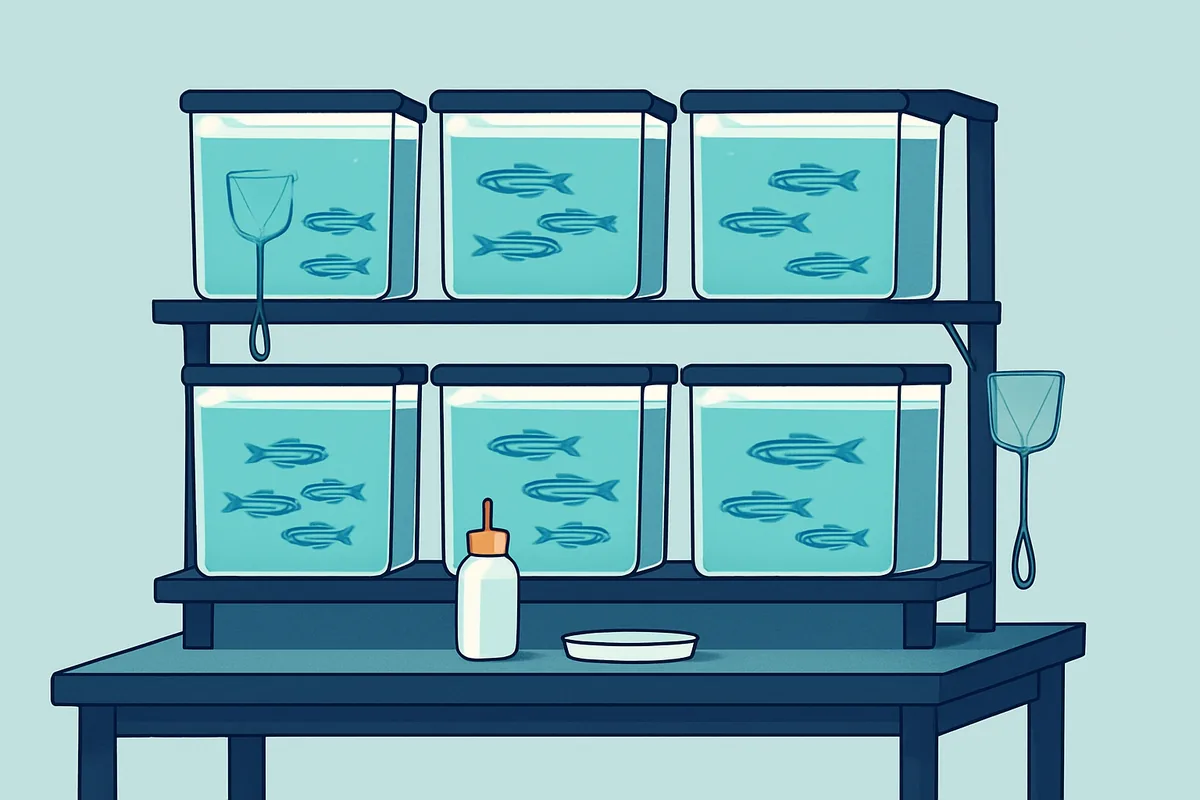
Invertebrate and microbial models are extraordinarily cheap. Worms grow on agar plates seeded with bacteria; a laboratory’s entire collection fits in an incubator. Flies live in vials of prepared medium and a substantial stock collection occupies a few shelves. Neither requires veterinary oversight. Zebrafish need recirculating aquatic systems with controlled temperature, filtration, water chemistry monitoring and daily feeding, which is substantial infrastructure but far below mammalian facilities.
Mice are expensive in ways that surprise people who have not paid for them. Costs include specific-pathogen-free barrier facilities with controlled air handling, individually ventilated cages, per-cage daily charges accumulating over years, veterinary staff, health monitoring, and the labour of genotyping every animal in a breeding colony. Maintaining a genetically modified line costs money continuously whether or not experiments are running, and colonies must be planned so that animals of the right genotype, sex and age exist when the experiment needs them. Cryopreservation of embryos or sperm exists precisely because storing a line frozen is far cheaper than breeding it. Non-human primates add another order of magnitude in cost, regulatory scrutiny and ethical review, and are used only where no alternative can address the question.
These constraints have scientific consequences. Expensive models push toward smaller experiments, which reduces statistical power and contributes to reproducibility problems. Cost pressure encourages reuse of existing strains rather than generating better-matched ones. And accumulated infrastructure around a species keeps drawing new work toward it, sometimes past the point where it is the best biological choice.
Ethical Review and the Three Rs
Work with animals is governed by a framework that most jurisdictions have built around three principles, usually stated as replacement, reduction and refinement.
Replacement means using a non-animal method wherever one can answer the question: cell culture, organoids, computational modelling, invertebrate work outside regulatory scope, human tissue studies. The principle has become considerably more actionable as human cell models improved.
Reduction means using the smallest number of animals that yields a reliable answer. Notably this is not simply “fewer”, because an underpowered experiment wastes animals entirely by producing a result nobody can trust. Proper statistical design, better experimental design, and sharing tissue between projects are the practical mechanisms.
Refinement means minimising suffering in the animals used: better anaesthesia and analgesia, humane endpoints defined in advance so an animal is not carried to death when the result is already clear, environmental enrichment, and handling methods that reduce stress. Refinement also improves data quality, because stressed animals are physiologically different animals, so this is not purely an ethical consideration.
The regulatory structure implementing these varies but shares a shape. Projects require prior approval from an ethical review body that weighs likely benefit against likely harm to the animals. Researchers require training and demonstrated competence. Facilities are licensed and inspected. Records are kept and published in aggregate. Procedures are classified by severity, with the most severe requiring specific justification.
An important detail is scope. Regulations generally cover vertebrates and some cephalopods, so worms and flies fall outside them, which is part of why invertebrate models carry so much early-stage screening. Some frameworks extend protection to late-stage vertebrate embryos, which affects zebrafish work.
The framework is not a formality. It shapes experimental design directly, and one of its more useful side effects is that it forces researchers to state in advance what the experiment will show and how many animals it will take, which is straightforwardly good practice regardless of the ethics.
Emerging Alternatives to Animal Models
Several developing approaches are shifting where the boundary sits, and the honest summary is that they are moving it steadily rather than dissolving it.
Human cell and organoid models have advanced substantially. Induced pluripotent stem cells allow human tissue to be generated from any donor, carrying that donor’s genetics, and three-dimensional culture produces tissue with realistic local architecture. Their limitation is the absence of circulation, immune cells and inter-organ interaction. Organ-on-chip systems add what static culture lacks: microfluidic channels providing flow, mechanical strain reproducing breathing or peristalsis, and multiple chambers linked so that one tissue’s output reaches another.
Computational modelling has become genuinely useful for predicting drug distribution and clearance from a compound’s physical properties, and increasingly for flagging likely toxicity before anything is synthesised. It works best where the underlying biology is well characterised, which limits it for novel mechanisms.
Human data collected directly is an underrated category. Large-scale genetic studies in human populations, tissue obtained during surgery, and carefully designed early-phase clinical studies all provide human-specific information that no model can supply. Genetic evidence that a variant affects disease risk in people is a strong starting point precisely because it needs no translation step.
What none of this replaces yet is the whole organism. Studying how a drug distributes through a body, how an immune system responds over weeks, how organs influence each other, or how a chronic disease progresses over a lifespan still requires something with all of those properties at once. The realistic trajectory is a steady narrowing of the domain where animals are the only option, driven by better human models, alongside a continuing role for animals in whole-body questions. That is a slower and less satisfying story than replacement, and it is the one the evidence supports.
Frequently asked questions
Why do so many findings from mouse studies fail in human trials?
Several reasons compound. The biology genuinely differs, most sharply in immunity, metabolism and brain function. Laboratory mice are often genetically uniform and housed in clean, controlled conditions, unlike the varied, older and multiply-affected human populations that trials recruit. Disease models frequently reproduce a symptom rather than the underlying human disease. And publication pressure favours positive results, so the mouse literature likely overstates effects that human trials then fail to reproduce.
Are fruit flies and worms really relevant to human disease?
Yes, for a specific class of question. The core machinery of cells and the major developmental signalling pathways are conserved across animals, so genes controlling those processes have human counterparts doing related jobs. A substantial number of human disease genes have recognisable fly equivalents. These organisms are best used to identify genes and dissect mechanisms at scale, with mammalian work then testing whether the mechanism operates the same way in a mammal.
Why is the zebrafish so widely used now?
Because it occupies an unusually favourable position on the trade. It is a vertebrate with a backbone, heart, kidney and vertebrate nervous system, yet it produces large clutches of externally developing embryos that are optically transparent, so organ formation can be watched directly in a living animal. It is far cheaper to house than mice and permits screens at a scale mammals cannot support, which makes it a natural bridge between invertebrate genetics and mammalian work.
Does the Three Rs framework actually reduce animal use?
It changes practice measurably, though total numbers depend on how much research is being done overall as well as on efficiency per project. Replacement has grown as human cell models improved. Refinement has clearly advanced through better analgesia, defined humane endpoints and enrichment. Reduction is the subtlest, because using too few animals wastes them by producing unreliable results, so genuine reduction comes from better statistical design rather than simply smaller groups.
Will animal research eventually stop entirely?
Not in the near term, and the reason is structural. Non-animal methods cannot yet reproduce a circulation delivering drugs to tissues, a full immune response developing over weeks, several organs affecting one another, or a disease progressing across a lifespan. Those are precisely the questions much animal work exists to answer. What is realistic, and is already happening, is a steady contraction of the domain where an animal is the only option, as human models and computational approaches take over questions they can genuinely address.
When you next read that something was shown in mice, or in flies, the useful question is what kind of claim it was. If the claim concerns a conserved cellular mechanism, the organism was probably well chosen and the finding is likely to hold. If it concerns immunity, metabolic regulation, or anything resembling behaviour, treat it as a hypothesis about humans rather than a result in them. That distinction is the working knowledge that model organism biologists apply constantly, and it explains most of what looks from outside like scientific inconsistency.