
Someone is told their drug screen came back positive. They know they have taken nothing, and the natural conclusion is that the laboratory made a mistake. In most cases the laboratory did exactly what it was designed to do, and the result is not yet a finding at all.
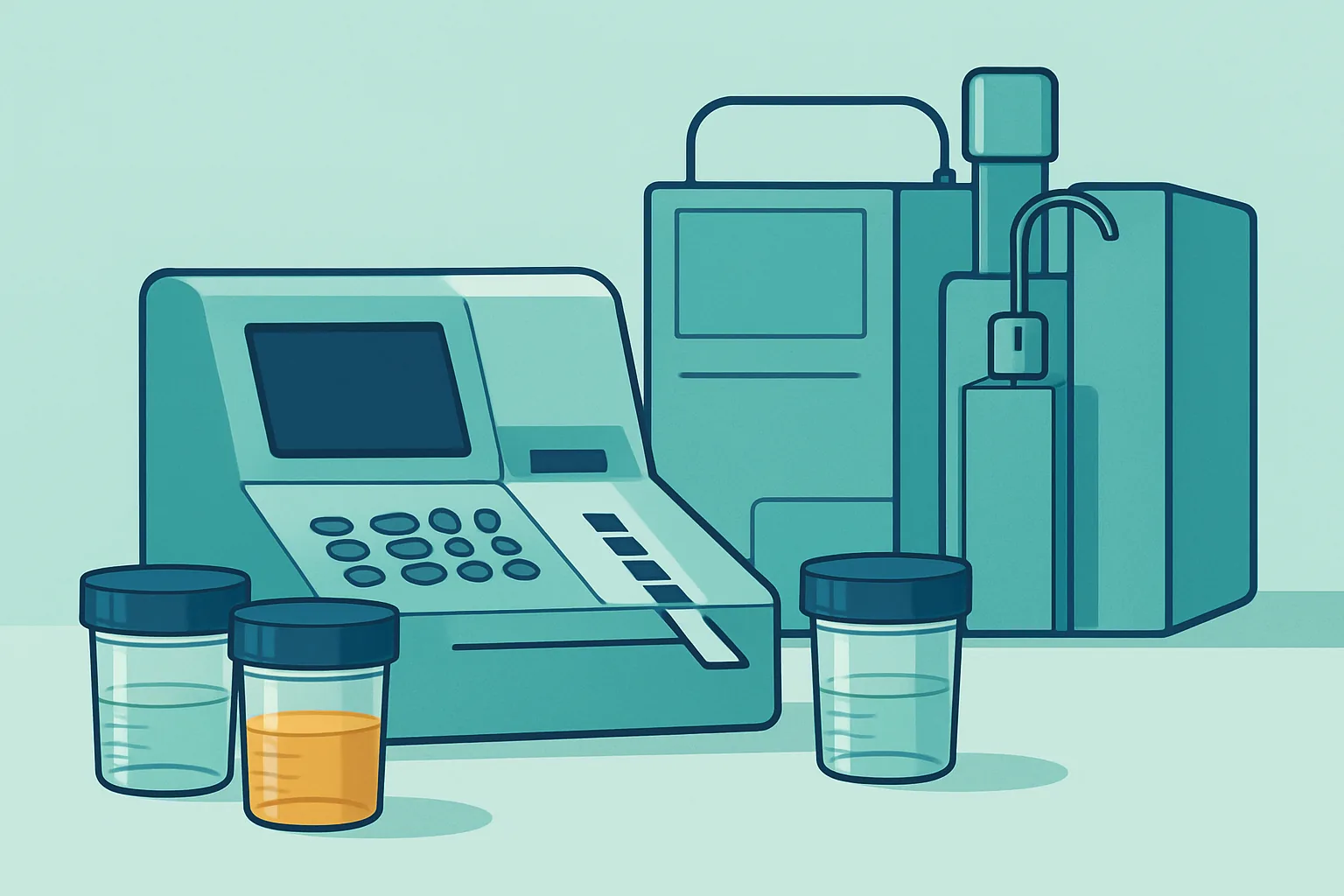
Drug testing programmes are built in two stages on purpose. The first stage is an immunoassay: fast, inexpensive, capable of running hundreds of samples an hour, and deliberately tuned to be broadly reactive rather than precisely specific. The second stage is mass spectrometry, which identifies a specific molecule with near-certainty but is slower and considerably more expensive. The screen is designed to be over-inclusive so that the confirmation, which is the actual test, only has to run on a small fraction of samples.
The system works well when everyone understands it. It causes real harm when a preliminary positive is treated as a conclusion, which happens most often when the result reaches someone outside the laboratory before confirmation has run. Understanding how each stage works, and what each can and cannot establish, is the difference between an inconvenience and a wrongly lost job.
Key takeaways
- An immunoassay screen is a preliminary result by design and is not sufficient evidence that a substance is present.
- Screens use antibodies that recognise a molecular shape, so structurally similar compounds can trigger a positive.
- Cut-off concentrations are administrative thresholds, not the detection limit of the method.
- Confirmation by mass spectrometry identifies specific molecules and effectively eliminates cross-reactivity.
- Detection windows differ enormously between urine, blood, oral fluid and hair, and none of them measure impairment.
How Immunoassay Drug Screens Work
An immunoassay uses an antibody raised against a target drug or a class of related drugs. The antibody binds molecules with a particular three-dimensional shape and charge distribution, and the assay converts that binding into a measurable signal.
Most drug screens use a competitive format, which is initially counter-intuitive. The reagent contains a fixed, limited amount of antibody and a labelled version of the drug supplied by the manufacturer. When the sample is added, any drug present in it competes with the labelled version for the available antibody binding sites. More drug in the sample means less labelled drug bound, which means less signal. The signal therefore falls as concentration rises, and the instrument reads that inverted relationship back out as a concentration estimate.
This format exists because the target molecules are small. Sandwich assays, where two antibodies bind the same target simultaneously, need a molecule large enough to present two distinct sites, and most drugs are far too small for that. Competition is the only workable approach.
The consequence that matters is what the antibody is actually recognising. It does not recognise “amphetamine” as a concept. It recognises a shape. Antibodies used in drug screening are frequently raised deliberately against a shared structural core so that one reagent detects an entire family, which is efficient when the family members are all of interest. The same broad recognition means that any unrelated compound presenting a similar face to the antibody will also bind, and the assay has no way to tell the difference.
Cross-Reactivity and Common False Positives
Cross-reactivity is not a defect. It is the direct and unavoidable consequence of using shape recognition to detect small molecules, and it is the reason the confirmation step exists.
Certain patterns recur across laboratories. Amphetamine-class assays are the most affected, because the amphetamine backbone is a small and extremely common structural motif shared by many decongestants, appetite suppressants, some antidepressants, and several prescription medicines used for entirely unrelated conditions. Opiate assays vary in how they handle the wider opioid family and can respond to dietary poppy seed, since poppy seeds genuinely contain trace morphine. Assays for some sedative classes can respond to structurally related prescription medicines. Cannabinoid assays are relatively specific but have historically shown reactivity with certain unrelated drugs depending on the reagent.
Two points are worth holding onto. First, the specific pattern of cross-reactivity is a property of the individual reagent, not of drug testing in general, and manufacturers publish tables listing which compounds interfere and at roughly what concentration. Two laboratories using different reagents can genuinely disagree about the same sample at the screening stage. Second, a cross-reacting compound usually has to be present at a much higher concentration than the target drug to produce a positive, which is why ordinary therapeutic doses of an interfering medicine sometimes cause a positive and sometimes do not.
The practical implication for anyone being tested is to disclose medications to the medical review process rather than to the collector, and to expect that disclosure to matter at the confirmation and review stage rather than preventing the screen from flagging.
Cut-Off Concentrations and Their Consequences
A cut-off is a concentration threshold above which a sample is reported as a preliminary positive. It is chosen administratively, and it is not the lowest concentration the instrument can detect.
This distinction is the source of endless confusion. An assay may be capable of detecting a drug well below the cut-off, and the laboratory will still report the sample negative, because reporting is defined by the threshold rather than by detectability. Programmes set cut-offs above the level where incidental exposure, minor contamination or assay noise would generate positives, accepting that this makes low-level use invisible. That is the intended trade.
Cut-offs also differ between the two stages, and confirmation cut-offs are typically lower than screening cut-offs.
| Feature | Screening immunoassay | Confirmatory mass spectrometry |
|---|---|---|
| What it detects | A molecular shape, often a whole drug class | A specific named molecule |
| Typical throughput | High; automated, minutes per sample | Lower; longer preparation and run |
| Cost per sample | Low | Substantially higher |
| Cross-reactivity | Expected and documented | Effectively eliminated |
| Cut-off role | Sets who gets confirmed | Sets what is reported as present |
| Result status | Preliminary only | Definitive, defensible |
The reason confirmation cut-offs can sit lower is that the method no longer needs a margin for interference. Once the analyte is identified by both its chromatographic behaviour and its mass fragmentation pattern, a lower concentration can be reported with confidence. This occasionally produces the situation where a sample screens negative but would have confirmed positive had it been sent on, which is a deliberate feature of a system that prioritises defensibility over sensitivity.
Confirmatory Mass Spectrometry Explained
Confirmation combines two independent separations, and the combination is what makes it definitive.
The first is chromatography. The sample is prepared to remove the bulk of the matrix, then injected onto a column where compounds travel at different speeds according to their chemistry. Each compound emerges at a characteristic retention time, which is the first piece of identifying evidence. Gas chromatography is used for volatile and derivatised compounds; liquid chromatography handles a broader range and now dominates in clinical toxicology.
The second is mass spectrometry. Molecules emerging from the column are ionised and sorted by mass-to-charge ratio. In tandem instruments the process runs twice: a precursor ion of the expected mass is selected, fragmented in a collision cell, and specific product ions are measured. A given molecule fragments in a characteristic and reproducible pattern, so requiring both the correct precursor mass and the correct product ions at the correct ratio is a demanding test that essentially no other compound in the sample will pass by coincidence.
Quantification uses an internal standard, typically the same molecule synthesised with heavy stable isotopes. It behaves identically through extraction and chromatography but has a different mass, so it corrects for sample-to-sample variation in recovery and instrument response. This is why confirmatory numbers are far more reliable than screening estimates.
The limitation is scope. A confirmation method looks only for the compounds it was set up to find. A substance not on the panel will not be reported, however much of it is present, which is why novel compounds designed to evade routine panels remain a persistent problem for testing programmes.
Chain of Custody in Testing Programmes
Where a result carries consequences, the analytical work is only half of what makes it defensible. The other half is documentation proving that the sample tested was the sample collected, unaltered.
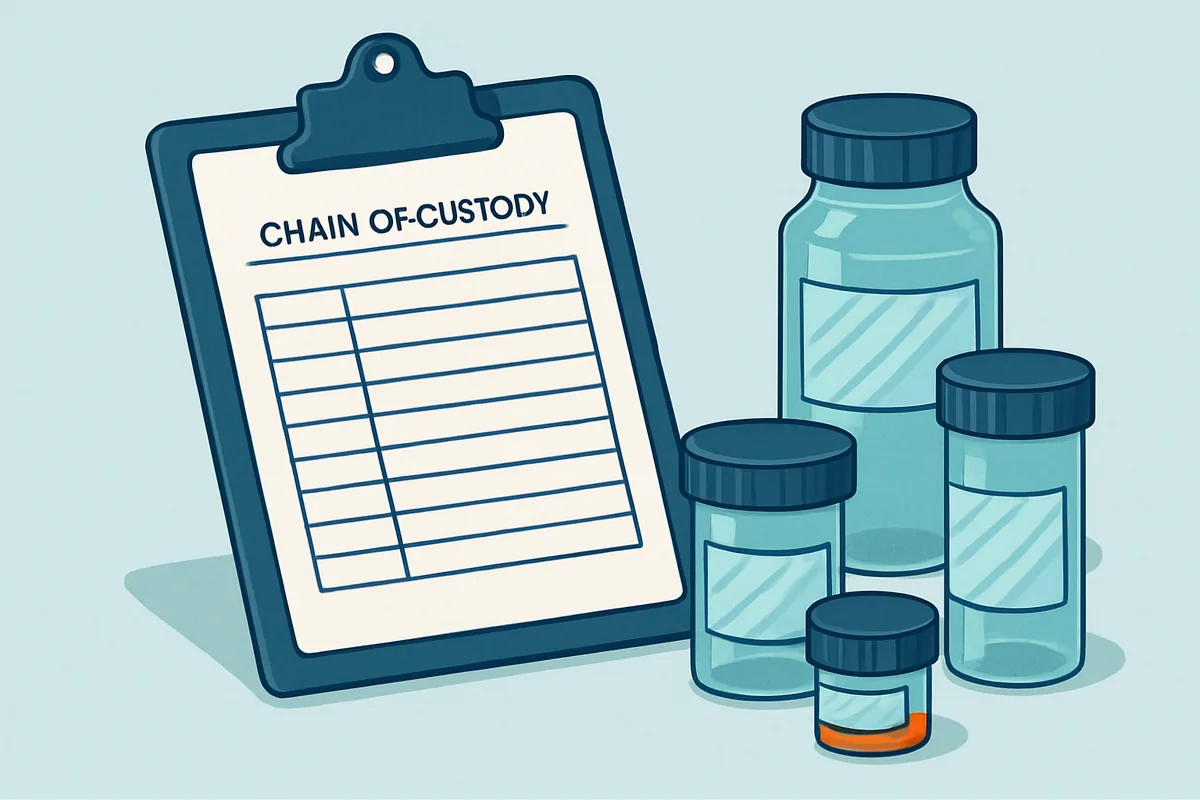
Chain of custody is a continuous written record. Collection is witnessed or observed under defined conditions, the container is sealed with tamper-evident seals in the donor’s presence, the donor initials the seal, and every subsequent transfer of the sample is signed and dated by both parties. The laboratory records receipt, notes seal integrity, and documents every aliquot taken. Any gap in that record is a defect that can invalidate the result regardless of how good the chemistry was.
Split-sample collection is a standard protection. The specimen is divided into two sealed containers at collection, one tested and one held. If the donor disputes a confirmed positive they can request the second container be tested at a different certified laboratory, and both the seal and the independent result stand as evidence.
The medical review stage is the other safeguard. In regulated programmes a qualified reviewer contacts the donor before a confirmed positive is reported to anyone else, and asks whether a legitimate explanation exists. A valid prescription that accounts for the finding results in the report being changed to negative. This step is precisely where disclosed medication becomes relevant, and skipping it, which happens in less formal programmes, removes the main protection against a result that is analytically correct and administratively wrong.
Adulteration, Dilution and Sample Validity
Because urine is collected out of direct observation in most settings, laboratories test the sample itself for signs of tampering, quite separately from testing for drugs.
Validity testing checks a small set of physical and chemical properties. Creatinine concentration and specific gravity together indicate whether the sample has been diluted, either by drinking large volumes of fluid beforehand or by adding water directly. pH outside the physiological range suggests an added acid or base. Oxidising activity indicates a chemical adulterant intended to destroy drug molecules in the sample. Temperature measured immediately at collection indicates whether the sample was recently produced by the donor or brought from elsewhere.
Each has a defined outcome. A sample that is dilute but within physiological limits is usually reported as dilute and often recollected. A sample outside physiological limits for creatinine or pH is reported as substituted or adulterated, which in most programmes is treated the same as a positive, or worse, because it implies intent.
Adulteration is largely a solved problem from the laboratory’s side. Commercial products marketed for defeating tests generally either fail to destroy the analyte, or leave detectable traces of the oxidising agent, or shift the sample’s basic chemistry into a range that validity testing flags immediately. Dilution is more difficult, because moderate dilution is genuinely common and innocent, which is why the response to a dilute sample is usually recollection rather than accusation.
Detection Windows Across Sample Types
Different specimens answer different questions, and choosing the wrong one produces a technically correct result that does not address what anyone wanted to know.
Urine is the workhorse. Drugs and their metabolites concentrate in urine, so sensitivity is good and the detection window runs from hours to several days for most substances, longer for heavy chronic use of some compounds. What urine cannot indicate is when the drug was taken or whether the person was impaired at any point, because it reflects accumulated excretion rather than current circulating concentration.
Blood is the only specimen that relates meaningfully to impairment, because it measures what is reaching the brain at the moment of sampling. Its window is correspondingly short, often hours, and collection is invasive. This is why blood is used in impaired-driving and clinical contexts and rarely in workplace programmes.
Oral fluid sits between the two. It broadly tracks recent use, collection is easy and can be directly observed without the dignity problems of urine collection, and the window is typically shorter than urine. It has become common in roadside and workplace settings for those reasons.
Hair offers a long retrospective window, potentially months, because drug incorporates into the growing shaft. It cannot show recent use, since newly grown hair takes time to emerge, and interpretation is complicated by external contamination and by variation in incorporation between individuals.
None of these measures impairment except blood, and even blood does so imperfectly for many substances. A test tells you a molecule was present. What that means about behaviour is a separate question that the laboratory cannot answer.
Frequently asked questions
Can poppy seeds really cause a positive opiate screen?
Yes, because poppy seeds carry trace morphine from the plant, and enough of it can appear in urine after a substantial portion to exceed a screening threshold. Programmes have addressed this partly by raising opiate cut-offs and partly through confirmation and medical review, which can look for markers that distinguish dietary exposure from heroin use. It remains a genuine and well-documented interference rather than an urban myth.
If a screen is positive but confirmation is negative, what happened?
Almost always cross-reactivity: something in the sample bound the antibody without being the target drug. It can also happen when the drug was present just above the screening threshold but below the confirmation reporting limit for the specific analyte, or when the screen detects a class while confirmation looks for particular members of it. In every case the reportable result is the confirmation, and the correct report is negative.
Does drinking a lot of water before a test help?
It lowers the concentration of everything in the urine, which is exactly what validity testing looks for. Creatinine and specific gravity fall together, the sample is flagged as dilute, and the usual consequence is a recollection, often under observed conditions. Deliberate over-dilution to the point of falling outside physiological limits is treated as substitution in most programmes, which typically carries the same consequence as a positive.
Why do laboratories not just use mass spectrometry for everything?
Cost and throughput. Confirmation requires more sample preparation, longer instrument time, isotope-labelled internal standards and highly trained analysts. Screening the whole population and confirming only the small fraction that flags achieves the same final accuracy at a fraction of the total cost. Some laboratories have moved toward broad mass spectrometry screening as instruments have become faster, but the two-tier logic still holds wherever volumes are high.
Does a positive result show that someone was impaired at work?
No, and this is the most consequential misunderstanding in the field. Urine and hair testing measure past exposure over windows of days to months, with no relationship to concentration at any particular moment. Even blood, which does reflect current levels, maps imperfectly onto impairment because tolerance and individual response vary widely. Testing programmes generally rest on policy rather than on any claim to measure fitness for work at the moment of collection.
If a preliminary positive lands in front of you, the useful response is neither panic nor denial. Ask whether confirmation has been run, and on what specific analyte. Ask whether medical review has taken place and whether prescribed medications have been considered. Ask whether a split sample was collected and is still available. Each of those questions targets a stage that is designed to catch exactly this situation, and a screening result that has not yet passed through them is not, in any meaningful sense, a result.
This is education, not medical advice. Laboratory results only carry meaning alongside your symptoms, history and examination. Talk to a qualified clinician about your own results before changing anything about your care or supplements.