
Automation is sold on a simple proposition: the robot works without breaks, does not make transcription errors, and frees skilled staff for work that requires judgement. All three claims are true. None of them determines whether a particular installation will pay for itself.
What determines that is the interaction of two thresholds. Above a certain throughput, the fixed cost of automating is spread thin enough that the per-sample saving becomes decisive. Below a certain level of process variability, the robot can execute the work without constant human rescue. Installations that satisfy both do extremely well. Installations that satisfy one but not the other tend to become expensive, under-used equipment that staff work around rather than with.
Key takeaways
- Automation replaces repetitive execution, not decision-making, and its value comes as much from consistency as from speed.
- Advertised liquid handler throughput ignores tip changes, plate movement, deck reloading and method overhead, which usually dominate real cycle time.
- Track systems in clinical laboratories deliver most of their benefit before analysis, in sorting, centrifugation, decapping and storage.
- High sample-to-sample variability in container, volume or condition defeats automation faster than any technical limitation.
- Method transfer and revalidation are usually the largest hidden cost, and they recur with every software update and method change.
What Automation Actually Replaces
The first question to answer honestly is which part of the work is being handed over, because the answer determines where the benefit comes from.
Automation is good at repetitive physical execution to a fixed specification: moving a defined volume from a defined position to another defined position, repeating an operation hundreds of times without fatigue, holding a timing tolerance exactly, and recording what it did. It is poor at recognising that a sample looks wrong, deciding that a result needs a different approach, or improvising when something is not where the method says it should be.
This means the tasks worth automating are those where the specification is complete and the inputs are uniform. Serial dilutions, plate replication, reagent addition across a plate, nucleic acid extraction from a standard sample type, library preparation with a fixed protocol, and sample aliquoting into daughter tubes all qualify. Method development, troubleshooting, interpreting an unusual result, and any process where the operator routinely adapts the procedure to the sample do not.
The benefit is frequently misattributed. Managers propose automation to save staff time, but in many laboratories the dominant return is consistency rather than headcount. A robot’s coefficient of variation on a repeated pipetting step is typically better than a skilled human’s, and far better than a team of humans of mixed experience working across three shifts. Where downstream results depend on precise volumes, that reduction in variability shows up as fewer repeats, tighter quality control, and less argument about whether an outlier was real.
The second benefit that survives scrutiny is traceability. An automated system logs what it did, when, with which reagent lot, in which position. Reconstructing that from a paper worksheet is slow and incomplete. In regulated settings, that logging alone can justify a substantial part of the cost.
Liquid Handlers and Their Real Throughput

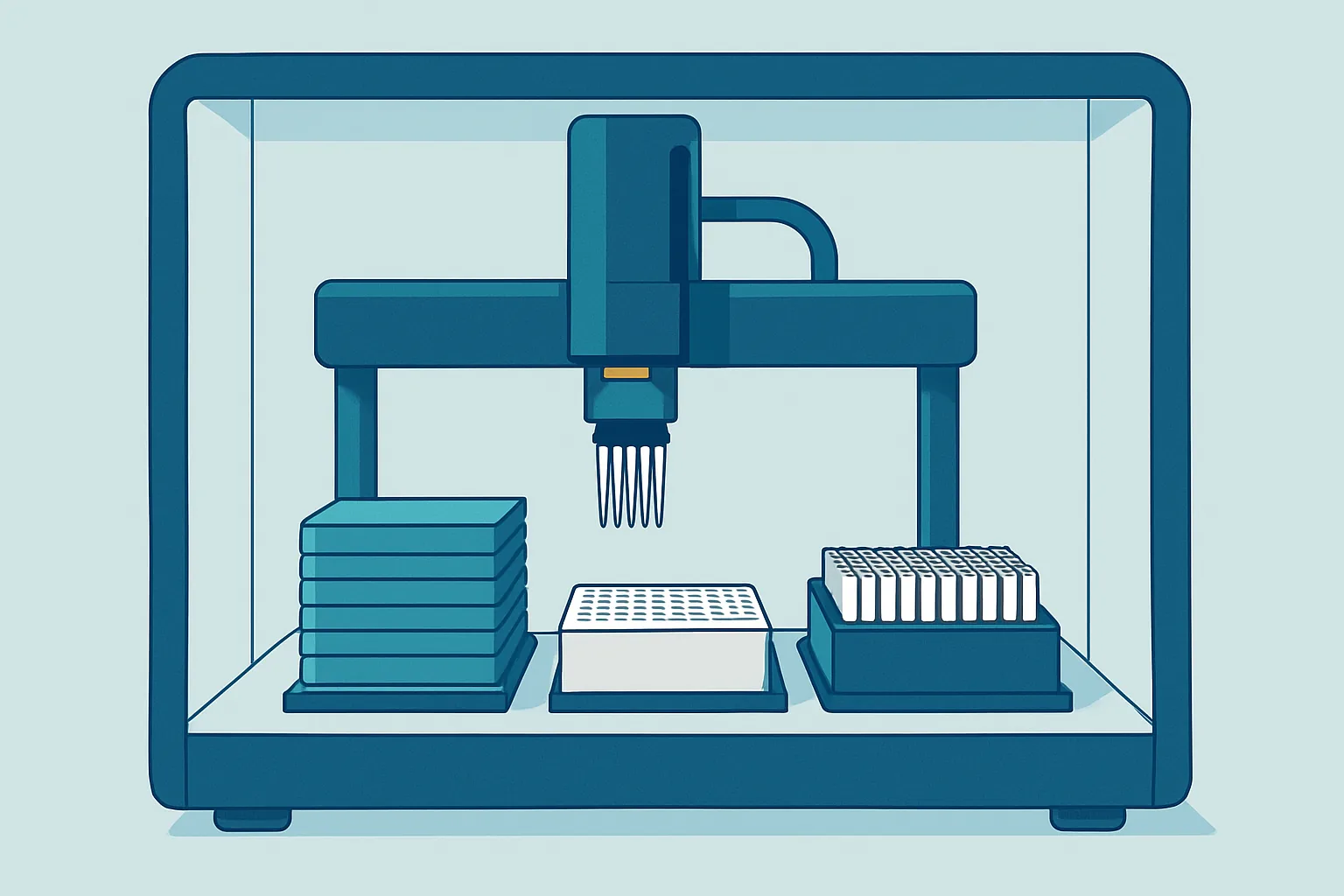
The headline figure in a liquid handler specification is derived from the maximum aspirate and dispense rate of the pipetting head. Real throughput is set by everything else.
Consider a plate-based operation. The head must move to the tip rack, pick up tips, move to the source, aspirate with a defined delay for viscous liquids, move to the destination, dispense, possibly mix, move to the waste chute, eject the tips, and return. Every one of those movements takes time, and for a protocol requiring a tip change between samples, the tip handling alone can approach or exceed the time spent moving liquid.
Deck capacity is the next constraint. A robot can only run unattended while it has tips, plates, reagent troughs and waste capacity on its deck. When the deck is exhausted, a human reloads it, and the run stops until they do. A system with generous deck space and stacker hotels genuinely runs unattended for hours; a compact system with a small deck requires attention every twenty minutes, which does not free the operator to do anything substantial elsewhere.
| Contributor | Manual process | Automated process | Net effect |
|---|---|---|---|
| Liquid transfer itself | Moderate, operator dependent | Fast and consistent | Automation clearly ahead |
| Tip handling | Fast, integrated with the motion | Discrete pick and eject cycles | Often comparable |
| Setup and deck loading | Minimal | Substantial per run | Manual ahead |
| Error recovery | Immediate and improvised | Run halts, requires intervention | Manual ahead |
| Small batch of a few samples | Efficient | Setup overhead dominates | Manual clearly ahead |
| Large batch of hundreds | Fatiguing, error prone | Runs to completion | Automation clearly ahead |
| Precision across a batch | Degrades with fatigue | Constant | Automation clearly ahead |
| Overnight or unattended running | Not possible | Possible with adequate deck | Automation clearly ahead |
The shape of that table explains the throughput threshold. Automation carries a large fixed cost per run in setup, deck loading, priming and cleanup, and a small variable cost per sample. Manual work carries almost no fixed cost and a large variable cost. The crossover is a batch size, not a technology preference, and for many methods it sits higher than people expect, often in the region of a full plate or several plates rather than a handful of samples.
Track Systems in Clinical Laboratories
The clinical laboratory is where automation is most mature, and its history is instructive because the biggest gains did not come from the analysers.
Analytical instruments were automated decades ago and are already fast. What remained manual, and remained slow, was everything around them: receiving tubes, checking them against requests, sorting by destination, centrifuging, removing caps, aliquoting for multiple destinations, carrying racks between benches, recapping and storing samples for the retention period, and retrieving them when a clinician adds a test. Those pre-analytical and post-analytical steps consumed a large share of staff time and generated most of the identification errors.
Total laboratory automation connects the analysers with a conveyor and puts the surrounding steps on it. A tube is loaded once, identified by barcode, and routed automatically to centrifuge, decapper, aliquoter and analysers in the order its requests demand, then to a refrigerated store. Add-on requests within the retention window are retrieved by the system without anyone searching a rack.
The benefits that show up most reliably are reduced turnaround time variability rather than reduced average time, fewer specimen identification errors because the tube is handled less, better ergonomics, and the ability to run a night shift with fewer staff. Reduced average turnaround is real but is often smaller than expected, because analysis time was never the dominant component for routine work.
The costs are correspondingly large. A track requires floor space in a specific layout, and retrofitting one into a laboratory designed around benches usually means rebuilding the room. It ties the laboratory to a vendor’s ecosystem, since analyser compatibility with the track is not universal, which constrains future purchasing decisions and weakens negotiating position on reagents. And it introduces a shared failure point: when a section of track stops, everything downstream stops, so a manual contingency route must exist and staff must practise it.
The scale threshold is genuinely high. Full track automation makes sense for laboratories processing large daily volumes with a stable test mix. Below that, modular automation of individual steps, such as a standalone automated centrifuge and decapper or an aliquoting workstation, captures much of the benefit at a fraction of the cost and without the architectural commitment.
Where Variability Defeats Automation
The second threshold is the one that catches laboratories out, because variability is invisible in a process map and obvious only in practice.
Container variability is the most common. An automated system expects tubes of defined dimensions in defined racks with barcodes in a readable position. A sample stream that includes several tube geometries, referred samples in unfamiliar containers, hand-written labels, labels applied over the barcode, or tubes filled to varying levels requires human intervention on every exception. Above a certain exception rate, the operator is effectively running a manual process interrupted by a robot.
Sample condition variability is next. Automated liquid handling assumes predictable fluid behaviour. Highly viscous, lipaemic, foaming, clotted or particulate samples do not aspirate predictably, and liquid level detection can be defeated by foam or by fibrin. Systems handle this to a degree with pressure monitoring and error flagging, but each flag is an intervention.
Protocol variability defeats automation quietly. A method that is nominally fixed but in practice adapted by experienced staff, such as extending an incubation when a sample looks weak or changing a dilution based on an expected result, cannot be automated without first deciding what the rule actually is. Frequently that decision reveals that the process was never standardised, and standardising it delivers benefits regardless of whether the robot is ever purchased.
The useful diagnostic before committing is to count exceptions honestly over a representative period. What proportion of samples arrive in a non-standard container, in unusual condition, with an incomplete request, or requiring a deviation from the standard protocol? A low exception rate makes automation attractive. A high one means the money is better spent upstream, standardising collection, containers and requesting, and the automation case should be revisited afterwards.
Method Transfer and Revalidation Effort
Moving a validated manual method onto an automated platform is not a translation exercise. It is a new method that happens to have the same intent, and it usually needs to be validated as one.
The reasons are physical. Automated pipetting uses different tip geometry, different aspiration speeds and different dispense mechanics from a human with a hand pipette. Mixing by aspiration differs from vortexing. Timing becomes exact where it was previously approximate, which can change results if a step was tolerant of a longer incubation that staff routinely gave it. Dead volumes differ, so reagent consumption changes. Evaporation from an open plate over a long automated run differs from a short manual one. Any of these can shift a result enough to matter.
The work required therefore includes comparing automated and manual results across the analytical range on real samples, establishing precision on the new platform, confirming that carryover between wells and between runs is acceptable, and demonstrating that the method performs at both the smallest and largest batch sizes it will be run at. For regulated work, that comes with installation, operational and performance qualification, updated procedures, and retraining with documented competency.
The part most often underestimated is that this is not a one-off. Instrument control software updates can alter timing or motion in ways that require at least partial revalidation. Changing a consumable, such as a different tip supplier, changes fluid behaviour and needs verification. Adding a new sample type to an existing method requires demonstrating that it behaves like the validated ones. A laboratory running many automated methods carries a permanent revalidation workload, and it needs someone whose job includes it.
Maintenance Burden and Downtime Risk
An automated system concentrates risk. Ten technicians pipetting is a resilient arrangement; if one is ill, output falls by a tenth. One robot doing the work of ten is efficient until it stops, at which point output falls to whatever the manual contingency can sustain.
Preventive maintenance is not optional and is not trivial. Pipetting channels need seals and O-rings replaced on schedule, and volume accuracy needs periodic verification against a gravimetric or photometric standard. Robotic arms need alignment checks, since deck teaching drifts and a gripper that misses a plate by a millimetre will eventually drop one. Washers and dispensers need cleaning regimes to prevent salt crystallisation and blockage. Track systems need belt, sensor and gate maintenance along their length. Most of this requires a service contract, and service contracts on complex automation are a significant recurring cost, commonly a meaningful percentage of the capital price each year.
Downtime planning is the piece that distinguishes laboratories that cope from those that do not. Before the system arrives, decide what happens when it fails: whether the manual method remains validated and staff remain competent in it, whether a second system or a partner laboratory can absorb work, and what the acceptable outage duration is. Then negotiate the service response time against that answer. A four-hour response commitment costs more than a next-business-day one and is worth it only if the outage cost justifies it, which the downtime analysis will tell you.
Calculating a Realistic Payback Period
The business case should be built from measured figures for your own process rather than vendor models, and it should be honest about what is genuinely saved.
On the cost side, include the capital price, installation and any room modification, method development and scripting, validation and qualification, training, the annual service contract, consumables at your real per-sample rate including dead volume and tip usage, and the ongoing revalidation effort. Include the cost of the fallback arrangement if one is being maintained.
On the benefit side, quantify hands-on time saved per batch, multiplied by realistic batch numbers per year and by fully loaded staff cost. Then apply the test that separates good business cases from wishful ones: is that time actually recovered? If the staff member remains present, reloading the deck and monitoring the run, the saving is partial. If they are redeployed to work that would otherwise have required another hire, the saving is real. If they simply have a less tiring day, that is a genuine benefit for retention and error rates but it is not a cash saving, and it should be stated as what it is.
The resulting payback period should be compared against the system’s realistic service life and, more importantly, against the vendor’s likely support horizon. A five-year payback on a platform the manufacturer will stop supporting in six is not a good investment. A two-year payback on a well-supported platform running near capacity is straightforward.
Frequently asked questions
At what sample volume does automation start to make sense?
There is no universal number, because it depends on how long the manual method takes per sample and how much fixed overhead the automated run carries. The reliable approach is to measure both: time a technician through a full manual batch, then estimate the automated cycle including setup, deck loading, run time and cleanup. Where the two curves cross is your threshold. For plate-based work it frequently falls around a consistently full plate per run, several times a week; for sporadic small batches, manual work usually stays ahead.
Will automation let me reduce staff numbers?
Sometimes, but it is the least dependable benefit and the one most often overstated in business cases. Automation usually changes what staff do rather than how many are needed: someone must load decks, resolve errors, maintain methods and handle exceptions, and those tasks require more skill, not less. The more robust benefits are absorbing growth without new hires, running additional hours without additional shifts, and reducing repeats. Building a case on headcount reduction alone tends to disappoint everyone.
What is the most common reason an automation project underdelivers?
Automating a process that was never standardised. When experienced staff have been quietly adapting a protocol to each sample, writing it as a fixed script exposes decisions nobody had formalised, and the robot either executes the wrong rule consistently or halts on every exception. The second most common reason is underestimating exception rates in the incoming sample stream, so that a system designed for hands-off running requires constant intervention.
Do I need a full track system or will modular automation do?
Most laboratories below very high daily volumes get the majority of the available benefit from modular automation: a standalone centrifuge and decapper, an aliquoting workstation, an automated storage and retrieval unit. These address the pre-analytical steps where the errors and the labour actually concentrate, cost far less, do not require rebuilding the room, and leave future analyser purchases unconstrained. Full track integration earns its cost at high, stable volume with a settled test mix.
How should I plan for the system being down?
Decide the acceptable outage length before you buy, because that decision drives the service contract you need. Keep the manual method validated and keep staff competent in it by running it periodically rather than only in a crisis, and check that the reagents and consumables it needs are still in stock and in date. Identify whether a second instrument, a neighbouring site or a reference laboratory can absorb work, and confirm that arrangement in advance rather than during the outage.
The decision rarely turns on whether the technology can do the job, since it usually can. It turns on whether your throughput is high enough and steady enough to spread the fixed costs, whether your samples are uniform enough that the system runs rather than halts, and whether you have the scripting and validation capacity to keep methods alive over years. Measure the exception rate, time both versions of the process, and build the payback from your own numbers. Laboratories that do that arithmetic before signing tend to be the ones still pleased with the purchase three years later.