

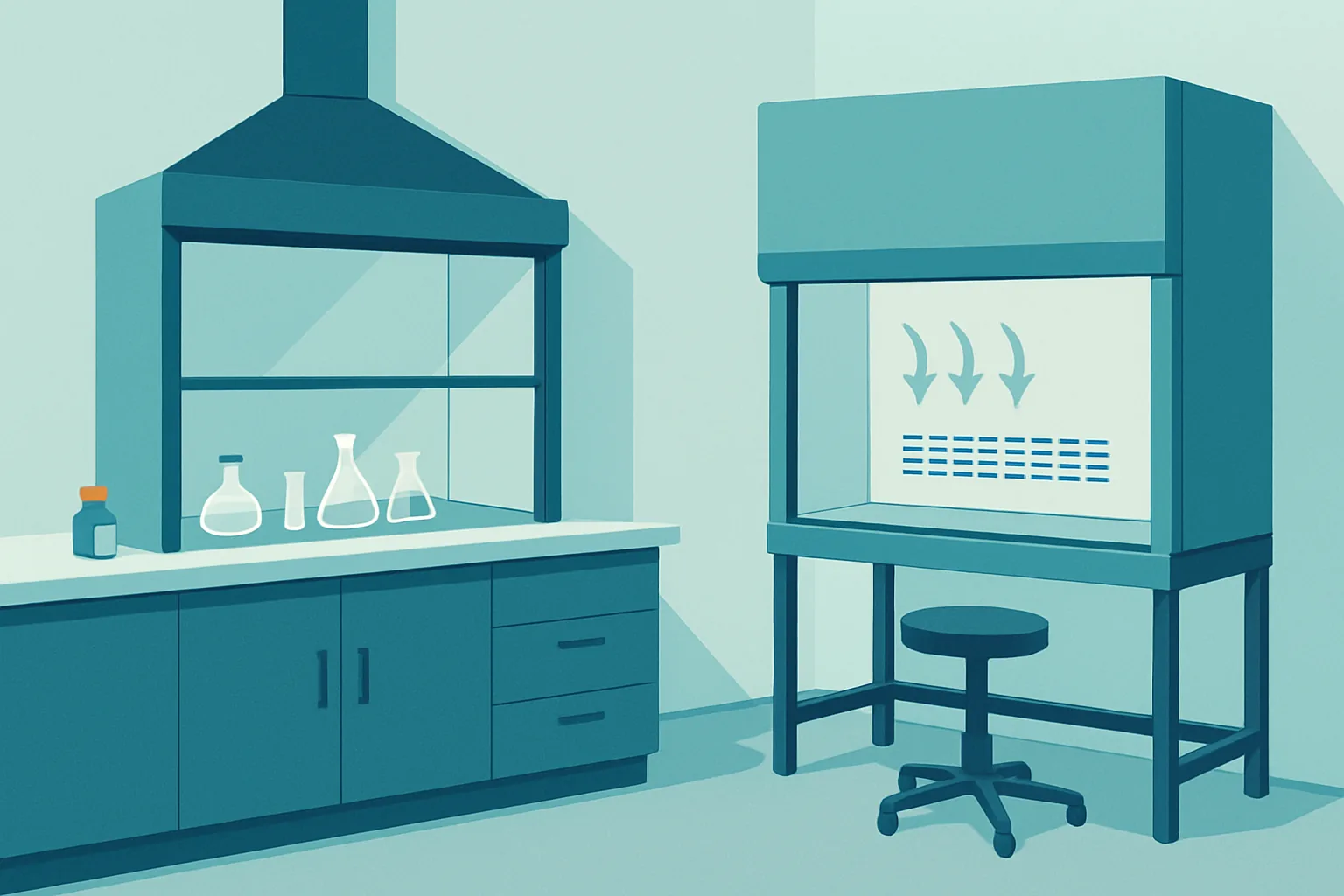
From across a laboratory the two devices look almost identical. Both are enclosures with a work surface, a sliding transparent sash, a fan somewhere and a sticker on the front recording when they were last tested. New staff routinely treat them as interchangeable, and the equipment does nothing to discourage that, because both draw air inwards past the operator and both feel like they are containing something.
They are built on opposite principles. A chemical fume hood protects the person, and it does so by pulling contaminated room air across the work and expelling it outdoors. Nothing about that design protects the material inside, which sits in a stream of unfiltered air from the room. A biosafety cabinet protects the person and the material and the environment, using filtered air delivered downward onto the work surface and filtered air on the way out.
Getting this wrong causes two distinct kinds of accident. Sterile cell culture performed in a fume hood becomes contaminated, sometimes without anyone realising why for months. Volatile or toxic chemistry performed in a biosafety cabinet exposes the operator to vapour the cabinet cannot remove, and can damage the filters that the cabinet’s biological containment depends on. Both errors are common, and both follow from assuming that inward airflow means safety.
Key takeaways
- A fume hood protects the operator from chemical vapour and offers no protection to the material inside.
- A biosafety cabinet protects the operator, the sample and the environment from biological hazards.
- Filters used in biosafety cabinets capture particles and do not remove chemical vapour.
- Class designations describe how much air is recirculated and whether the cabinet is ducted, which determines what may be used inside.
- Certification, correct sash position and unobstructed grilles matter more to real protection than the device type alone.
What a Chemical Fume Hood Protects
A chemical fume hood is, at bottom, a controlled leak. Room air is drawn in through the open front, passes over the work surface, travels up the back of the enclosure and is discharged through ductwork to a stack above the roofline. The purpose is to capture vapour, gas, aerosol or dust released inside the enclosure and carry it away before it can reach the operator’s breathing zone.
The performance measure is face velocity, the average speed of air moving through the open sash. Too slow and contaminants escape through the opening; too fast and the stream becomes turbulent, generating eddies at the sash edge and around the operator’s body that can actually carry material outwards. Face velocity is therefore specified as a range rather than a target to be maximised.
The single most important thing about this design is what it does not do. The air arriving over the work is ordinary room air, carrying whatever dust, skin cells, fungal spores and bacteria the laboratory contains. A fume hood provides zero product protection. Anything requiring sterility will be contaminated in one, reliably, and this is not a matter of technique.
The second thing it does not do is filter the exhaust in most installations. Contaminated air goes outdoors, diluted by the atmosphere, which is why the stack must discharge well above the roof and away from air intakes.
Ductless variants draw air through a chemical adsorbent, usually activated carbon, and return it to the room. They suit narrow applications where the chemistry is known and the filter is matched to it, and are genuinely dangerous outside those limits, because a saturated adsorbent bed releases what it captured with no obvious sign.
What a Biosafety Cabinet Protects

A biosafety cabinet is a ventilated enclosure designed for work with infectious or otherwise hazardous biological material. Its defining feature is high-efficiency particulate filtration, applied both to the air delivered over the work surface and to the air leaving the cabinet.
Those filters capture particles with very high efficiency across the size range that matters biologically, including bacteria, fungal spores and the droplet nuclei that carry viruses. The mechanism is not sieving. Larger particles are captured by interception and inertial impaction on the fibres, while very small particles collide with fibres because of their random thermal motion. Efficiency is therefore lowest at an intermediate particle size and higher above and below it.
The airflow arrangement delivers three protections at once. A curtain of air drawn in through the front grille prevents anything generated inside from reaching the operator, giving personnel protection. Filtered air descending vertically onto the work surface sweeps the working area with particle-free air, giving product protection. And filtration of the exhaust prevents release into the room or, in ducted installations, into the environment.
That descending filtered air is what makes these cabinets suitable for sterile work, and it is why cell culture is done in them rather than in a fume hood. The same downward flow explains several handling rules: objects placed on the work surface disturb the airflow downstream of themselves, so items should not be positioned between the filtered supply and open vessels, and rapid arm movements through the front opening disrupt the air curtain that provides the personnel protection.
The critical limitation is that particulate filters do nothing to vapour. A volatile solvent evaporating in a cabinet passes straight through the filter medium. In a recirculating cabinet, it returns to the room.
Airflow Patterns Compared Side by Side
Drawing the two air paths clarifies most of the practical differences.
In a fume hood, air enters at the front, travels horizontally over the work, and exits at the rear and top. It is a single-pass system, and everything in the enclosure sits in that one stream.
In a biosafety cabinet, air drawn in at the front grille does not pass over the work at all in the common designs. It is captured immediately at the grille and drawn into a plenum below or behind the work surface. Separately, air is pushed through a supply filter above and descends onto the work surface as a smooth vertical stream, which splits between front and rear grilles before being recirculated or exhausted through a second filter.
So the work surface is bathed in filtered air that never touched the room, while the operator is shielded by a separate inflow curtain. The two streams meet just inside the sash opening, and that boundary is where containment succeeds or fails.
| Feature | Chemical fume hood | Biosafety cabinet |
|---|---|---|
| Protects the operator | Yes, from vapour and aerosol | Yes, from biological aerosol |
| Protects the sample | No | Yes |
| Protects the environment | By dilution outdoors | By filtration |
| Air over the work surface | Unfiltered room air | Filtered, descending |
| Exhaust treatment | Usually none, ducted outdoors | Particulate filtration |
| Suitable for volatile chemicals | Yes, this is its purpose | Only in specific ducted classes and limited amounts |
| Suitable for sterile technique | No | Yes |
| Typical airflow direction at work surface | Horizontal, front to back | Vertical, top to bottom |
The other difference worth noting is what each does when the fan fails. A fume hood becomes an open box, and vapour escapes into the room. A biosafety cabinet loses both its air curtain and its filtered supply at once, exposing the operator and the work together. Neither has a safe failure mode, which is why airflow alarms are not optional.
Class Designations and Their Meanings
Biosafety cabinet classes describe the balance between protections, and the differences are practical rather than bureaucratic.
A Class I cabinet draws room air across the work and filters all of it before discharge. It protects the operator and the environment but not the product, since the air passing over the work is unfiltered. Functionally it resembles a fume hood with a filtered exhaust, and it suits containment of aerosol-generating equipment such as centrifuges or homogenisers, where sterility is irrelevant.
A Class II cabinet adds the descending filtered air supply and is the type used for the overwhelming majority of biological work. Within Class II there are subtypes that differ in how much air is recirculated within the cabinet and whether the exhaust is discharged to the room or ducted outside. The common general-purpose type recirculates a majority of its air and exhausts the remainder, usually into the room, which makes it unsuitable for anything volatile. Other subtypes exhaust all of their air through ductwork with no recirculation, which permits limited use of volatile chemicals under defined conditions. Some designs place contaminated plenums under negative pressure surrounded by air at negative pressure relative to the room, which adds protection against leaks through the cabinet structure itself.
A Class III cabinet is a sealed glovebox held at negative pressure, with all air filtered on entry and typically double-filtered on exit. Material passes through an airlock or dunk tank, and the operator never shares air with the interior. This is for the highest-risk agents, trading a large loss of dexterity for absolute separation.
The subtype designation tells you whether solvent use is permissible, and it is printed on the cabinet. It cannot be inferred from appearance, and assuming a cabinet is ducted because something duct-shaped sits above it is a recurring mistake, since some recirculating models connect to building exhaust by a loose canopy that does not make them safe for chemical use.
Recirculation and Filtration Differences
The recirculation question is where most cross-over accidents originate.
A recirculating Class II cabinet returns the greater part of its air to the work zone continuously, passing it through the supply filter each time. Particles are removed effectively. Vapour is not, because a particulate filter has no mechanism for capturing individual molecules. Volatile material introduced into such a cabinet accumulates in the recirculating stream and is then exhausted into the room the operator is standing in, at a concentration governed by nothing more than the exhaust fraction and the room ventilation.
There is a second, less obvious harm. Some solvents attack the sealant and the filter medium itself. Damage there is invisible and degrades the biological containment that the cabinet exists to provide, so a single episode of inappropriate chemical use can compromise the cabinet for every subsequent user until the next certification catches it.
Fume hoods have the mirror-image limitation. Because they discharge unfiltered, they are not appropriate for infectious aerosols, which would be released outdoors and, more immediately, are not prevented from contacting the operator’s hands and arms in a horizontal air stream that passes directly over the work.
There is also a category of enclosure that protects only the product: a clean bench blows filtered air outwards, from the back of the cabinet towards the operator. These give excellent product protection and negative operator protection, since anything on the work surface is blown into the user’s face. They suit pouring sterile media or assembling sterile equipment, and nothing infectious, toxic or allergenic. Because they resemble a biosafety cabinet, they are among the most misused devices in laboratories.
Procedures That Need Both Protections
Some work is simultaneously biological and chemical, and this is where planning is required rather than a default choice.
Fixing cells for microscopy involves biological material and a fixative that is volatile and a recognised respiratory hazard. Traditional nucleic acid extraction involves infectious starting material and hazardous organic solvents. Preparing certain cytotoxic drugs combines a potent chemical hazard with a requirement for sterility.
There is no universal answer, but there are recognised routes. The cleanest is to separate the steps: handle the biological material in a biosafety cabinet, inactivate the biological hazard, then move the chemical step to a fume hood. Where inactivation is possible this is almost always better, because it removes the conflict rather than managing it.
Where the steps genuinely cannot be separated, a cabinet that exhausts entirely to the outside through hard ductwork permits limited quantities of volatile material under conditions that must be assessed rather than assumed. Quantities matter: a few millilitres of fixative used in a sealed manner is a different proposition from an open dish of solvent. Pharmacy compounding uses a further variation, placing a containment cabinet inside a negative-pressure room, so that room design supplies the protection the cabinet cannot.
The general principle is to identify each hazard separately and ask which device addresses it, rather than looking for a single box that handles everything. When no available device addresses both, the process itself needs redesigning.
Certification, Testing and Sash Discipline
A containment device is a system comprising the enclosure, the fan, the ductwork, the building ventilation and the person using it. Certification tests the hardware. Discipline supplies the rest.
Biosafety cabinets require certification on installation, after any relocation, after filter replacement and at defined intervals thereafter. Testing includes measuring inflow and downflow velocities, checking the filters for leaks by challenging them with a test aerosol and scanning the downstream face, and verifying that the air curtain actually contains material at the front opening. Moving a cabinet even a short distance invalidates certification, because vibration disturbs filter seals. The certification sticker records the date and the class or subtype, and it is the first thing worth reading on an unfamiliar cabinet.
Fume hoods are checked for face velocity across the sash opening and for containment using tracer techniques. Building ventilation matters more than it appears: a hood competes with the room’s supply air, and changes elsewhere in the building can degrade performance without anything about the hood itself changing.
Sash discipline is the part most often neglected and most within an individual’s control. Fume hood sashes are marked with a maximum safe operating height, because face velocity is set for that opening; raising the sash beyond it lowers the velocity and degrades capture. The sash is also a physical shield against splashes, and lowering it when not actively reaching in costs nothing. In variable-volume systems it also cuts the volume of conditioned air exhausted, a substantial energy saving across a building.
Grille obstruction is the equivalent failure in biosafety cabinets. Pipette wrappers, waste bags or notebooks placed over the front grille block the inflow that provides personnel protection. Working too close to the opening, or moving arms rapidly in and out, disrupts the same curtain, and overloading the work surface creates dead zones where aerosols linger.
A final habit worth building is checking the airflow indicator before starting rather than after finishing. Every properly installed device has one, and it is the only way to know the device is doing anything at all.
Frequently asked questions
Can cell culture be done in a chemical fume hood?
No, and the reason is structural rather than a matter of care. A fume hood draws unfiltered room air across the work surface continuously, so anything open inside it is being bathed in laboratory air carrying dust, skin cells and fungal spores. Contamination is a question of when rather than whether. The device that provides both the sterile working environment and operator protection is a Class II biosafety cabinet, which delivers filtered air downward onto the work while maintaining an inward air curtain at the front opening.
Is it safe to use a small amount of solvent in a biosafety cabinet?
It depends entirely on the cabinet subtype, and the safe default is no. Recirculating cabinets return most of their air to the work zone and exhaust the remainder into the room, and their particulate filters do not capture vapour at all, so a solvent introduced inside will reach the operator’s breathing zone. Some solvents also degrade the filter medium and sealants, silently damaging the biological containment for later users. Cabinets that exhaust entirely through hard ductwork can accommodate small quantities under an assessed procedure, and the subtype is stated on the certification label.
What does the sash line on a fume hood actually mean?
It marks the maximum opening at which the hood was tested and at which face velocity remains within the specified range. Air is pulled through the opening at a rate set by the fan, so a larger opening means slower air, and below a certain speed contaminants are no longer reliably captured. Raising the sash above the marked line therefore reduces protection even though the hood sounds and feels the same. The sash should also be lowered whenever the operator is not actively reaching in, since it serves as a physical barrier and reduces energy use.
Why does moving a biosafety cabinet require recertification?
The containment depends on the filters being sealed into their frames without any bypass, and on the fan delivering specific velocities through a known geometry. Vibration during a move can disturb those seals, creating a leak path that no visual inspection will reveal, and the new location may have different air currents, differing distance from doors and vents, and different room ventilation balance. Certification testing scans the filter face for leaks and measures the actual airflow in place, which is why it has to be repeated where the cabinet now stands, even after a move of a few metres.
What is the difference between a biosafety cabinet and a laminar flow clean bench?
Air direction, and it reverses the protection entirely. A clean bench pushes filtered air out towards the operator, giving excellent product protection and actively directing anything on the work surface into the user’s face. A biosafety cabinet maintains inward flow at the front and filters its exhaust, protecting the operator as well as the work. The two look similar and are frequently confused, which is why clean benches should be used only for sterile assembly of non-hazardous material, such as pouring media, and never for anything infectious, toxic or allergenic.
The rule that prevents most of these errors is short. Ask what needs protecting: the person, the sample, the environment, or more than one. A fume hood protects the person from chemicals. A clean bench protects the sample and nothing else. A Class II biosafety cabinet protects all three against biological hazards but not against vapour. Where the answer includes both a volatile chemical and a biological hazard at the same moment, the honest conclusion is usually that the procedure needs splitting rather than that a device needs stretching.