
Every tissue culture facility has an incubator set to a particular gas concentration, and in most of them the setting was inherited rather than chosen. Someone set it years ago, the cells grew, and the number acquired the status of a house rule. Ask why it is that number rather than a different one and the usual answer is that it is what everyone uses.
The real answer is chemical and worth knowing, because it explains almost every strange result a culture facility produces. The gas concentration is one half of a buffer system. The other half is the sodium bicarbonate dissolved in the medium, and the two are linked by an equilibrium that sets the pH of the liquid the cells actually live in. Change one without the other and the pH moves, and cells respond to pH long before they respond to anything a researcher intended to vary.
Once that link is clear, the rest of incubator management stops being a list of rituals and becomes a set of consequences. Why the door must not stand open. Why the water pan is not optional. Why cultures at the edge of a shelf behave differently from those in the middle. Why the same experiment gives different answers in two incubators set identically.
Key takeaways
- Incubator gas concentration and medium bicarbonate content form a single buffer system and must be matched to each other.
- A medium formulated for one gas level will sit at the wrong pH if used at another, regardless of how the cells look.
- Humidity exists to stop evaporation concentrating the medium, which changes both osmolality and pH.
- Temperature and gas uniformity across shelves are never perfect, and the worst positions are near the door and the walls.
- Most contamination originates from what is carried into the chamber rather than from the chamber itself.
Why Cells Need a Controlled Atmosphere
Cells removed from a body lose every regulatory system that kept their surroundings constant. In tissue, blood delivers oxygen and nutrients, removes carbon dioxide and waste, and the lungs and kidneys together hold pH within a narrow band. In a flask, none of that exists. The medium is a fixed volume that must supply everything and absorb everything until it is replaced, and the incubator has to substitute for the whole of physiological regulation.
Four variables matter. Temperature sets the rate of every enzymatic process, and mammalian cells are adapted to a narrow range near body temperature where their proteins fold and function correctly. A degree or two below slows growth noticeably; several degrees above causes stress responses and, sustained, death.
pH is the variable that changes fastest and is most often the hidden cause of a failed experiment. Cells are metabolically active and continuously acidify their surroundings, mainly by producing carbon dioxide and, in most cultured lines, considerable lactate. Without buffering, the medium in a healthy flask would become distinctly acidic within a day.
Osmolality determines whether water moves into or out of cells, and evaporation raises it because water leaves while solutes do not.
Oxygen is the variable most often ignored. Standard incubators run at ambient oxygen, considerably higher than most tissues actually experience. This is usually tolerated, but it is a chronic oxidative stress, and for stem cells and certain primary cells, growing at reduced oxygen changes behaviour substantially.
Bicarbonate Buffering and the CO2 Link
The buffer at the centre of cell culture is the same one the body uses. Carbon dioxide dissolves in water and forms carbonic acid, which dissociates into hydrogen ions and bicarbonate. The reaction runs in both directions, and where it settles determines pH.
The consequence is direct. Adding bicarbonate to the medium pushes the equilibrium towards consuming hydrogen ions, raising pH. Raising the carbon dioxide concentration in the surrounding gas pushes dissolved carbon dioxide into the medium, generating hydrogen ions and lowering pH. The pH of the medium therefore depends on the ratio between the bicarbonate dissolved in it and the carbon dioxide in the air above it.
This is why the incubator setting and the medium formulation are a matched pair. A medium containing a low bicarbonate concentration reaches physiological pH at a lower gas level; a medium with more bicarbonate needs more carbon dioxide to hold the same pH. Using a low-bicarbonate medium in a high-carbon-dioxide incubator drives the medium acidic. Using a high-bicarbonate medium in a low-carbon-dioxide incubator drives it alkaline. Both happen routinely when a laboratory switches medium supplier or formulation without checking the bicarbonate content on the bottle.
The phenol red indicator in most media is a genuinely useful instrument rather than decoration. It reports pH continuously and visibly: orange-yellow when acidic, deep pink to purple when alkaline, and a particular orange-red when correct. Learning to read that colour is the cheapest diagnostic in the facility, and a flask that has gone pink after standing on the bench is demonstrating the buffer running backwards as carbon dioxide escapes into room air.
That escape is also why work outside the incubator should be brisk. Every minute a plate sits in a hood, its pH drifts upward.
Some media use alternative buffers that do not depend on gas concentration, which suits work outside an incubator, though they carry their own constraints on cell type and toxicity at higher concentrations.
Humidity Control and Evaporation
Medium is mostly water, and water evaporates into unsaturated air. The incubator is warm, which accelerates it. Left uncontrolled, a culture loses water steadily while every solute in it stays behind.
The effects compound. Osmolality rises, which stresses cells directly. Concentrations of salts, amino acids and bicarbonate all rise together, so pH shifts as well. And the volume of medium falls, which in a shallow multiwell plate can be a large proportional loss over a few days.
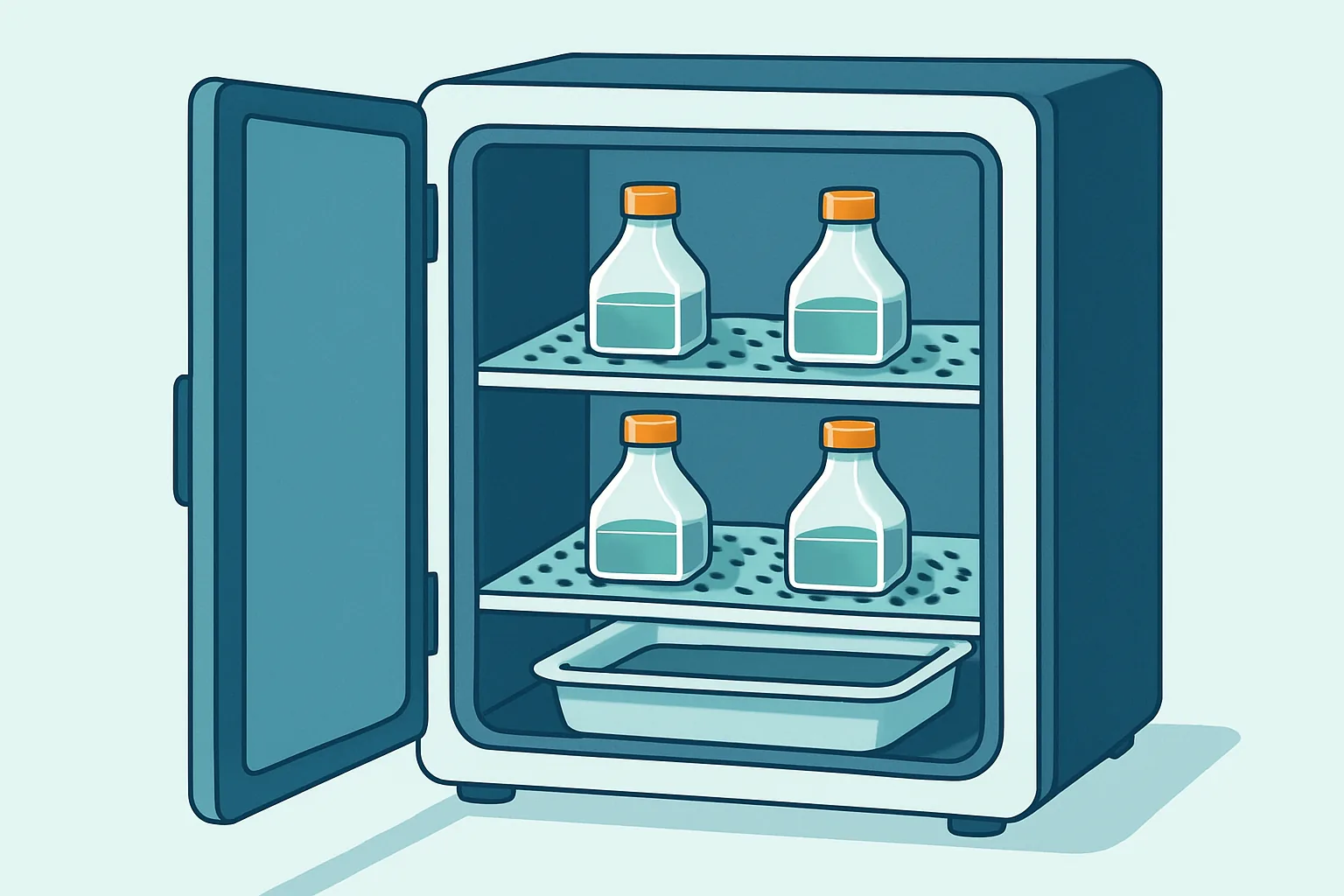
Humidity is maintained by evaporation from a pan of water in the base of the chamber, and the design detail that matters is surface area rather than depth. A pan that has run low, or one that has been pushed to one side, gives a chamber that reads as humid at the sensor while regions further from the pan are drier than intended.
The geometry of the vessel changes how much this matters. A tall flask with a small liquid surface area and a large headspace loses water slowly. A 96-well plate has a large surface area relative to a small volume, and the outer wells are worst affected because they exchange with the chamber more readily. This produces the well-known edge effect, in which outer wells consistently differ from inner ones for reasons that have nothing to do with the treatment applied. Filling the outermost ring with sterile liquid and using only the inner wells for data is a standard and effective response.
Humidity also has a cost. A warm, saturated chamber suits fungal and bacterial growth, and the water pan is the most contamination-prone object in the incubator. Sterile water, regular replacement and a suitable additive are the usual controls, and some designs avoid a pan entirely by generating steam.
Temperature Uniformity Across Shelves
Manufacturers specify uniformity across the chamber, and the specification describes a stable, closed, empty incubator. Real ones are opened repeatedly and packed with vessels.
Heat enters through the walls, either from a heated jacket or from a water jacket. Water-jacketed incubators hold temperature better during a power interruption because the water stores considerable heat, at the cost of being slower to recover and much heavier. Direct-heat designs recover faster and are lighter.
Openings dominate the real-world variation. Every time the outer door opens, warm humid air leaves and room air enters, and the recovery of temperature, humidity and gas concentration takes minutes rather than seconds. Gas recovers fastest because it is actively injected. Humidity recovers slowest because it depends on evaporation from the pan. A busy incubator opened many times a day may spend a substantial part of each working day out of specification, and this is invisible on a display that samples at the sensor.
Inner glass doors reduce the loss considerably, and segmented inner doors reduce it further by allowing access to one shelf without exposing the others. Loading discipline matters too: a shelf packed edge to edge blocks convection, creating pockets that sit cooler and drier than the reading suggests. Leaving gaps between vessels is not fussiness, it is what allows the chamber to behave like the specification.
For work sensitive to small differences, the pragmatic approach is to identify the positions in a given incubator that behave consistently, with an independent logger placed in the actual working positions, and to keep critical cultures there.
Sensor Types and Calibration Drift
Two sensor technologies dominate carbon dioxide measurement, and their failure modes differ enough to matter.
Thermal conductivity sensors infer gas concentration from how the gas mixture conducts heat. They are inexpensive and durable, and they have a significant weakness: humidity and temperature also affect thermal conductivity. A reading taken while humidity is recovering after a door opening is therefore unreliable, and these sensors need the chamber to be fully equilibrated before they can be trusted or calibrated.
Infrared sensors measure absorption of infrared light at a wavelength carbon dioxide absorbs strongly. They are largely unaffected by humidity and temperature, they respond faster, and they are the better choice for incubators opened frequently. They cost more and their optical components can degrade over years, so they still require verification.
All sensors drift. Drift is gradual and produces no alarm, because the instrument is reporting what it believes. An incubator that reads correctly while delivering a different concentration will produce a medium pH that is quietly wrong, and the resulting phenotype will be attributed to almost anything else first.
| Aspect | Thermal conductivity sensor | Infrared sensor |
|---|---|---|
| Measurement principle | Heat conduction of the gas mixture | Absorption of infrared light |
| Affected by humidity | Yes, substantially | Minimally |
| Affected by temperature | Yes | Minimally |
| Recovery after door opening | Slow, needs full equilibration | Fast |
| Typical purchase cost | Lower | Higher |
| Main long-term failure | Cumulative drift | Optical degradation |
| Suitability for busy shared use | Limited | Good |
Independent verification is the answer, and it need not be elaborate. A handheld gas analyser, or a colorimetric test, checks the display against reality, and temperature is verified with a calibrated thermometer at shelf level. Both should be recorded, because the value lies in seeing the trend before it becomes a problem.
Contamination Sources Inside the Chamber
A contaminated incubator is usually a contaminated laboratory that has found somewhere warm to grow. The chamber is rarely the origin, and treating it as such leads to endless decontamination cycles that fix nothing.
The dominant route in is the outside of vessels. Flasks handled with gloves that touched a bench, plates set down on an unclean surface, and bottles carried from a cold room all bring organisms to the shelves, where warmth and humidity do the rest. The second route is the water pan, which becomes a reservoir if it is topped up rather than emptied and refilled.
Fungal contamination is the most characteristic incubator problem because spores travel through air and germinate readily in humid warmth. It often appears first on shelf supports, door seals or the pan rather than in a culture, and by the time a flask is visibly affected the chamber has usually been seeded for some time. Bacterial contamination more often reflects a technique or reagent problem and shows up in cultures before the chamber.
Mycoplasma deserves separate attention because it is invisible. These organisms are too small to see under a routine microscope, do not turbidly cloud medium, and pass through some filters. They spread between cultures through shared reagents and careless handling, and they alter metabolism, growth rate and gene expression enough to invalidate results while the culture appears entirely healthy. Routine testing is the only way to know, and quarantining incoming lines until tested is the only reliable way to keep an incubator clean.
Design features help. Copper and copper-alloy interiors inhibit microbial survival on surfaces. High-temperature decontamination cycles built into many models sterilise the chamber thoroughly, though they take hours and cannot be run while cultures are inside. Filtration of the incoming gas and of chamber air reduces airborne load.
None of that substitutes for practice: wiping vessel exteriors on entry, not storing anything in the chamber that does not need to be there, and keeping the number of people using a single incubator small.
Maintenance Schedules That Prevent Losses
The economics of incubator maintenance are unusually favourable. The contents of a single chamber may represent months of work, irreplaceable primary material or expensive differentiated cultures, and the maintenance that protects them takes minutes per week.
A workable rhythm has three tiers. Weekly, the water pan is emptied, cleaned and refilled with fresh sterile water, and the display readings are recorded rather than merely glanced at. Recording matters because drift is only visible as a trend.
Monthly, an independent check of temperature and gas concentration is made with equipment that does not share the incubator’s own sensors, and the interior surfaces, shelves and door seals are wiped down. Door seals repay attention because a hardened or damaged gasket leaks continuously, which shows up as high gas consumption long before it shows up as a bad culture.
Periodically, on a schedule matched to use, the chamber is fully decontaminated, sensors are calibrated or serviced, gas filters are replaced, and the gas supply arrangement is reviewed. Cylinder changeover is a common source of interruption, and an automatic changeover manifold with two cylinders removes an entire category of overnight failure.
Alarms deserve a specific decision. An incubator that alarms only on its front panel in an empty building at the weekend is not alarmed at all. Remote alerting to a person who can act, and an independent monitor that does not depend on the incubator’s own sensors, together convert most catastrophic losses into inconveniences.
The final piece is documentation of what normal looks like. A logbook showing typical gas consumption, typical recovery time after a door opening and typical sensor readings turns a vague sense that something is off into a specific, checkable observation, which is usually the difference between catching a problem in a week and discovering it in an experiment.
Frequently asked questions
Why did my medium turn pink after sitting in the hood?
Phenol red reports pH, and the pink or purple end of its range means alkaline. Medium buffered with bicarbonate holds physiological pH only while the carbon dioxide above it is at the matched concentration. Room air contains far less carbon dioxide than an incubator, so as soon as a vessel leaves the chamber, dissolved carbon dioxide begins escaping and the balance shifts towards bicarbonate, raising pH. This is normal and reverses within a short time back in the incubator, but prolonged periods outside are genuinely stressful to cells and should be kept brief.
Can I use the same medium at a different gas setting?
Only if the bicarbonate concentration is appropriate for that setting, and this is a common and avoidable mistake. Media are formulated with a specific bicarbonate content intended to give physiological pH at a specific carbon dioxide concentration, and that figure is printed on the bottle or in the formulation sheet. Running a low-bicarbonate formulation at a high gas level acidifies the medium, and the reverse makes it alkaline. Cells may survive either for a while, which is precisely what makes the error persist unnoticed.
Does the water pan really need sterile water?
Yes, because it is the warmest, wettest and most permanently undisturbed object in the chamber, which makes it the most likely place for microbial growth to establish. Tap water introduces organisms directly and leaves mineral deposits that provide surface for biofilm. The other half of the rule matters as much: the pan should be emptied and cleaned rather than topped up, since topping up simply dilutes an established population. Where a suitable additive is compatible with the incubator and the work, it reduces the risk further.
Why do my outer wells always behave differently?
Because they exchange heat and water vapour with the chamber more readily than inner wells do. Evaporation is faster at the edge, so the medium there becomes more concentrated over the course of an experiment, raising osmolality and shifting pH, and the volume itself falls. Temperature at the edge also equilibrates faster after handling. The standard remedy is to fill the outermost ring with sterile liquid and treat it as a buffer zone, using only interior wells for data, which costs plate capacity and removes a systematic artefact.
How often should the carbon dioxide sensor be checked against something independent?
Monthly is a reasonable default for a shared incubator in regular use, with more frequent checks after any service, relocation, decontamination cycle or gas supply change. The reason for independence is that a drifting sensor reports the value it believes, so the incubator’s own display cannot reveal the problem. A handheld analyser or a colorimetric check takes a few minutes. What makes the practice valuable is recording the numbers over time, because a slow trend is far more informative than any single reading.
The unifying idea is that an incubator is not a warm box with a gas supply but a chemical system in which the gas phase and the liquid phase are coupled. Once that coupling is visible, the maintenance stops looking like housekeeping. The water pan protects osmolality. The door discipline protects pH. The sensor check protects the buffer ratio. Each of them is defending a variable the cells are responding to whether or not anyone is measuring it, and cultures that fail for unexplained reasons are usually failing for one of these.