

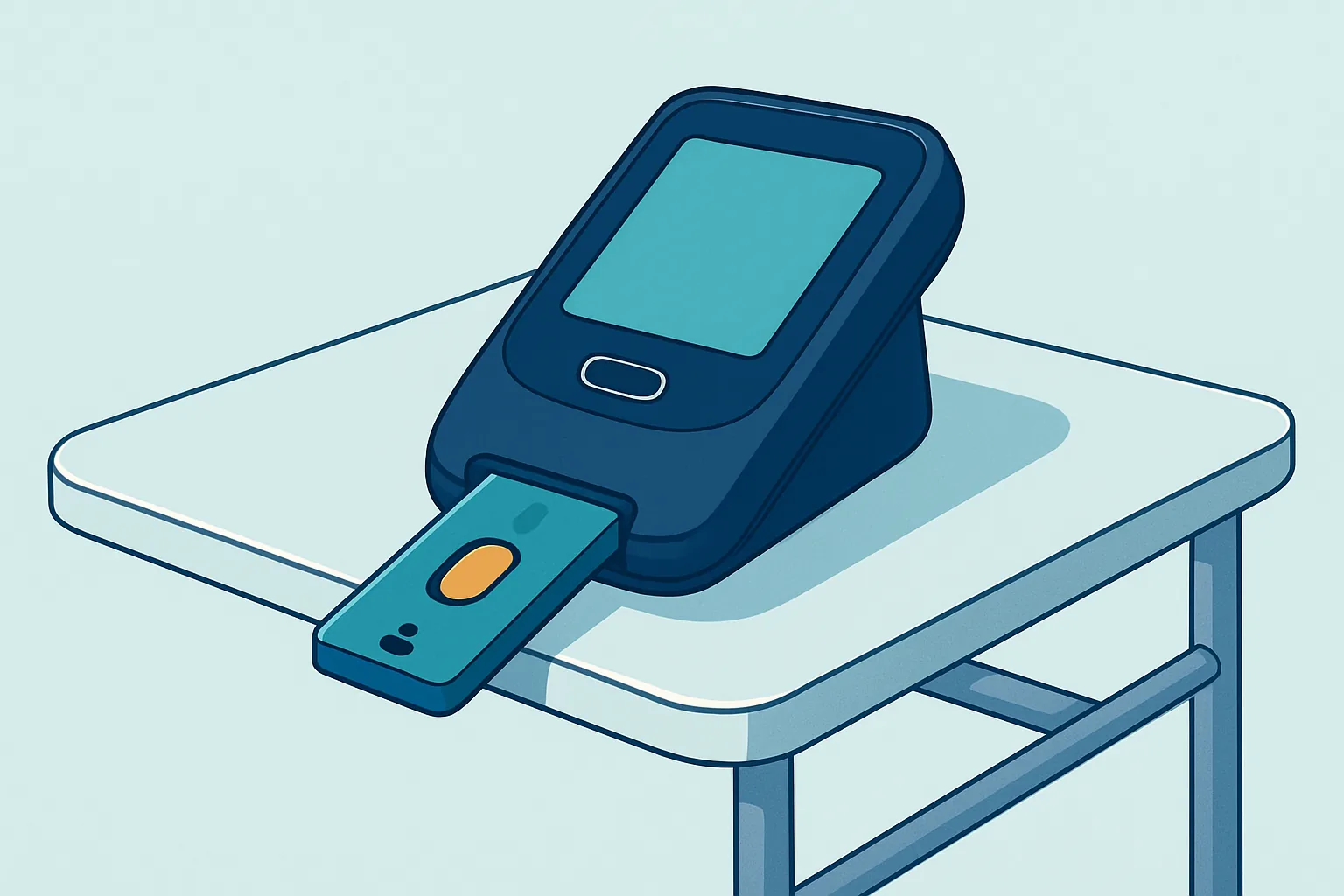
A blood glucose reading appears on a meter in five seconds. A troponin result from a bedside cartridge arrives in a few minutes. The same analytes measured in the central laboratory take a great deal longer, mostly because of transport, centrifugation and batching rather than the measurement itself.
The obvious question is why the slow route persists at all. The answer is that the two results are not equivalent measurements that differ only in delivery time. Miniaturising an assay changes the chemistry, the sample type, the calibration strategy and the person performing it, and every one of those changes costs something in analytical performance. Whether that cost matters depends entirely on how the number will be used.
This piece looks at what actually degrades when a test leaves the laboratory, how large the degradation typically is, and where the trade lands clearly in favour of speed. The framing that matters is not which method is better but which imprecision is tolerable given the decision at hand.
Key takeaways
- Point-of-care devices generally show wider imprecision than core laboratory analysers, with the gap varying by analyte.
- Much of the difference comes from sample type, small volumes and simplified calibration rather than poor engineering.
- Operator variability is often larger than instrument variability and is the hardest component to control.
- Quality control away from the laboratory depends on connectivity, lockouts and training rather than on a technologist noticing drift.
- Speed wins decisively where the clinical action is time-critical and the decision threshold is far from the measured value.
What Counts as Point-of-Care Testing
Point-of-care testing means any diagnostic measurement performed near the patient, with the result available during the same episode of care. The definition is about location and turnaround rather than technology, which is why the category spans an enormous range of sophistication.
At one end sit visually read lateral flow devices: a strip, a drop of sample, a coloured line. At the other sit cartridge-based analysers that perform genuine quantitative immunoassays or molecular amplification in a device small enough to carry. Between them lie handheld electrochemical meters, blood gas analysers on a ward trolley, and desktop instruments in a clinic side room that are, in truth, small laboratory analysers placed outside the laboratory.
The regulatory and quality frameworks differ across this range, but the analytical pressures are common. Devices must accept an unprocessed sample, usually whole blood rather than serum or plasma. They must work without a trained operator preparing anything. They must be robust to the temperature and humidity of a corridor rather than an air-conditioned laboratory. They must complete the analysis in minutes without a wash step or a separation the user has to perform.
Every one of those requirements removes a degree of freedom the laboratory uses to control error. The laboratory can spin a sample to remove cells, dilute into a defined matrix, run a multi-point calibration, average replicate readings and repeat anything that looks odd. A cartridge at a bedside can do none of this, and the performance figures reflect that.
Miniaturised Chemistry and Its Limits
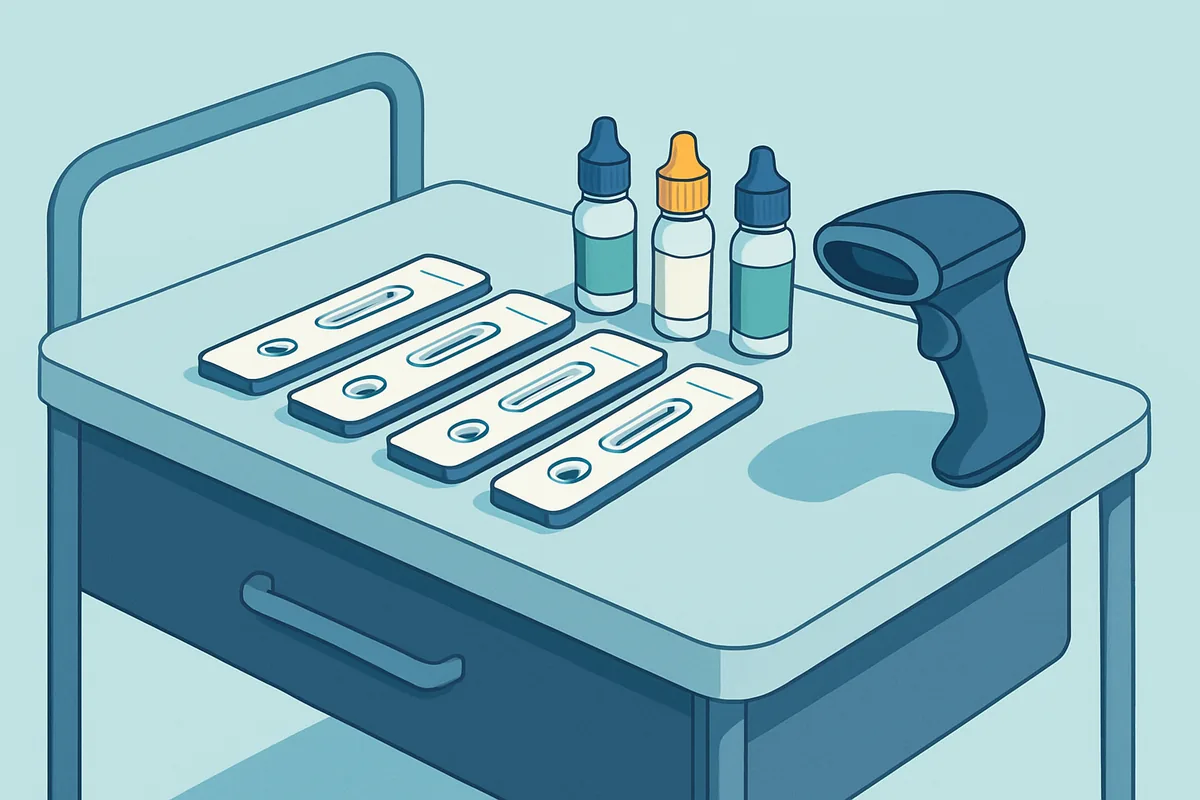
Shrinking an assay is not simply a matter of using less of everything. Several physical effects become dominant at small scale, and the design compromises follow from them.
Sample volume is the first constraint. A fingerprick provides a very small volume, and from that volume the device must deliver enough analyte to generate a reliable signal. Fewer target molecules in the measurement chamber means more counting noise, which sets a floor on precision that no amount of engineering removes. This is why point-of-care assays for very low-concentration analytes have lagged behind those for abundant ones.
Sample type is the second. Most laboratory reference methods run on serum or plasma; most point-of-care devices run on whole blood. Red cells occupy volume, so the effective plasma fraction depends on haematocrit, and unless the device measures and corrects for it, a patient with a high or low haematocrit will produce a biased result. Many devices do correct, but the correction is an estimate rather than a separation.
Calibration is the third. A laboratory analyser is calibrated with multiple standards across the range and recalibrated regularly against controls. A single-use cartridge cannot be calibrated by the user at all, so calibration is embedded during manufacture and encoded on the lot. Performance therefore depends on lot-to-lot manufacturing consistency in a way that laboratory methods do not, and a lot shift is invisible to the person holding the device.
Reaction time is the fourth. Immunoassays approach equilibrium slowly, and a laboratory method can afford to wait. A device promising a result in minutes must read the reaction before equilibrium, at a point on a curve where the signal is still changing. Anything that shifts the reaction rate, including temperature, shifts the result. This is the main reason bedside devices are more temperature-sensitive than laboratory ones.
Comparing Imprecision Against Core Lab Analysers
Imprecision is usually expressed as a coefficient of variation, the standard deviation of repeated measurements divided by the mean. It is the honest way to compare methods because it separates random scatter from systematic bias, and it is what determines whether a change between two results is real.
The general pattern across analytes is consistent: point-of-care methods show larger coefficients of variation than core laboratory methods for the same analyte, and the ratio is larger for analytes measured near the bottom of their range. The gap is modest for robust electrochemical measurements such as glucose and blood gases, and substantially wider for low-concentration immunoassays.
| Aspect | Core laboratory analyser | Point-of-care device | Practical consequence |
|---|---|---|---|
| Typical imprecision | Lower | Higher, often by a meaningful multiple | Serial changes need to be larger to be believed |
| Sample | Serum or plasma, processed | Whole blood, unprocessed | Haematocrit and interference effects |
| Calibration | Multi-point, regular, on site | Factory encoded per lot | Lot shifts are hard to detect locally |
| Operator | Trained technologist | Clinical staff, variable | Technique becomes an error source |
| Repeat testing | Routine when a flag appears | Consumes another cartridge | Odd results less often confirmed |
| Interference detection | Automated haemolysis and lipaemia indices | Usually absent | Interfered results reported silently |
Two consequences follow directly. First, serial monitoring is harder. To be confident that a patient’s value has genuinely changed, the difference must exceed the combined analytical and biological variation of the two measurements. Wider imprecision raises that threshold, so a bedside device is a poorer tool for detecting a small trend even when it is perfectly adequate for detecting a large abnormality.
Second, results from the two systems should not be used interchangeably in the same patient’s series. A value that appears to have moved may simply have been measured on a different platform with a different calibration lineage. Where both routes are in use, the platform should be recorded with the result, and clinicians should be trained to look for it.
Operator Variability as a Hidden Factor
Manufacturer performance figures are generated by trained staff following the instructions exactly. Real-world performance includes the ward at three in the morning, and the difference is frequently larger than any instrument specification.
The classic example is capillary sampling. Squeezing a finger hard to produce a drop dilutes the blood with interstitial fluid, which shifts several analytes. Failing to wipe the first drop introduces tissue fluid and residual skin contamination. Insufficient sample volume can either trigger an error or, on some devices, produce a result from an underfilled chamber. None of these are visible in the number that appears.
Timing errors matter on devices that require a fixed interval between sample application and reading, particularly visually read tests. Reading a lateral flow device early can miss a weak line; reading it late can allow a faint non-specific line to develop. Both errors are systematic in one direction and both are entirely invisible in the record.
Storage and handling of consumables is a quieter contributor. Cartridges and strips have temperature limits and, once opened, a limited stability. A vial left open on a warm windowsill, or a box stored above a radiator, degrades reagents without changing their appearance. Because there is no laboratory receiving these materials and logging their conditions, the failure surfaces only as results that drift without explanation.
The mitigation is training and, more effectively, device design that removes choices from the operator. Cartridges that lock out after their expiry date, meters that refuse to run without a scanned operator identifier, and devices that measure fill adequacy before proceeding all convert a silent error into a visible refusal, which is a large improvement even though it feels like an obstruction.
Quality Control Outside the Laboratory
In a laboratory, quality control is continuous and someone owns it. Controls run at defined intervals, results are plotted, rules flag drift before it reaches patients, and a technologist investigates. None of that infrastructure exists on a ward by default, so it must be imported.
Liquid quality control material remains the backbone. Running a known control sample at defined intervals and on each new lot detects both device faults and reagent problems. The practical difficulty is compliance: control testing consumes cartridges and time, and it produces no clinical result, so it is the first thing to lapse when a unit is busy. Devices that refuse to report patient results until an overdue control has been run solve this bluntly and effectively.
Electronic or internal checks are offered by many devices and are useful but limited. A simulated electrical signal confirms that the detection electronics and software are behaving. It says nothing about the reagent chemistry, which is where most real failures live. Treating an electronic check as equivalent to a liquid control is a common and consequential misunderstanding.
External quality assessment closes the loop. Enrolling point-of-care devices in the same proficiency testing schemes the laboratory uses reveals systematic bias against a peer group, which is exactly the failure that internal controls miss when the control material itself has drifted or the calibration lot is off. Many accreditation frameworks now require this for devices producing results that enter the clinical record.
Governance is the piece most often missing. Someone, usually within the laboratory, needs formal responsibility for every device in the institution: its inventory, training records, control compliance, lot changes and incident reports. Where that role is unassigned, devices accumulate in cupboards, expired stock stays in use, and nobody notices until a result is questioned.
Connectivity, Logging and Result Traceability
A result that never reaches the patient record is a clinical and legal problem regardless of how accurate it was. Historically, bedside results were written on a chart, transcribed, or simply acted on and forgotten, and transcription is itself a meaningful source of error.
Modern connected devices transmit results directly to the laboratory information system or the electronic record, tagged with the device identifier, operator identifier, patient identifier, reagent lot and timestamp. That metadata is what makes retrospective investigation possible. When a result is later questioned, the ability to establish which device, which lot and which operator produced it is the difference between an explanation and a shrug.
Connectivity also enables central oversight. A laboratory can monitor control compliance across dozens of devices from one screen, spot a device whose controls are drifting, and disable it remotely before it produces a misleading patient result. This converts point-of-care testing from a distributed set of unsupervised instruments into something resembling a managed analytical service.
Barcoded patient identification deserves specific mention because misidentification is the most serious error in the whole category. A perfectly accurate result attributed to the wrong patient is worse than no result. Scanning a wristband rather than typing a number removes the largest single source of that error, and any device selection process should weight this heavily.
Clinical Situations Where Speed Wins
The trade resolves clearly when two conditions hold together: the clinical decision is time-critical, and the measured value sits far from the threshold that would change the decision.
Blood gas and electrolyte analysis in critical care is the strongest case. The values change quickly, the interventions are immediate, and a delay of an hour for transport and processing removes most of the value of the measurement. Blood gas samples are also unstable, so the laboratory route introduces its own preanalytical error, and the comparison is not between a fast imprecise result and a slow precise one but between two imperfect options.
Glucose measurement in a patient who is hypoglycaemic is similar. The action threshold is far from the measured value, the required action is urgent, and the imprecision of a meter is irrelevant to the decision. The same device becomes inadequate when the question is fine-grained monitoring of a stable patient, where small changes matter and the imprecision swamps them.
Infectious disease testing in an outpatient or community setting wins on a different axis. The decisive advantage is not analytical but behavioural: a patient who receives a result before leaving is treated, whereas a patient who must return for a result sometimes does not. A modestly less sensitive test that reaches everybody can outperform a superior test that reaches a fraction.
The situations where the trade fails are equally identifiable. Diagnosis that hinges on a value close to a decision threshold, serial monitoring of small changes, and any measurement that will be compared against previous laboratory results all favour the core laboratory. So does any setting where governance is thin, because an unsupervised device with no control programme is not a faster test but an unquantified one.
Frequently asked questions
Is a bedside result ever good enough to make a diagnosis on its own?
It depends on the analyte and how far the result sits from the decision threshold. A markedly abnormal value on a device with a functioning quality control programme is generally actionable, particularly when the clinical picture agrees. A borderline value is a different matter, because the wider imprecision means a repeat measurement could plausibly land on the other side of the threshold. The usual practice is to act on clear results and confirm equivocal ones through the laboratory.
Why do my meter reading and my laboratory result differ?
Several reasons stack together. The meter usually measures whole blood while the laboratory measures plasma, and those two matrices give systematically different values for some analytes. Calibration lineages differ between manufacturers. Time matters as well, since some analytes change between the moment the fingerprick was taken and the moment the venous sample was processed. A difference that stays within the expected combined imprecision of the two methods is not evidence that either is wrong.
Do point-of-care devices need the same accreditation as the laboratory?
In most regulated systems, results entering the clinical record are subject to quality requirements regardless of where they are produced, and accreditation bodies increasingly inspect point-of-care programmes alongside the laboratory. The practical requirements usually include documented operator training and competency, a control testing schedule, participation in external quality assessment, lot and inventory management, and a named individual accountable for the service.
Are lateral flow tests inherently less reliable than cartridge analysers?
They are less precise by design, because they produce a visual or semi-quantitative readout rather than a measured signal, and because interpretation depends on a human judging a line. That does not make them unreliable for the purpose they are designed for, which is detecting the presence of something above a threshold. Problems arise when a qualitative test is treated as if it carried quantitative information, or when a faint line is interpreted as a small amount of analyte rather than as a result near the limit of detection.
What single change most improves point-of-care quality in a hospital?
Assigning clear ownership to the laboratory, with connectivity to enforce it. Central oversight of every device, with automatic capture of results, mandatory operator identification, and lockouts when controls are overdue, addresses the largest error sources at once: unrecorded results, untrained operators, expired consumables and undetected drift. Training alone helps but decays; a system that will not produce a result until its conditions are met does not.
The useful mental model is that point-of-care testing buys time with precision and pays for it with governance. Where a decision cannot wait and the answer is unambiguous, that is an excellent trade. Where the answer is close to a threshold, or the value will be compared with something measured elsewhere, the slower route is slower for reasons that are still doing work.
This is education, not medical advice. Laboratory results only carry meaning alongside your symptoms, history and examination. Talk to a qualified clinician about your own results before changing anything about your care or supplements.