
Most people who end up in a clinical laboratory did not plan on it at eighteen. They started a biology or biochemistry degree, discovered that research funding is precarious and that medical school is not the only route into patient care, and found a profession that sits between the two: technical, regulated, permanently in demand, and almost entirely invisible to the public.
The job title varies by country. Medical laboratory scientist, biomedical scientist, clinical laboratory scientist and medical technologist all describe broadly the same work, with local differences in scope and seniority. Underneath the labels the role is consistent: performing and validating the tests that clinicians use to diagnose and monitor disease, and taking professional responsibility for whether a result is fit to release.
This piece describes the route in, including the parts that recruitment brochures underplay. Not because they are deterrents, but because knowing about them in advance is the difference between a career and a false start.
Key takeaways
- The work is a mix of routine analysis, troubleshooting, quality control and judgement about which results are safe to release.
- Entry usually requires a science degree plus structured clinical training, and the order of those two varies by country.
- Rotations across the main disciplines are where the profession is actually learned, and they are assessed.
- Laboratories run continuously, so shift work and on-call are normal features of the job rather than exceptions.
- Automation is changing the balance of tasks toward validation, molecular work and troubleshooting rather than reducing headcount.
What the Role Involves Day to Day
A working day in a clinical laboratory is less about pipetting than newcomers expect and more about managing a system that is already running.
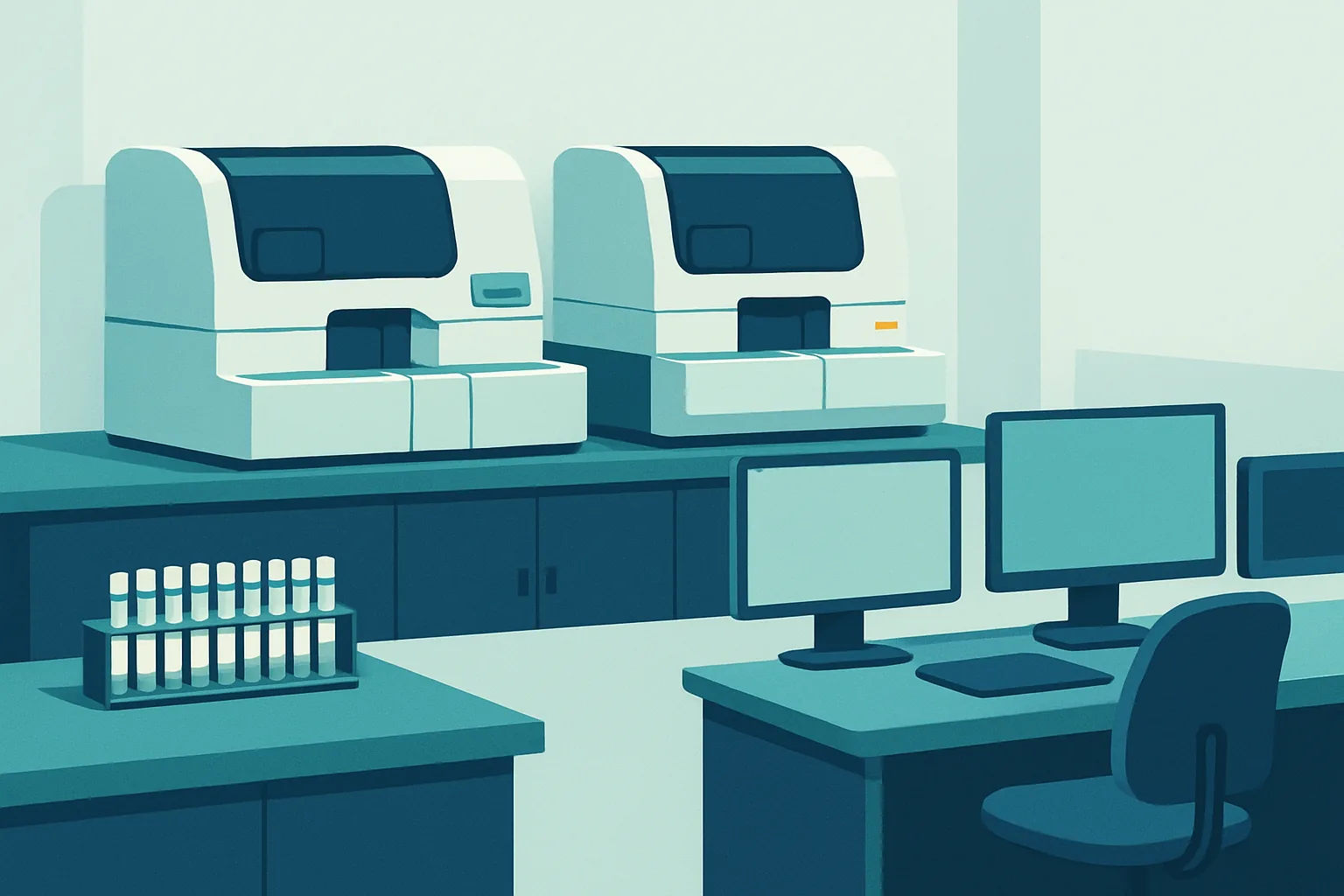
The day usually opens with instrument checks. Analysers need start-up routines, reagent levels verified, calibrations confirmed and quality control material run and reviewed before any patient sample is processed. Reviewing that control data is a professional decision, not a formality: if a control has drifted, the scientist has to decide whether results are still reportable, whether recalibration is needed, and whether work already released needs revisiting.
Samples then arrive continuously. Most are handled by automation, which sorts, centrifuges, aliquots and presents tubes to analysers. The scientist’s attention goes to the exceptions: samples flagged by the instrument, results outside defined limits, values inconsistent with a patient’s previous ones, and specimens that are unsuitable because they are clotted, haemolysed, underfilled or wrongly labelled.
Result validation is the core intellectual task. Before a result reaches a clinician, someone competent has to decide it is credible. That means asking whether the number fits the rest of the profile, whether it is plausible for this patient, and whether anything in the sample could have interfered. Automated rules handle the straightforward cases; the ones that reach a human are the ambiguous ones by definition.
Beyond that sit the tasks that fill the rest of the day: manual and semi-automated methods that resist automation, microscopy, blood film review, culture plate reading, crossmatching in transfusion, instrument maintenance and fault-finding, documentation, and communicating critical results by telephone to the clinical team, which carries a defined time limit and a record.
The parts people find unexpectedly satisfying are usually the troubleshooting and the moments where the laboratory catches something. A film review that changes a diagnosis, a transfusion incompatibility identified before a unit is issued, or a delta check that reveals two samples were swapped are the events that make the job feel consequential. The parts people find unexpectedly hard are the repetition, the pressure of turnaround targets, and the invisibility.
Degree Routes and Accredited Programmes

There are two broad structures, and which one applies depends on where you intend to work.
The integrated route is a degree designed from the outset to produce a clinical laboratory scientist. It combines academic study in the main laboratory disciplines with supervised placement in a working laboratory, and graduating from an accredited programme leads directly to eligibility for certification or registration. Where this route exists, it is the cleanest path, because the placement is built into the timetable rather than something you must arrange yourself.
The conversion route starts with a general science degree, commonly biomedical science, biology, biochemistry, microbiology or chemistry, followed by structured clinical training in an approved laboratory. The training is documented against a competency framework and assessed, and completion leads to the same registration or certification. This route suits people who discover the profession partway through a degree, but it depends on securing a training post, and those posts are limited in number and competitive in some regions.
Accreditation is the detail that decides everything. Programmes are accredited by professional bodies against defined standards, and certification eligibility is generally tied to graduating from an accredited programme or completing an approved training pathway. A degree that looks identical on paper but lacks accreditation can leave a graduate needing additional coursework or supervised experience before they can sit a board examination. Anyone choosing a course should confirm its accreditation status directly with the relevant certifying body rather than relying on marketing copy.
There is also an entry tier below scientist level, variously called technician, assistant or associate. It requires less formal education, covers a narrower scope of duties, and in many systems offers a documented route to upgrade later while working. For someone unsure about the profession, or unable to commit to a full degree immediately, starting there is a legitimate strategy rather than a compromise, and laboratories generally value staff who have come up that way.
Clinical Rotations and What They Cover
The rotations are where the profession is actually learned, and they are structured around the main disciplines because each has a genuinely different logic.
| Discipline | Core work | Skill it develops | Common pressure point |
|---|---|---|---|
| Clinical chemistry | Automated analysers, high volume | Quality control, interference recognition | Turnaround times, instrument downtime |
| Haematology | Cell counting, film review, coagulation | Microscopy and morphology judgement | Distinguishing artefact from pathology |
| Transfusion | Grouping, antibody screening, crossmatch | Procedural discipline under time pressure | Emergency issue with incomplete information |
| Microbiology | Culture, identification, susceptibility | Pattern recognition, clinical liaison | Long incubation times, mixed growth |
| Molecular | Nucleic acid extraction and amplification | Contamination control, assay design | Sensitivity to the smallest procedural lapse |
| Histopathology | Tissue processing, sectioning, staining | Manual dexterity, section quality | Specimen identity and orientation |
Chemistry teaches the discipline of quality control and the habit of asking whether a number is real before believing it. Haematology teaches the eye: recognising cell morphology under a microscope is a skill that takes months to develop and cannot be shortcut, and it remains one of the clearest examples of a trained human outperforming an instrument.
Transfusion is where most trainees first feel the weight of the work. The consequences of an error are immediate and severe, so procedures are rigid, checks are duplicated, and deviations are treated seriously. Trainees who thrive there tend to be the ones comfortable following a protocol exactly while staying alert to when something does not fit.
Microbiology is the most interpretive discipline. Reading a culture plate involves judgement about which organisms matter, whether growth represents infection or contamination or normal flora, and how the result relates to what the clinician is treating. It also involves the most direct contact with clinical teams.
Molecular work has grown from a specialist corner to a core discipline. It rewards meticulous technique because the amplification that makes it sensitive also makes it unforgiving of contamination.
Rotations are assessed, usually through a portfolio of evidence, direct observation of practice, and discussion with an assessor. Trainees frequently underestimate the portfolio, then spend evenings reconstructing it near the deadline. Keeping it current from week one is the single most useful habit a trainee can adopt.
Licensure Requirements by Region
This is the part that most often derails a plan, particularly for people intending to work abroad.
In the United States, the dominant credential is board certification from a professional certifying body, earned by meeting an eligibility route and passing an examination. Certification is national. Licensure is separate and is set by individual states, and only some states require it. Where a state licence is required, it has its own application, fees and sometimes additional requirements beyond certification.
In the United Kingdom, practising as a biomedical scientist requires registration with the statutory regulator, which is protected by law. The route runs through an accredited degree plus a completed portfolio of competence in an approved training laboratory.
Elsewhere, arrangements vary considerably. Some countries operate national registration through a health professions council, others rely on employer-assessed competence within a broader healthcare framework, and a few regulate only certain disciplines such as transfusion.
The practical consequences are worth spelling out. Qualifications do not transfer automatically across borders, and moving country often requires an assessment of your training against local standards, supplementary examinations or supervised practice, and evidence in the form of transcripts and detailed logs of laboratory experience. Assembling that evidence years later is painful, which is why keeping thorough records of what you have done, verified by supervisors, is worth the effort even if you have no plans to move.
Shift Patterns and On-Call Realities
Laboratories in acute hospitals do not close, and this shapes the profession more than any other single factor.
Emergency departments, operating theatres, intensive care and maternity services generate work continuously, and several tests have to be available within minutes at any hour. Blood gases, coagulation before urgent surgery, crossmatched blood for a haemorrhage, and cerebrospinal fluid examination for suspected meningitis cannot wait for morning.
Larger laboratories cover this with rotating shifts, meaning staff work a pattern of days, evenings and nights on a cycle. Smaller sites cover the night with an on-call rota, where a scientist is at home but must be able to reach the laboratory within a defined time and may be called several times in a night, then be expected to work the following day depending on local rules.
The night shift is a different job from the day shift. One or two people cover every discipline rather than specialising, there is no senior colleague at the next bench, and the decisions are often the ones that matter most. It builds competence and confidence faster than any other experience, and it is genuinely demanding. Shift work has well-documented effects on sleep and health, and it is the most common reason people give for leaving laboratory practice for a daytime role.
There is also a substantial part of the sector that does not work this way. Reference laboratories, public health laboratories, research support, industry, and specialist services such as cytology and histopathology generally operate on weekday hours. Anyone strongly averse to shift work has options, though they are usually not in acute hospital practice at the start of a career.
Specialisation Options After Qualifying
Qualification is the beginning of a longer structure, and the routes forward diverge more than people expect.
The technical route deepens expertise in one discipline. It typically involves a specialist qualification or higher degree, and leads to roles such as senior specialist, lead scientist for a discipline, or consultant-level practitioner in systems that recognise that grade. This is the path for people who want to remain close to the science, and it increasingly includes clinical interpretation and direct advice to clinical teams.
The management route moves toward operations: staffing, budgets, procurement, accreditation, and the endless work of keeping a service running through instrument replacements and reorganisations. It pays better and involves less bench work, and it suits people who like solving organisational problems.
The quality route is underrated. Accreditation to international standards requires documented quality management, internal audit, incident investigation and continuous improvement, and laboratories need people who genuinely understand it. Quality managers are portable across sectors and in steady demand, including in industry and diagnostics manufacturing.
Beyond the hospital, the same training opens doors to diagnostics companies in applications support, field service and product development; to research institutes needing people who can actually run assays reliably; to public health laboratories doing surveillance and outbreak work; and to regulatory and inspection roles. Molecular and genomic laboratories have absorbed a large number of scientists who started in general disciplines, and cross-training into them mid-career is common and usually supported.
Where the Job Market Is Heading
Demand for laboratory work has been persistently strong, and the reasons are structural rather than cyclical. Populations are ageing, chronic disease monitoring generates repeat testing, and diagnostic pathways increasingly begin with a laboratory result. At the same time, a substantial proportion of the existing workforce is approaching retirement in many countries, and training pipelines have not expanded proportionally. The result in most regions is a labour market where qualified staff are sought after and vacancies are slow to fill.
Automation is the change everyone asks about. Track systems, auto-verification rules and consolidated platforms have removed a great deal of manual handling, and they have genuinely changed what the job consists of. What they have not done is replace the professional. Automation performs the repetitive steps well and handles the exceptions poorly, and the exceptions are where the risk lives. The effect has been to shift the balance of the role toward validation, troubleshooting, method verification and the specialist disciplines that resist automation, particularly microbiology interpretation, transfusion problem-solving and molecular work.
Two other shifts are worth watching. Point-of-care testing has moved some routine analysis out of the laboratory and to the bedside, but it has created a corresponding need for laboratory staff to oversee those devices, train users, and manage their quality control, which is now a recognised specialism. And genomic testing continues to expand, creating demand for scientists comfortable with sequencing workflows, bioinformatics pipelines and the interpretation frameworks that go with them.
Frequently asked questions
Do I need a specific degree, or will any biology degree do?
It depends on where you intend to practise. Some systems accept a general life sciences degree provided it covers required subject areas and is followed by an approved period of clinical training. Others require a degree from a specifically accredited programme, and a graduate without one may need to complete additional coursework before becoming eligible for certification. Because this is decided by the certifying or registering body rather than the university, the only reliable approach is to check eligibility with that body before enrolling.
Is it possible to enter without a degree?
In many systems, yes, at technician or assistant level. These roles perform a defined range of procedures under supervision, require shorter formal training, and are a common entry point for people who want to test the profession or who need to earn while studying. Progression to scientist level generally requires completing a degree and the associated clinical competencies, and employers frequently support this through part-time or day-release study because retaining experienced staff is cheaper than recruiting.
How much patient contact is there?
Very little in most roles, which is a decisive factor for some people in both directions. The main exceptions are phlebotomy duties in laboratories that include them, point-of-care support work on wards, and some transfusion and clinical liaison roles. What does exist is substantial contact with clinical colleagues, particularly in microbiology and transfusion, where discussing a result with the treating team is a routine part of the work.
Will automation make the job disappear?
There is no sign of it. Automation has absorbed the repetitive handling steps and left behind the parts that require judgement: deciding whether a result is valid, resolving what an instrument has flagged, verifying new methods, and handling everything that does not fit the standard pathway. Meanwhile total testing volume keeps rising and the disciplines least amenable to automation are growing. The realistic expectation is a job whose content keeps changing rather than one that goes away.
What separates people who stay from people who leave?
Tolerance of shift work is the largest factor, followed by whether someone finds satisfaction in accuracy and process rather than variety. People who leave bench practice often stay in the sector, moving to quality, management, diagnostics industry or point-of-care roles, which is why the training holds its value even for those who do not remain at the bench. Those who thrive tend to describe the same thing: they like being the person who notices when something is wrong.
The honest summary is that this is a skilled, regulated profession with reliable demand, a defined training route, and a genuine ceiling that most people never reach because they stop at the first qualification. The barriers to entry are moderate and the barriers to progression are mostly self-imposed.
Anyone considering it should do two things before committing. Spend a day in a working laboratory, ideally including an evening, because the environment is specific and people tend to know quickly whether it suits them. And confirm the accreditation and licensing requirements for the place you intend to work before choosing a course, since that single piece of research prevents the most common and most expensive mistake in this career.