

Ask a mycotoxin analyst where the error in a result comes from and the answer is not the instrument. Modern methods can quantify these compounds at concentrations of a few parts per billion with good precision. The uncertainty in a mycotoxin result is dominated, overwhelmingly, by the step that happens before any laboratory is involved: deciding which handful of kernels out of a shipment weighing many tonnes will stand in for the whole thing.
This is not a minor technicality. Mycotoxin contamination is not distributed evenly through a lot. It concentrates in a small number of individual kernels or nuts, sometimes a very small number, each of which may carry a toxin load thousands of times the lot average. A shipment can comfortably exceed a regulatory limit on average while most randomly drawn small samples from it test clean.
Key takeaways
- Mycotoxins are produced by a handful of fungal genera, and which toxin appears depends on the fungus, the crop and the conditions.
- Contamination clusters in a few individual kernels, so the lot average and any small sample can differ enormously.
- Regulatory sampling plans specify very large aggregate samples for exactly this reason, and shortcuts invalidate the result.
- Rapid strip tests are useful for screening at intake; confirmatory work needs chromatography with mass spectrometry.
- Most mycotoxin problems are storage problems, and moisture control prevents more contamination than any test detects.
Which Fungi Produce Which Toxins
Mycotoxins are secondary metabolites: compounds a fungus makes that are not required for its own growth, and which appear to serve competitive or defensive purposes. They are small, chemically stable molecules, and that stability is what makes them a food safety issue rather than a spoilage issue. Cooking, baking and roasting reduce some of them modestly and destroy few of them completely, and the fungus that produced a toxin can be entirely dead and gone while the toxin remains.
Three genera account for most of what is regulated. Aspergillus species produce the aflatoxins, the most closely regulated group and the one associated with liver damage and liver cancer on long exposure, along with ochratoxin A. Penicillium species also produce ochratoxin A, and patulin, which is chiefly an apple and apple juice problem. Fusarium species produce a wide family including deoxynivalenol, the fumonisins, and zearalenone.
The division that matters practically is between field fungi and storage fungi. Fusarium species infect the growing plant, so their toxins are largely determined before harvest by weather and by the crop’s own resistance. Aspergillus and Penicillium are primarily storage organisms that colonise grain after harvest when moisture and temperature allow, though Aspergillus also infects certain crops in the field under drought stress. This distinction determines who can do anything about a given toxin: field toxins are an agronomic problem, storage toxins are a logistics problem.
Crops and Conditions That Favour Growth

Fungal growth in stored commodities is governed less by absolute moisture content than by water activity, which measures how much of that water is chemically available rather than bound to starch and protein. Two grains at the same moisture percentage can have quite different water activities depending on composition, and it is the available water that a fungus can use.
Below a certain water activity, no fungus grows at all. Above it, growth begins slowly, and the storage fungi have thresholds low enough that grain which feels dry to the touch can still support them. Temperature interacts with this: the same water activity supports faster growth when warm. Toxin production has its own requirements, generally narrower than those for growth, which is why toxin levels do not track visible mould reliably.
Crop susceptibility follows a fairly consistent pattern. Maize is vulnerable to both aflatoxins and fumonisins, and is the crop where drought stress during grain fill most reliably precedes an aflatoxin problem, because stressed plants develop damaged kernels that Aspergillus colonises. Groundnuts and tree nuts are classic aflatoxin substrates, being oil-rich and often dried in the field. Wheat and barley are the deoxynivalenol crops, with wet weather during flowering being the dominant risk factor. Coffee, cocoa, dried vine fruit and wine are the usual ochratoxin concerns, and cereals contribute to ochratoxin intake as well.
Physical damage is a consistent amplifier across all of them. Insect feeding creates entry points and raises local moisture and temperature through the insects’ own metabolism. Mechanical cracking during harvest and handling does the same. This is why insect control and gentle handling reduce mycotoxin risk even though neither has anything obvious to do with fungi.
Why Uneven Distribution Breaks Sampling
Here is the statistical heart of the problem. Suppose a shipment of groundnuts contains a small number of heavily contaminated kernels among a very large number of clean ones. The average concentration across the whole lot might sit near a regulatory limit. Now draw a small sample at random. Most such samples will contain no contaminated kernel at all and will test as clean. A few will contain one, and will test extremely high.
The distribution of results from repeated sampling of such a lot is therefore not the tidy bell curve that underlies most measurement statistics. It is heavily skewed, with a long tail: many low results, occasional very high ones, and a mean pulled upward by the rare extremes. Ordinary intuitions about repeatability fail completely. Two honest laboratories testing two honest samples from the same lorry can differ by an order of magnitude without either doing anything wrong.
The severity depends on the commodity. The problem is worst where individual particles are large and contamination is concentrated in few of them, which describes tree nuts and groundnuts. It is less severe in finely divided commodities where each particle carries a smaller share of the total, and least severe in processed products such as flour, paste or oil, where processing has already homogenised the material. This is why a peanut butter sample is far more representative of its batch than a raw groundnut sample of comparable size.
Total measurement uncertainty in mycotoxin work is conventionally broken into three contributions: the variability of drawing the aggregate sample from the lot, the variability of subdividing that sample down to a test portion, and the variability of the analysis itself. Across a wide range of commodities and toxins, the first contribution dominates, often by a wide margin, and the analytical step contributes least. Investing in a better instrument while drawing a lazy sample improves the smallest term in the equation.
Sampling Plans for Bulk Commodities
Regulatory sampling plans are designed around the skew, and they look excessive until the reason is understood.
The core principle is that many small increments should be taken from many locations throughout the lot and combined into one large aggregate sample. Increments are drawn during movement wherever possible, from a flowing stream on a conveyor or during loading and unloading, because a moving stream can be cut across its full width and gives every part of the lot a chance of being represented. Sampling a stationary heap or a filled container instead means sampling only what is reachable, and contamination has no obligation to be reachable.
The aggregate sample for a large lot of a high-risk commodity is specified in kilograms rather than grams, and large lots are subdivided into sublots that are each sampled and tested separately. The final laboratory test portion may be only a few grams, so the sample must be reduced by a factor of many thousands without losing its representativeness.
| Stage | What happens | Dominant risk | Typical control |
|---|---|---|---|
| Increment collection | Many small portions taken across the lot | Missing the contaminated fraction entirely | Sample from a moving stream, many increments |
| Aggregate sample | Increments combined into one large sample | Too small a total mass for a skewed distribution | Follow the mass specified for that commodity |
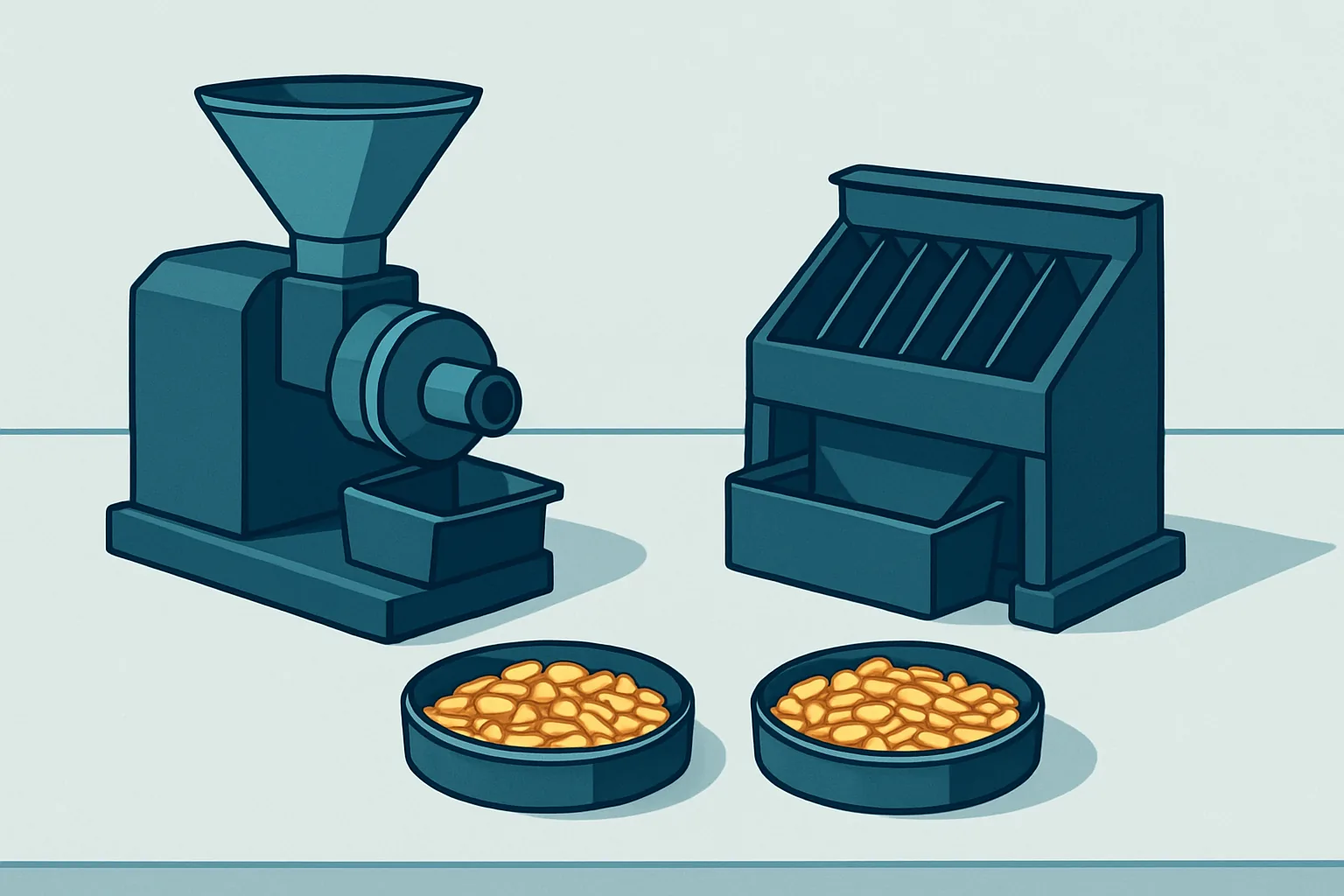
| Comminution | Whole sample ground to fine particle size | Coarse grind leaves hot kernels intact | Mill the entire sample, not a portion |
| Subdivision | Ground sample reduced to a test portion | Non-random splitting reintroduces skew | Riffle splitter or rotary divider, never scooping |
| Analysis | Extraction, cleanup and measurement | Recovery and matrix effects | Spiked recoveries and matrix-matched calibration |
That third row is where field practice most often fails. The entire aggregate sample must be ground, not a scoop from the top of it, and it must be ground finely, because coarse particles preserve the very unevenness the procedure exists to eliminate. Slurry milling, where the sample is ground with added water, improves homogeneity further for difficult commodities and has the additional benefit of controlling dust.
Subdivision must then be genuinely random. Scooping from a mixed pile is not, because particles segregate by size and density during pouring. A riffle splitter or rotary divider takes many thin alternating cuts and produces two portions that are statistically equivalent, and it is one of the least glamorous and most important pieces of equipment in the whole workflow.
Detection Methods From Strips to LC-MS
Once a properly prepared test portion exists, the analytical choice depends on whether the question is a rapid screening decision or a regulatory determination.
Lateral flow strips dominate intake screening at grain elevators and processing sites. The chemistry is a competitive immunoassay: the extract flows along a membrane carrying antibodies specific to the toxin, and toxin in the sample competes with a labelled reagent for antibody binding sites, so the test line becomes weaker as toxin concentration rises. A reader quantifies the line intensity, converting a visual judgement into a number. Results arrive in minutes, which is the entire point when a lorry is waiting at a weighbridge.
Strips have real limitations. Each is specific to one toxin or one closely related group, so screening for several toxins means running several tests. Antibodies cross-react to varying degrees with structurally similar compounds, which can inflate results. And the performance claimed for a strip applies to the matrix it was validated on, so applying a maize-validated strip to an unusual substrate is an assumption rather than a measurement.
Chromatographic methods provide the confirmatory answer. Extraction is followed by cleanup, historically using immunoaffinity columns that capture the target toxin on immobilised antibodies while everything else washes through. High performance liquid chromatography separates the extract, and detection is either by fluorescence, which suits the naturally fluorescent aflatoxins and ochratoxin, or by tandem mass spectrometry.
Mass spectrometry has become the default because it solves the multi-toxin problem. A single injection can quantify dozens of mycotoxins simultaneously, which matters because co-occurrence is the norm rather than the exception; a maize lot with fumonisins very often carries deoxynivalenol as well. Its principal difficulty is matrix effects, where co-extracted material from the food suppresses or enhances ionisation and distorts quantification. The defences are matrix-matched calibration standards and isotopically labelled internal standards that experience the same suppression as the analyte and cancel it out.
Regulatory Limits Across Regions
Mycotoxin limits are set nationally and regionally, and they differ enough that a consignment compliant in one market can be rejected by another. The variation is not arbitrary; it reflects genuine differences in dietary patterns, in the practical achievability of low limits given local agriculture, and in how conservative each authority chooses to be.
The general architecture is consistent. Limits are set per toxin and per commodity, with stricter values for foods eaten by infants and young children, whose intake per unit of body weight is higher and who are more vulnerable. Aflatoxin limits are typically expressed both for the most potent individual compound and for the sum of the group. Separate and much lower limits apply to the aflatoxin metabolite that appears in milk when dairy animals consume contaminated feed, which is why feed limits exist alongside food limits.
For a buyer, the practical implication is that a certificate of analysis is only as meaningful as the sampling behind it. A certificate stating a low result says nothing useful unless it also states the mass of the aggregate sample, the number of increments, and how the sample was reduced. Requesting that information is the single most effective piece of due diligence available, and it costs nothing.
Storage Practices That Prevent Growth
Testing detects a problem that has already occurred. Storage management prevents it, and the levers are few and well understood.
Drying to a safe moisture content before storage is the primary control, and it must be done promptly, because the hours immediately after harvest, when the crop is warm and wet, are when colonisation begins. The target moisture depends on the commodity and on how long it will be held, with longer storage requiring drier material. Oil-rich commodities such as groundnuts need lower moisture contents than cereals for equivalent safety, because water partitions differently in a fatty matrix.
Uniformity matters as much as the average. A bulk that averages a safe moisture content but contains a wet pocket will grow fungus in that pocket, and moisture migrates within a stored bulk driven by temperature gradients. Warm air rises through the centre of a bin, cools near the top, and deposits moisture there, creating a wet crust that spoils while the bulk beneath remains sound. Aeration to keep the bulk at a uniform temperature is the standard countermeasure, and it works by preventing the convection rather than by drying.
Temperature monitoring is the practical early warning. Fungal and insect metabolism generate heat, so a rising temperature in a monitored bin indicates biological activity long before anything is visible. Regular monitoring of stored bulk, with attention to trends rather than absolute values, catches problems while they are still localised.
Finally, sorting removes what prevention missed. Damaged, discoloured and shrivelled kernels carry a disproportionate share of the toxin load, so physical removal of the visibly defective fraction reduces average concentration substantially. Optical sorters that reject individual kernels on colour or fluorescence are used commercially for nuts and are among the few interventions that reduce contamination in an already-affected lot. They are not a licence to accept poor material, but they are a genuine tool.
Frequently asked questions
Can I tell whether food contains mycotoxins by looking at it?
No, in either direction. Toxin production and visible growth do not track each other closely, and the fungus that produced a toxin may be long dead while the compound remains, since these molecules are chemically stable and survive most processing. Conversely, visible surface mould on a food does not establish that a regulated mycotoxin is present, because most moulds do not produce them. Discarding obviously mouldy food is sensible for other reasons, but appearance is not a screening method.
Does roasting coffee or baking bread destroy mycotoxins?
Partially at best, and the degree depends on the compound and the process. These molecules are far more heat-stable than the fungi that make them, so processes that comfortably kill the organism leave much of the toxin intact. Roasting reduces ochratoxin in coffee to a meaningful but incomplete extent, and baking reduces deoxynivalenol modestly, with some of the loss representing conversion to related compounds rather than genuine destruction. Processing is a partial mitigation, never a control measure.
Why do two test results from the same shipment disagree so much?
Because contamination is concentrated in a small fraction of the particles, so the result depends heavily on whether a sample happened to capture one of them. The distribution of possible results from a contaminated lot is strongly skewed, with many low values and occasional very high ones, which means large honest disagreements between properly conducted tests are expected rather than anomalous. This is precisely why regulatory sampling plans specify large aggregate samples drawn as many increments, and why a certificate without sampling details is difficult to interpret.
Are organic grains and nuts at higher risk?
The evidence does not support a consistent difference in either direction, and the factors that actually determine risk are the same for both systems: weather during the growing season, promptness and adequacy of drying, insect control, and storage management. Fungicide use in conventional production can reduce some field-derived toxins, while other agronomic practices common in organic systems can reduce risk in other ways. Origin, season and storage history predict contamination far better than production system does.
Should home storage of nuts and grains worry me?
For most households the risk is small, and the same principles apply at small scale. Keep dry goods cool and genuinely dry, in containers that do not admit humidity, and use them within a reasonable period rather than storing them for years. Discard anything that smells musty or shows growth rather than cutting away the affected part, since toxin can diffuse beyond the visible boundary in moist foods. Buying from suppliers with real quality systems matters more than anything done at home.
This is education, not medical advice. Laboratory results only carry meaning alongside your symptoms, history and examination. Talk to a qualified clinician about your own results before changing anything about your care or supplements.